
For physiotherapy and rehabilitation clinics
Curogrid Physio: software for physiotherapy clinics
Assess with a body map, give home exercises by picture, and keep patients coming back for every session.
From ₹420 a month for the whole clinic. 5 days free.
The first visit
An assessment made for physiotherapy, not a doctor's prescription pad
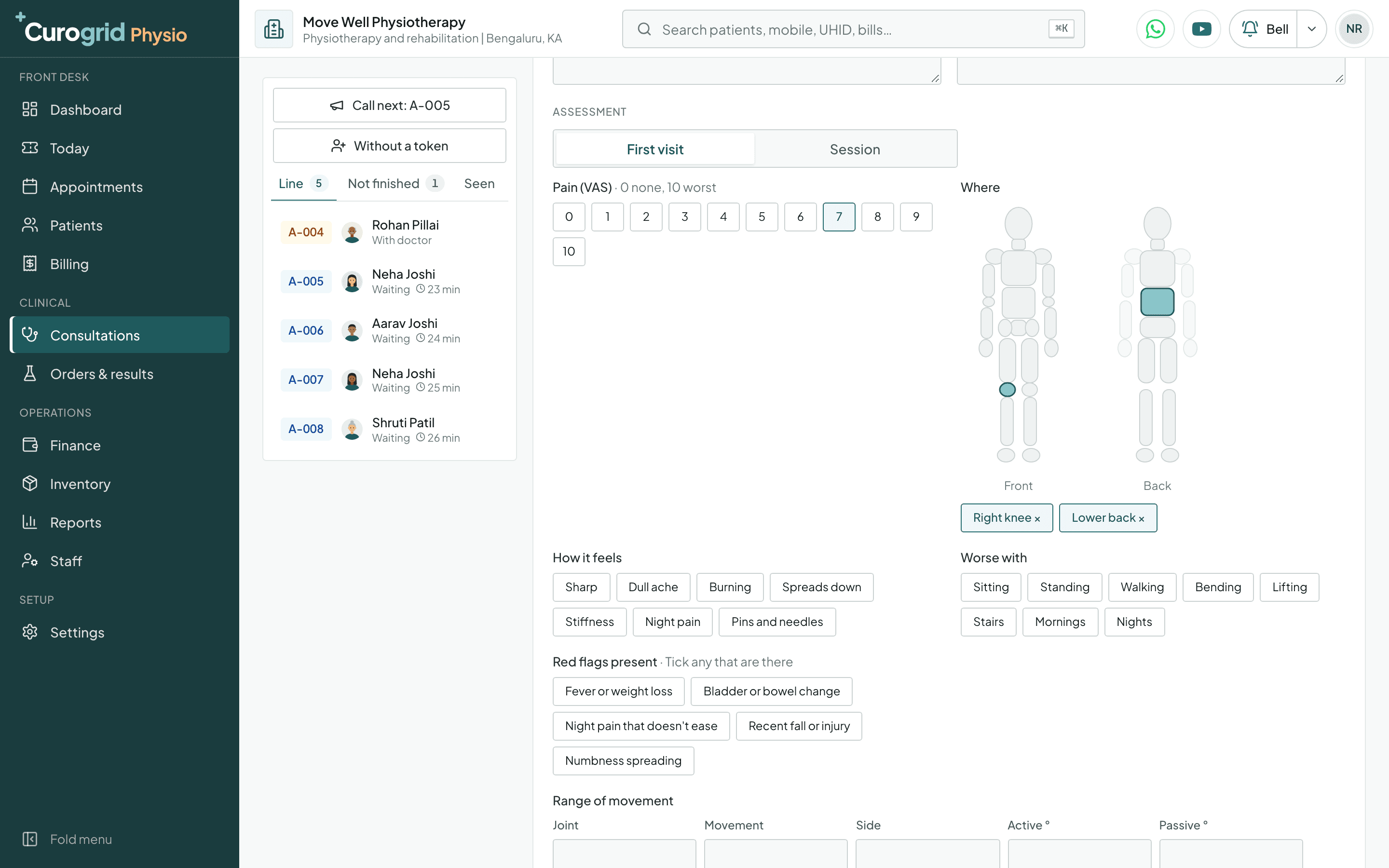
Most clinic software gives a physiotherapist a doctor's visit form: complaint, diagnosis, medicines. Curogrid Physio opens the first visit on a physiotherapy assessment, with the boxes you would otherwise draw on paper. Most of it is a tap, not typing.
- A full physio assessment in taps, not paragraphs
- Pain and the problem area marked on a body map
- Red flags asked every time, so you refer in time
See everything it records
The first visit: Assessment
- Pain (VAS)
- One tap from 0, none, to 10, the worst.
- Where
- A front and a back body figure. Tap the right knee, the lower back or any of 36 areas; right and left are the patient's own.
- How it feels
- Sharp, dull ache, burning, spreads down, stiffness, night pain, pins and needles.
- Worse with
- Sitting, standing, walking, bending, lifting, stairs, mornings, nights.
- Red flags present
- Fever or weight loss, bladder or bowel change, night pain that doesn't ease, recent fall or injury, numbness spreading. Tick any that are there.
- Range of movement
- A table of joint, movement and side, with active and passive degrees.
- Muscle strength
- Muscle and side, graded 0 to 5.
- Special tests
- Written, with ready words such as “SLR positive at 40°”, “Neer's positive” and “McMurray's positive”.
- Goals
- The patient's own: walk without pain, climb stairs, back to work, sleep without pain, lift the arm overhead.
- Plan
- IFT, TENS, ultrasound, hot pack, cold pack, traction, manual therapy, taping, exercises.
- Home exercises
- Picked by picture, each with its dose.
Every session after it: Session
- Pain today (VAS)
- The same 0 to 10 scale, so each session's score sits beside the first.
- Given today
- A table of modality, minutes and setting: IFT for 15 minutes, ultrasound at 1 MHz.
- Home exercises
- Kept, changed or progressed, by picture.
- Response
- Pain less, same, pain more, moving better, stiff after.
- Notes
- Ready words such as “Home exercises explained” and “Continue the same plan”.
The complaint, examination, diagnosis and advice are on the visit as well, and the diagnosis is searched by name or ICD-10 code. The assessment and the session note work the same on the phone app.
Home exercises
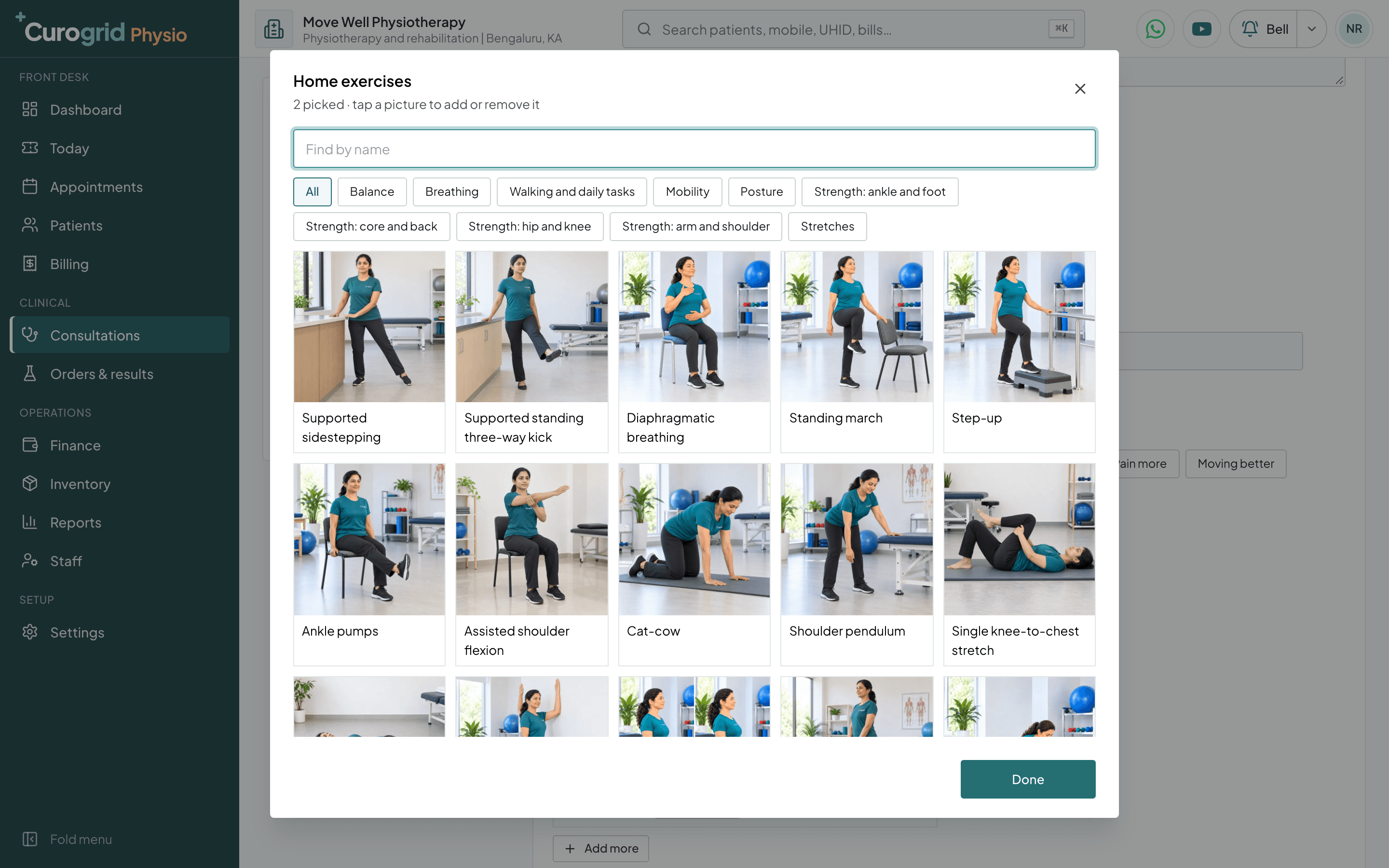
Home exercises the patient can follow, because they are pictures
A home programme written as “SLR 3 × 10, bridging 2 × 15” is forgotten by the time the patient reaches the bus stop. In Curogrid Physio you pick each exercise by its photograph, give it a dose, and hand the patient a printed sheet that shows what to do.
- Patients follow exercises they can see
- A printed home sheet in seconds
- Patients who do their exercises get better and come back
See everything it records
31 exercises in 10 groups
- Mobility
- Ankle pumps, Assisted shoulder flexion, Cat-cow, Shoulder pendulum, Single knee-to-chest stretch, Supine trunk rotation, Wall slides
- Strength: hip and knee
- Mini squat, Seated knee extension, Side-lying hip abduction, Sit to stand, Standing hip abduction, Straight leg raise
- Stretches
- Doorway chest stretch, Seated hamstring stretch, Standing calf stretch, Standing quadriceps stretch, Supine hamstring stretch
- Strength: core and back
- Bird dog, Glute bridge, Pelvic tilt
- Strength: arm and shoulder
- Resistance-band row, Wall push-up, Wrist extension
- Balance
- Supported sidestepping, Supported standing three-way kick
- Walking and daily tasks
- Standing march, Step-up
- Strength: ankle and foot
- Standing heel raise
- Posture
- Chin tuck
- Breathing
- Diaphragmatic breathing
A dose for each, in one tap
3 × 10, 2 × 15, Hold 20 s × 3, 10 times, Twice a day, Once a day. Or write your own, such as “5 × 10, hold 5 s”.
The home exercise programme
Print it from the visit and it comes out on your clinic's letterhead: each exercise with its picture, its name, the dose you gave and a line on how to do it, signed with your name, qualification and registration number.
Home physiotherapy
Home visits, from the same app
- Book it like any session
- The day's visits on the physiotherapist's phone
- Write the session at the bedside
- Collect the payment there
How it works
A patient after a knee replacement, an elderly patient after a stroke, a patient who cannot climb to a first-floor clinic: home physiotherapy is a large part of many practices. In Curogrid Physio a home visit is booked, written and billed in the same app as a clinic session, and the physiotherapist does it all from the phone.
Book it like any session. “Home visit” is a starter service of 60 minutes at a starter ₹1,200. The desk books it in the physiotherapist's diary, so the time away from the clinic is blocked like any other booking.
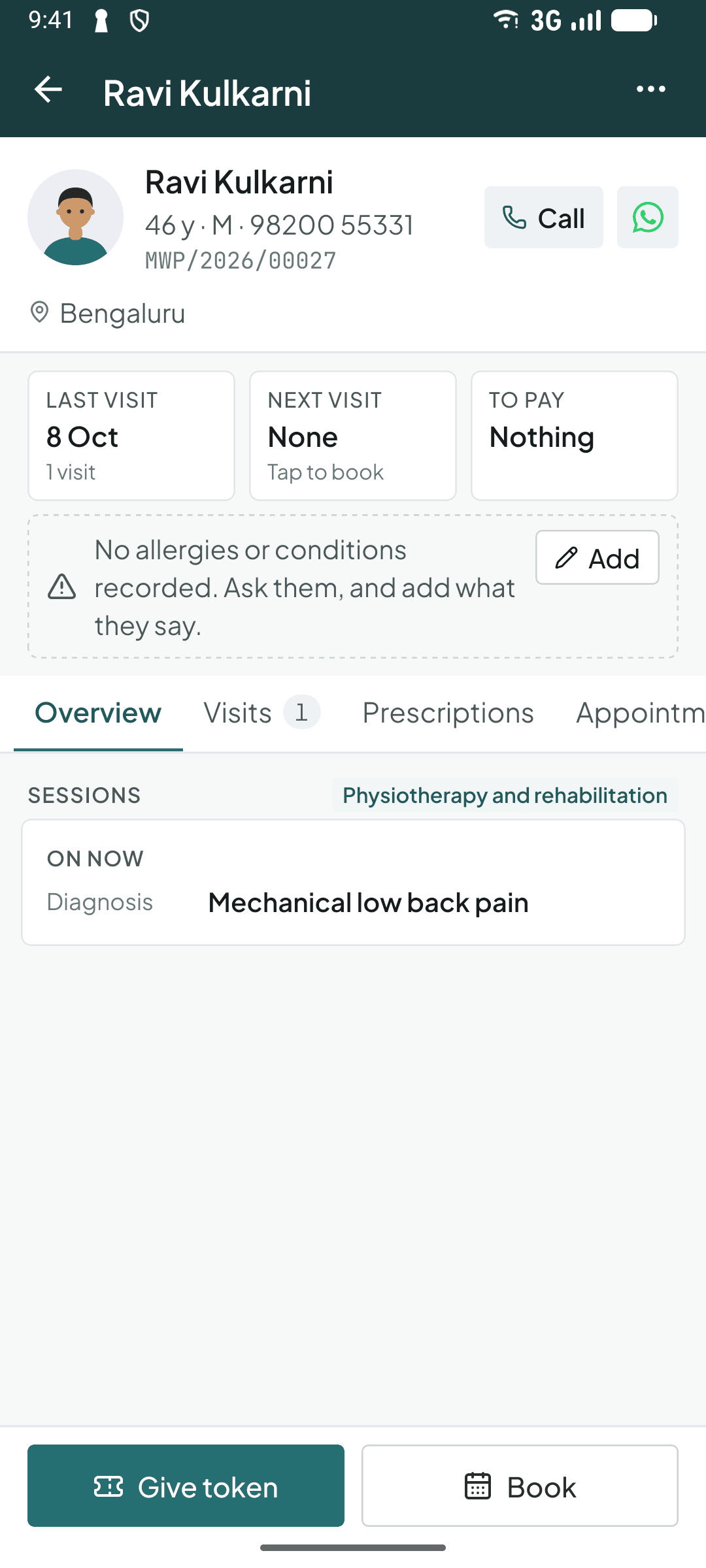
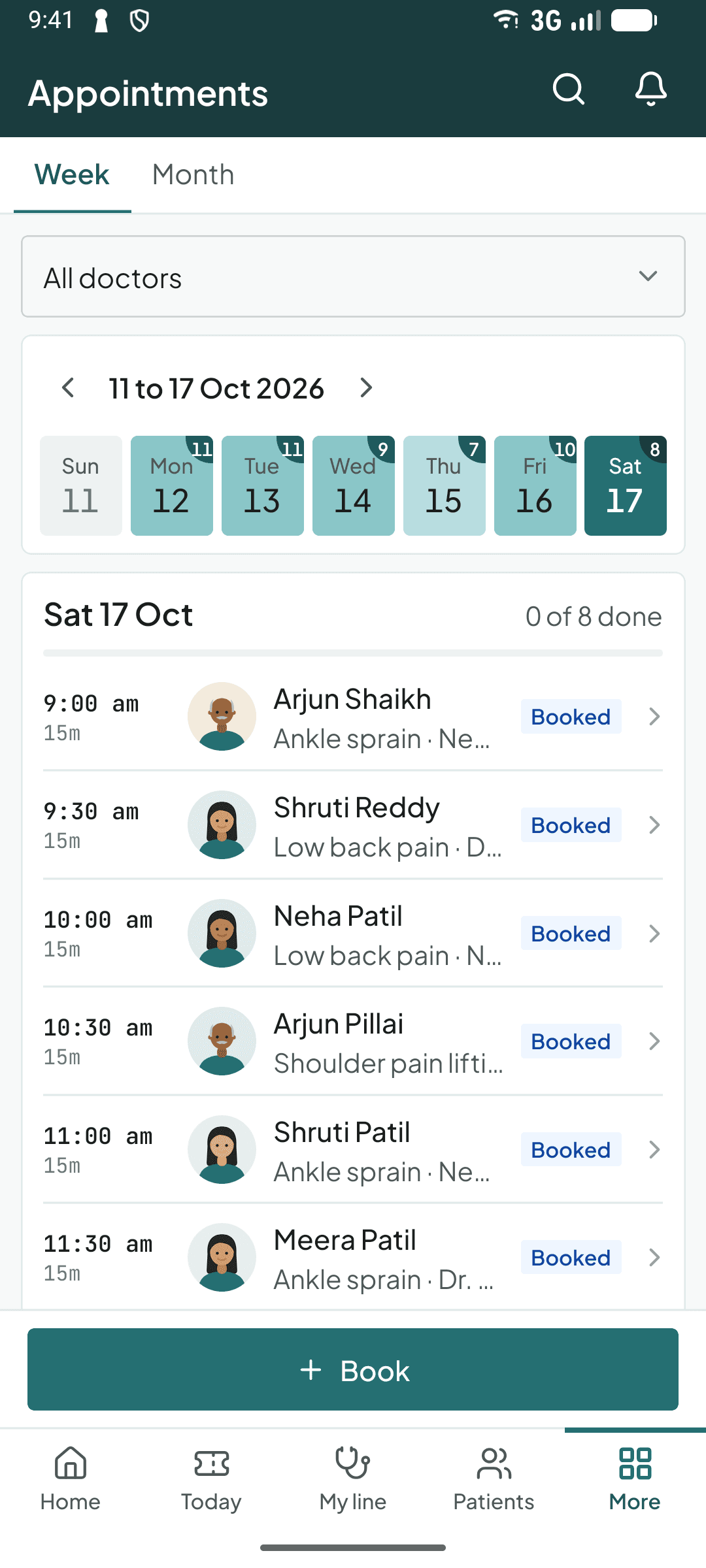
The day's visits on the physiotherapist's phone. The phone app shows the day's appointments for each physiotherapist. The patient's file has their address, and the Call and WhatsApp buttons reach the family before you leave.
Write the session at the bedside. Open the patient's file on the phone and write the visit with the same assessment or session note: the pain score, the body map, what was given, the home exercises by picture and the response.
Collect the payment there. Make the bill on the phone and take the payment by UPI, cash or card. The clinic's billing and the owner's dashboard show it at once, so nobody waits for the therapist to come back with a paper receipt.
What a home visit does not have: Curogrid does not plan the route, track the physiotherapist's location or add travel time, and the home exercise sheet prints from the computer, not the phone. A travel charge is a line you add to the bill.
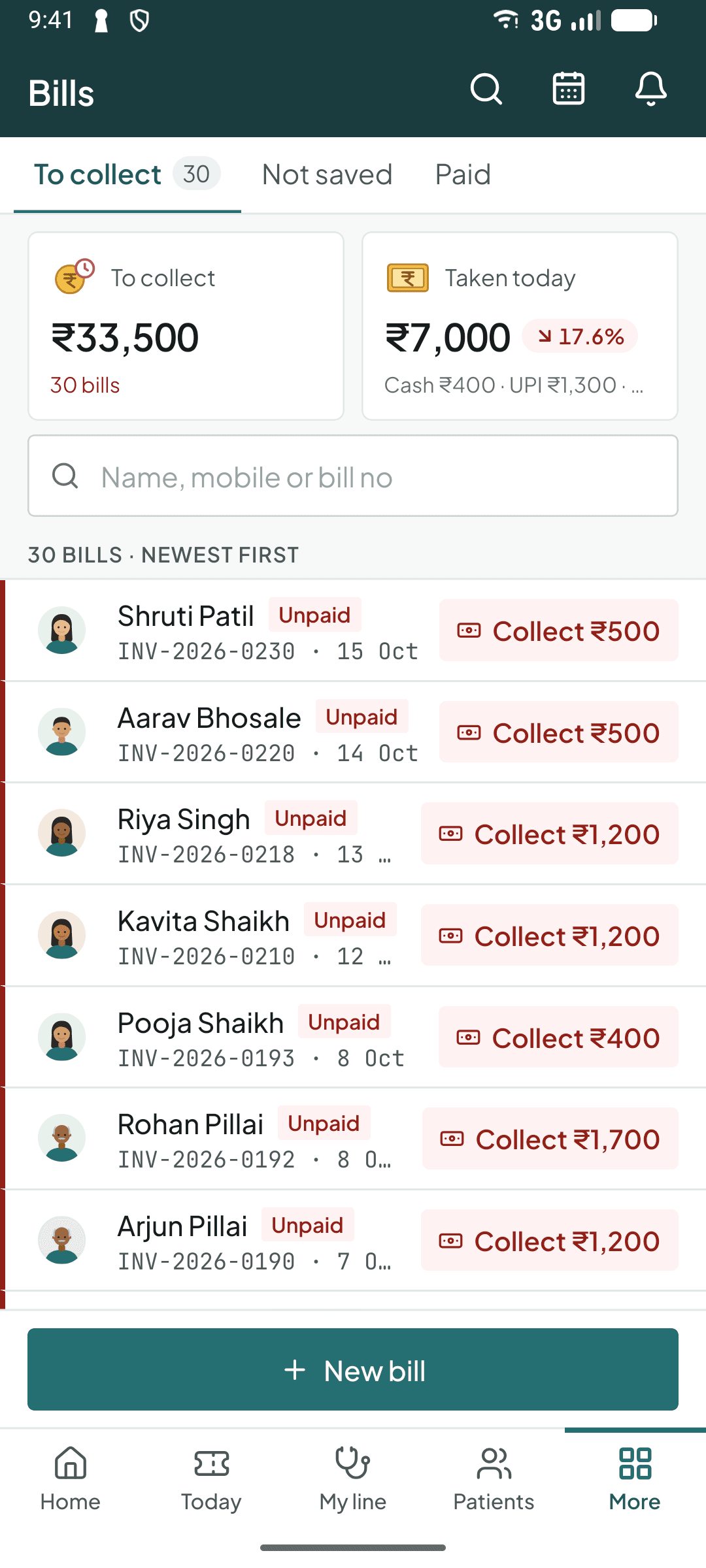
The whole clinic
Front desk, money and team, in one place
Tokens, appointments, bills, staff and the day's takings, on the computer and the phone.
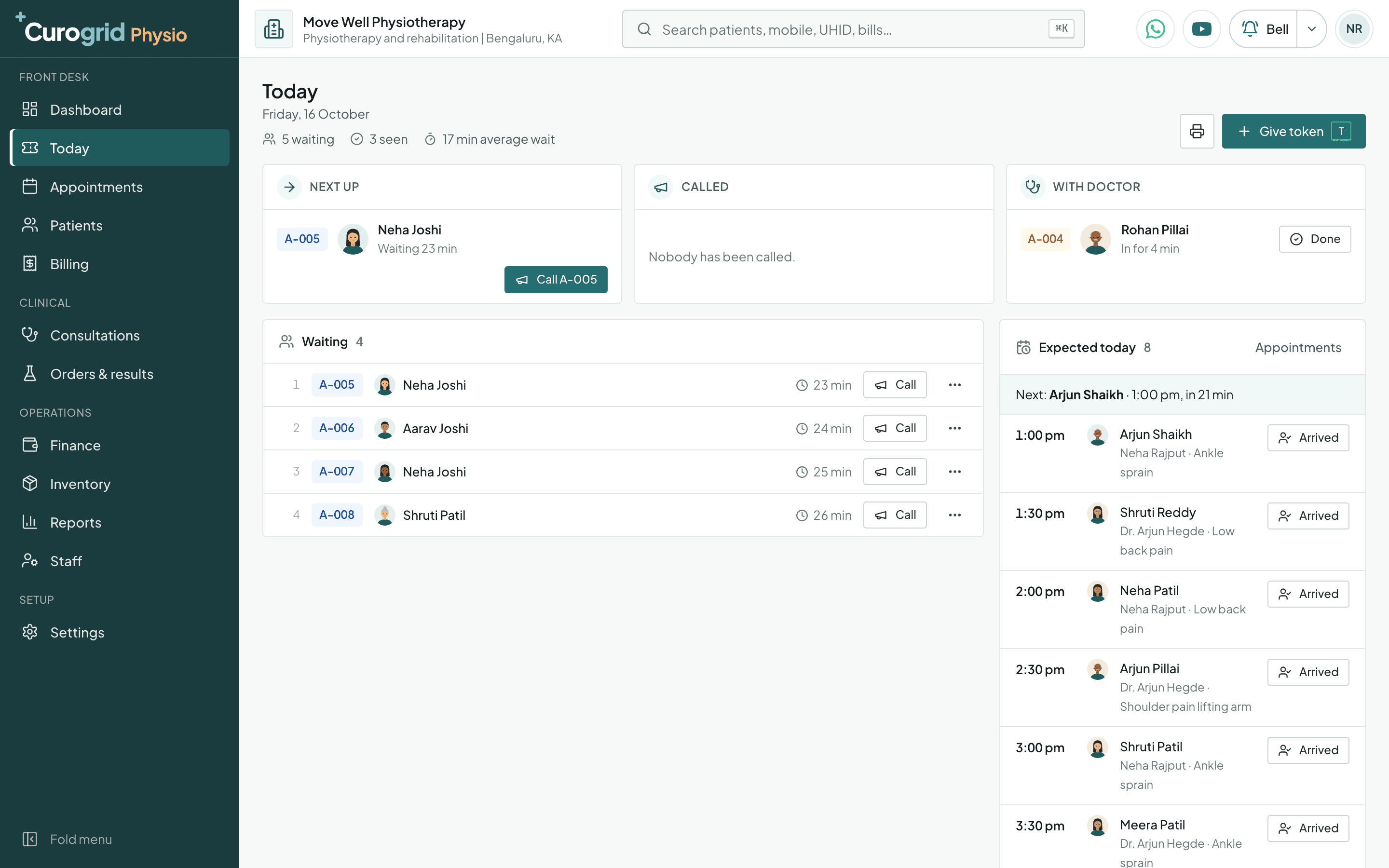
Today's line 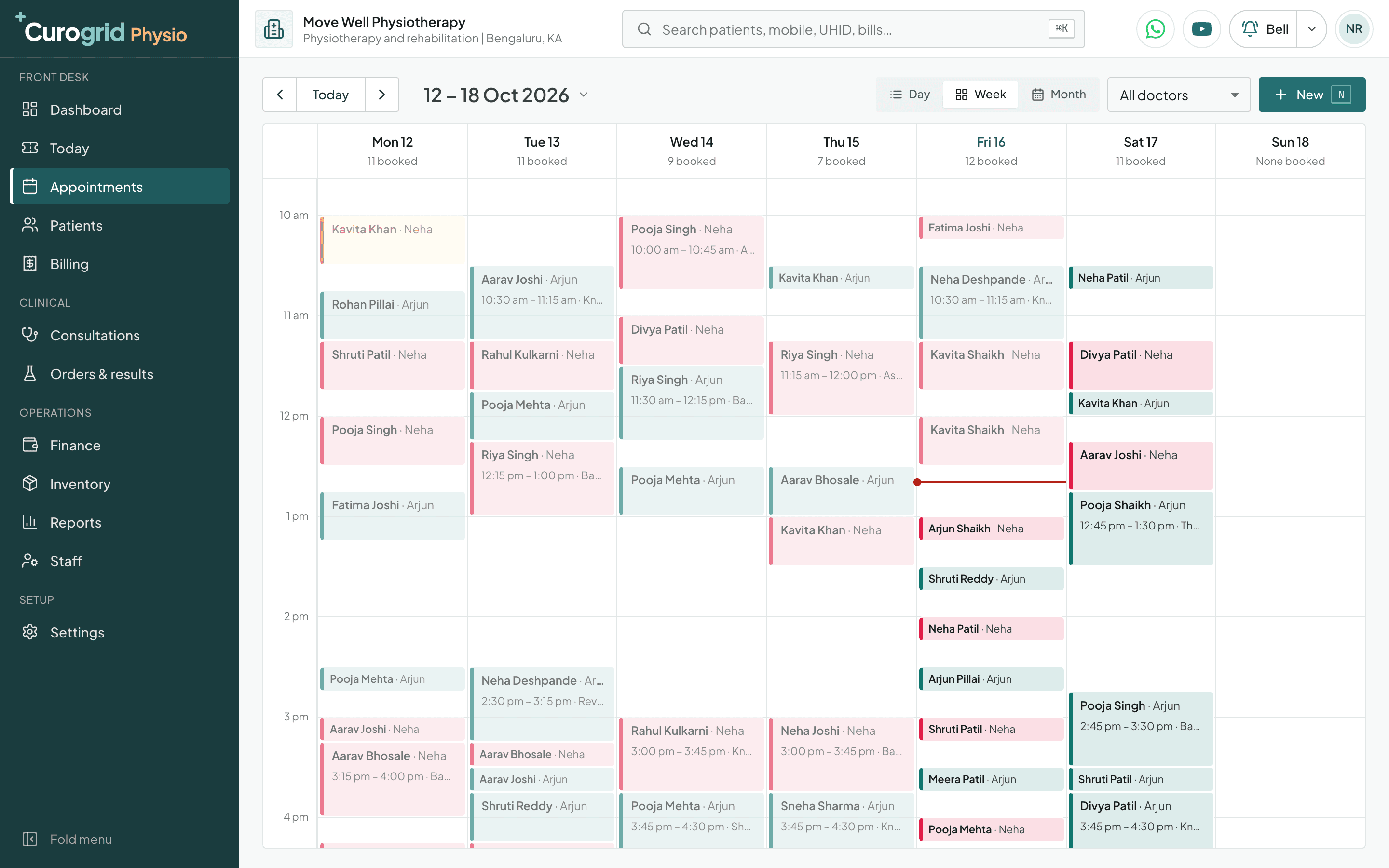
The appointment book 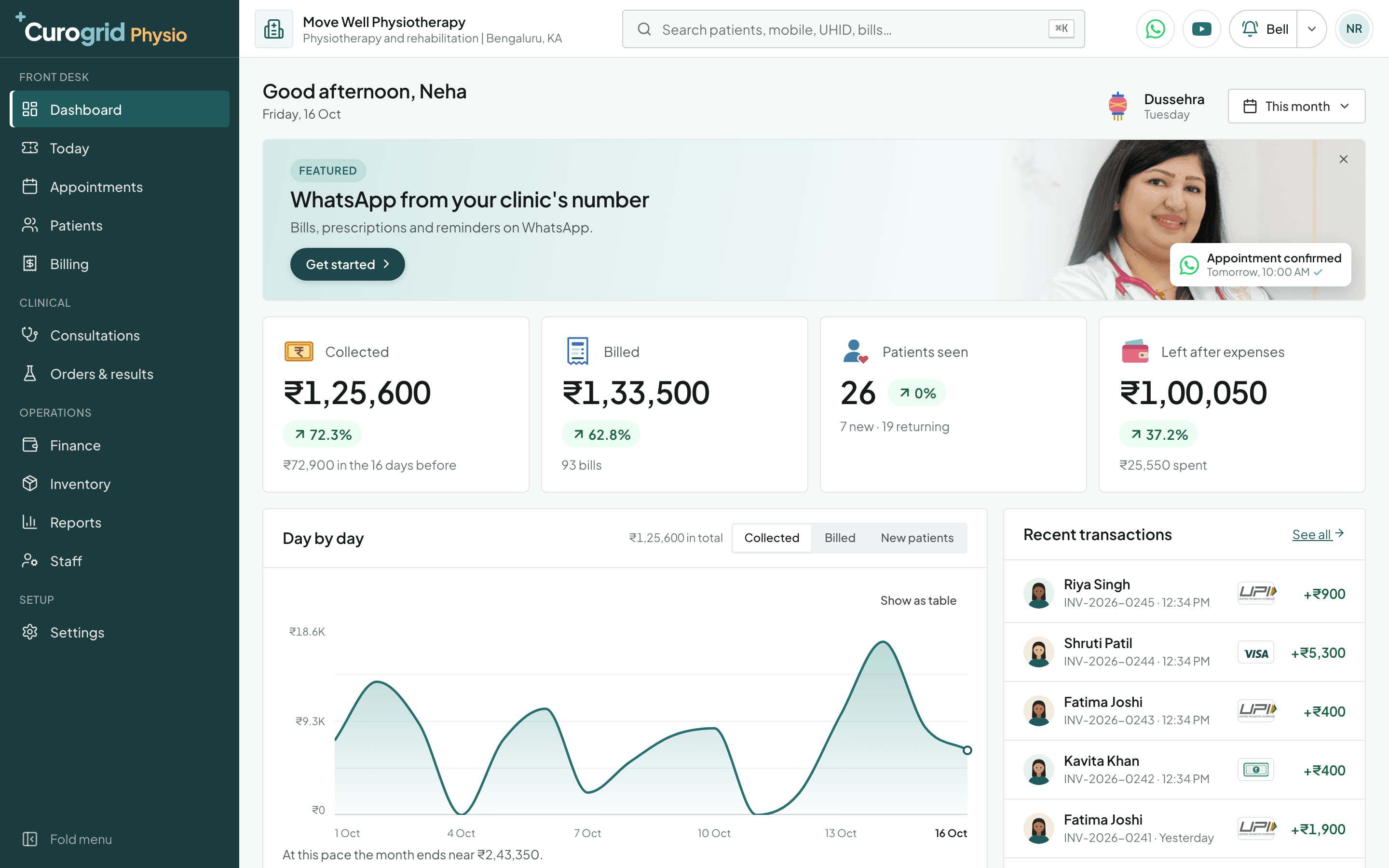
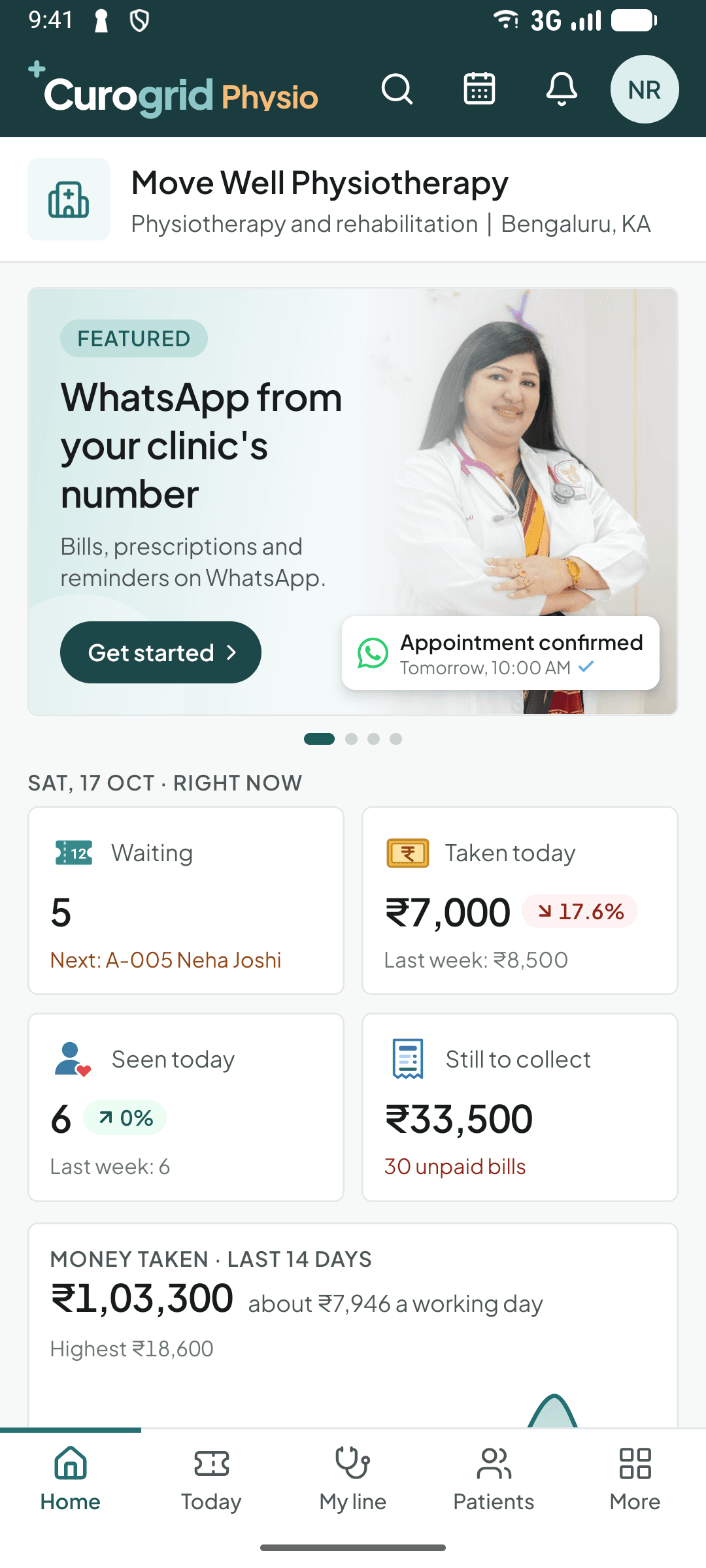
The owner's dashboard 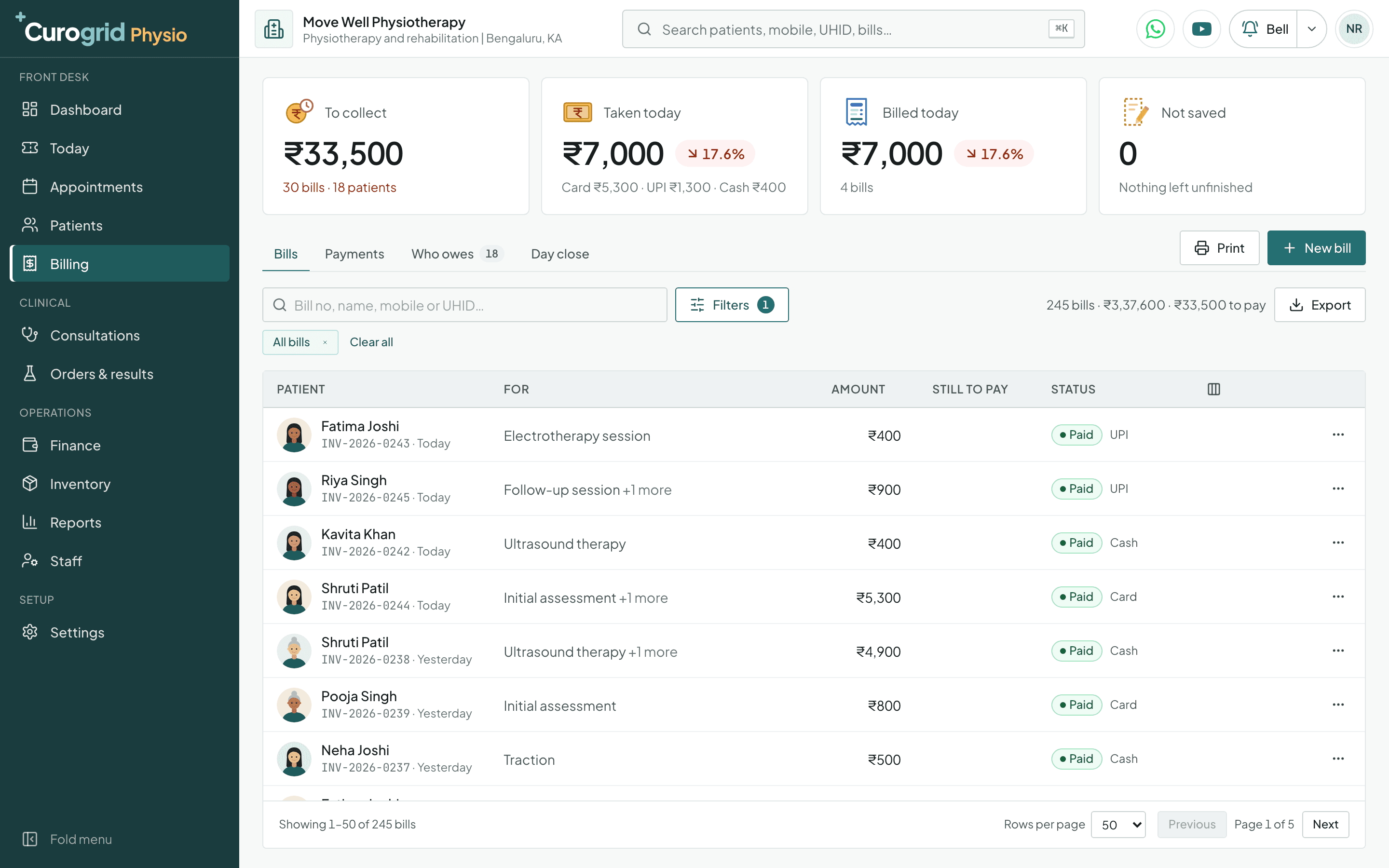
Billing by UPI, card and cash
A patient's way through a physiotherapy clinic, step by step
1. Before the first visit
The booking and the reminder. The desk books an “Initial assessment”, a starter service of 45 minutes at ₹800, in the physiotherapist's diary. The patient gets a reminder before the appointment on WhatsApp and by email.
2. At the desk
Registration asks what a physiotherapist needs to know. Name, age and mobile number, then two questions only a physiotherapy clinic asks: the patient's work (desk job, driver, labourer, homemaker) and the problem area (neck, shoulder, elbow or wrist, upper back, lower back, hip, knee, ankle or foot, after surgery, after a stroke). The orthopaedic surgeon or friend who sent them goes in “Referred by”.
3. In the waiting area
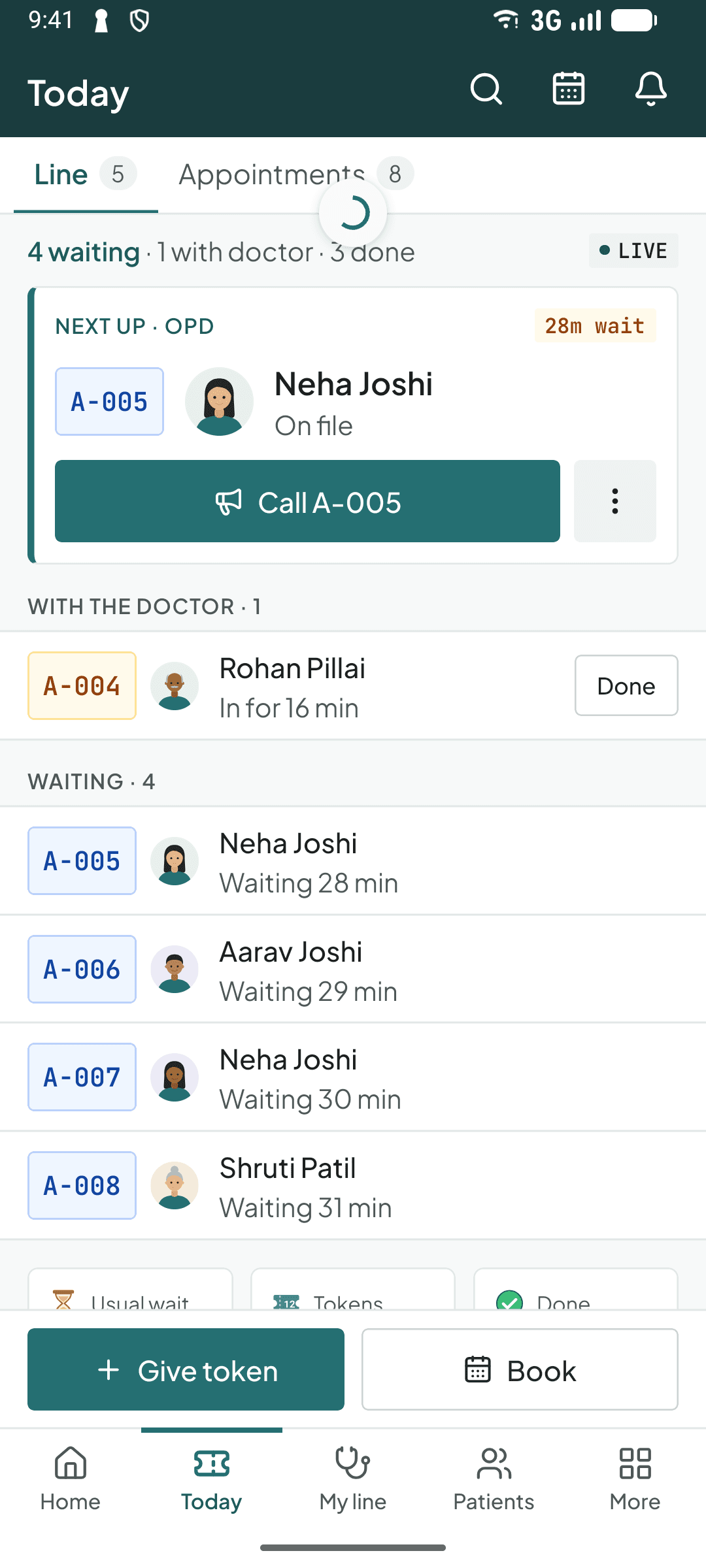
A token, and the line in order. Walk-ins get a token. The physiotherapist sees who is next and how long each person has waited, and calls the next patient from the computer or the phone.
4. The first visit
The assessment. Pain from 0 to 10, the painful area tapped on the body map, how it feels and what makes it worse, range of movement, muscle grades and special tests. The diagnosis, such as mechanical low back pain or adhesive capsulitis, is searched by name or ICD-10 code, and an X-ray or MRI is one tap.
5. Safety first
Red flags are asked every time. Five red flags sit on the assessment as a checklist: fever or weight loss, bladder or bowel change, night pain that doesn't ease, a recent fall or injury, numbness spreading. Ticking one keeps the answer in the file, so the reason for a referral is written down.
6. Before the patient leaves
Goals, a plan and the whole course booked. Write the goal in the patient's words, such as “climb stairs” or “back to work”, pick the plan, and book the course in one go: six sessions, two days apart, 45 minutes each, at the same time of day, unless you change it. A date that clashes or falls on leave is skipped and listed.
7. Same day
Home exercises in the patient's hand. Pick the home exercises by picture, give each a dose, and print the sheet. The patient's family sees what to do, not a list of abbreviations.
8. Every session
Session 3 of 6. Each booking shows its place in the course. The session note records pain today, each modality given with its minutes and setting, the home exercises, and whether the pain is less, the same or more.
9. When a patient drops out
A missed session is not quietly lost. The patient's file opens on a Sessions card: “3 of 6 done” and the date of the next session. A session that was missed and never rebooked is flagged, so the desk can call the patient back.
10. At the counter
Billed by session, by package or by visit. Bill one session, a “10 session package” at a starter ₹4,500, or a home visit. Take payment by UPI, cash or card, send the bill on WhatsApp, and see who still owes.
11. Over the weeks
Progress you can read back. Every session's pain score, treatment and response is kept on that visit, in date order in the patient's file, beside the goals set at the assessment.
On the phone
Your clinic in your pocket
The same Curogrid Physio on Android and iPhone, for the doctor, the front desk and the owner.
- See the line and call the next patient from anywhere
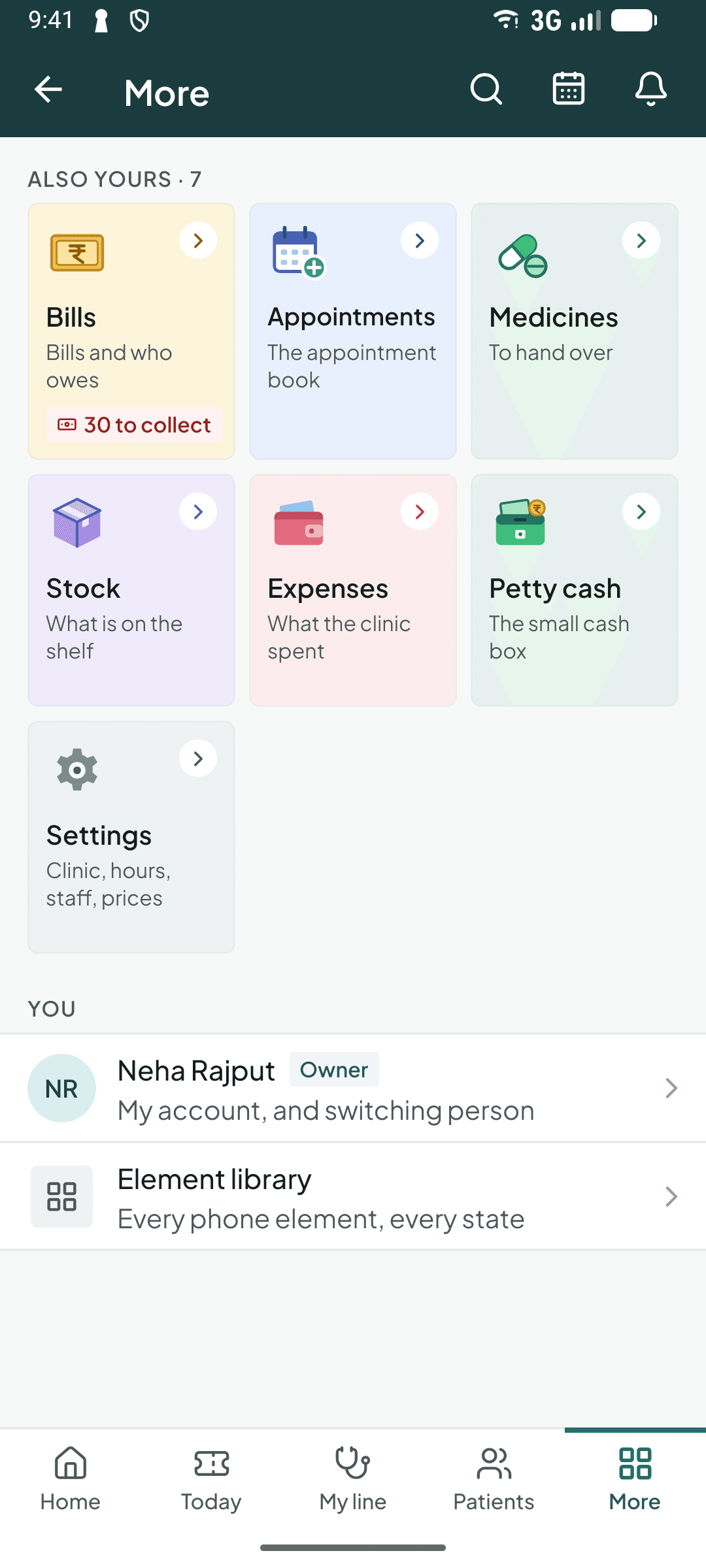
- Open a patient's file, write the visit, take the payment
- Today's appointments and takings, wherever you are
From ₹420 a month, for the whole clinic
Not per doctor. Everything on this page is included. Start with 5 days of Pro, free.
Questions from physiotherapists
Yes. The first visit has a physiotherapy assessment: pain on a 0 to 10 scale (VAS), a front and back body map where you tap the painful area, how the pain feels, what makes it worse, red flags, range of movement in degrees, muscle strength from 0 to 5, special tests, goals and the plan. Each later session records pain today, what was given, home exercises and the response.
Yes. Pick from 31 exercises by their photograph, in groups such as mobility, posture, strength and stretches, and give each a dose such as “3 × 10” or “Hold 20 s × 3”. They print as a home exercise sheet on your letterhead, with each picture, the dose and how to do it. There are no videos.
Yes. Turn on “Book a course of therapy sessions” in the booking drawer. Curogrid books six sessions two days apart, 45 minutes each, at the same time of day. You can change the number, up to 30, and the gap before you save.
Every booking in a course carries its place, such as “Session 3 of 6”, and the patient's file opens on a Sessions card that shows how many are done, such as “3 of 6 done”, and when the next one is booked.
The Sessions card in the patient's file says which session was missed and that it was not rebooked, so the course is not quietly left unfinished. The desk then books the missed session again.
Yes. “Home visit” is a starter service, set at 60 minutes and a starter price of ₹1,200. The desk books it in the physiotherapist's diary like any session. At the patient's home the physiotherapist opens the file on the phone app, writes the session with the same assessment and home exercises, and takes the payment by UPI, cash or card. The clinic sees it at once.
Yes. A “10 session package” is one of the starter services, at a starter price of ₹4,500. You can change the price, or add your own packages, and bill it like any other service. Curogrid does not count sessions down against a paid package.
Eleven: exercise therapy, manual therapy, ultrasound therapy, IFT, TENS, traction, shortwave diathermy, wax bath, gait training, taping and dry needling. Each is one tap in a new order, and any other therapy can be typed.
Yes. The Plus plan at ₹420 a month, before GST, is for the whole clinic and includes 6 staff logins. Pro is ₹999 a month. Every clinic starts with 5 days of Pro, free.
Yes, for Android and iPhone. The physiotherapist sees the day's sessions, writes the assessment or session note with the body map and home exercises, and takes payment. A patient's file on the phone shows the same Sessions card. Curogrid also runs in a web browser and as a Windows app.
Curogrid Plus is ₹420 a month and Pro is ₹999 a month, or ₹4,032 and ₹9,590 for a year. GST of 18% is added. The price is for the whole clinic, not for each doctor, and the Physiotherapy and rehabilitation setup is included in both plans. Every clinic starts with 5 days of Pro, free.
Yes. Curogrid sends the patient a reminder before the appointment by WhatsApp and email, and can send the prescription, the bill and the receipt the same way. On Plus the WhatsApp messages go from the Curogrid number. On Pro they go from your clinic's own number.
Not yet. A patient's 14-digit ABHA number can be recorded on their file, where it is marked as not checked with ABDM. Curogrid does not yet verify an ABHA number, create one or share records through ABDM.
No. Curogrid needs an internet connection. The phone app tells you when it is offline and saves nothing until the connection is back, and on a computer a visit you are typing is kept on that computer until it can be saved. The screens are in English only.
Good to know
Registrations and rules for a physiotherapy clinic in India, what Curogrid does not do, and the lists it offers. The rules are a plain summary, not legal advice, checked on .
Physiotherapy is one of the professions the Act recognises. The Commission's registration regulations were published in the Gazette in September 2026: a person may practise a recognised allied and healthcare profession only after registering, and registration lasts five years, renewed after continuing professional development. State councils are still starting, so ask your State Allied and Healthcare Council, or your state's existing physiotherapy council, what applies to you today. In Curogrid: Each physiotherapist's qualification and registration number are kept on their staff profile and print under their name on the papers Curogrid makes, such as the home exercise sheet.
In the states and union territories that have adopted the Act, a clinic cannot run without registering with the district registering authority, and national minimum standards are set for each kind of clinic. Other states have their own registration law. Your district health office will say which applies. In Curogrid: Curogrid does not register your clinic. Your clinic's name, address and contact numbers print on every bill and paper it makes.
This is not settled. The Directorate General of Health Services wrote on 9 September 2025 that physiotherapists may not use the prefix, and withdrew the letter the next day for further examination. On 4 November 2025 the Kerala High Court, in an interim order, barred physiotherapists without a recognised medical qualification from using it. The matter is still before the courts. Check the position before you print it. In Curogrid: The name on your papers is yours to write. In Staff, “Name as it prints” can read “Priya Rao, PT”, with your qualification on the line below.
A patient's record is personal data, and the clinic is responsible for it. Tell patients what you keep and why, keep it safe, use it for their care, and let a patient see or correct what you hold. The Rules were notified in November 2025 and most of their duties for clinics apply from May 2027. In Curogrid: Every member of the team has their own sign-in and role, so the records show who did what, and nobody shares a password.
Explain the assessment, the plan and its risks before you start, especially for dry needling, manipulation and electrotherapy, and keep the patient's agreement. For a child, a parent or guardian agrees. In Curogrid: Curogrid Physio adds an “Examination and treatment plan” consent form. The patient, a parent or guardian, or a relative signs it with a finger on the screen, and it is kept in the patient's file.
Used needles are sharps. Separate them where they are used, into a puncture-proof white translucent container, hand them to your area's common bio-medical waste facility, and train the staff who handle them. In Curogrid: Curogrid does not manage waste. Dry needling is one of the eleven therapies ready to order, so each session that used needles is on record.
Health care services by a clinical establishment, an authorised medical practitioner or para-medics are exempt from GST. Whether your sessions qualify depends on who gives them and what they are: advance rulings have refused it for wellness and some rehabilitation services. Ask your chartered accountant. In Curogrid: A GST rate is set on a service only if you give it one, and the clinic's GSTIN is needed only if you are registered. A clinic that is not billing GST simply leaves both empty.
The 10 session package is a price on the bill. Curogrid does not take one session off a paid package each time. The count of sessions comes from the course booking, such as “3 of 6 done”.
The 31 home exercises are photographs with a line on how to do each. There are no exercise videos, and you cannot yet add your own exercises or pictures. An exercise that is not in the library is written in the notes.
The home exercise sheet prints from the visit on the computer. Curogrid does not yet send it to the patient on WhatsApp by itself; print it, or save it as a PDF and send it.
There are no outcome questionnaires such as the Oswestry or neck disability index to fill and score. Pain is scored from 0 to 10 at every session, and anything else is written in the notes.
A home visit is booked, written and billed like a session. Curogrid does not plan a route, track the therapist's location or add travel time. A travel charge is a line you add to the bill.
The visit form keeps a medicines part, as every Curogrid clinic's does. Physiotherapy adds no medicine names to it, and you can leave it empty.
X-ray knee, X-ray spine (LS), X-ray cervical spine, MRI spine, MRI knee.
Exercise therapy, Manual therapy, Ultrasound therapy, IFT, TENS, Traction, Shortwave diathermy, Wax bath, Gait training, Taping, Dry needling.
Low back pain, Sciatica, Lumbago with sciatica, Cervicalgia, Spondylosis, Other specified intervertebral disc displacement (slipped disc), Adhesive capsulitis of shoulder, Rotator cuff syndrome, Gonarthrosis, Lateral epicondylitis, Plantar fascial fibromatosis, Carpal tunnel syndrome, Sprain and strain of ankle, Stiffness of joint, not elsewhere classified (stiff joint), Presence of orthopaedic joint implants (joint replacement), Bell's palsy (facial palsy), Hemiplegia, Sequelae of stroke, not specified as haemorrhage or infarction, Cerebral palsy, Other physical therapy.
Try Curogrid Physio in your clinic
5 days of Pro, free. Pick “Physiotherapy and rehabilitation” in setup and the assessment, the exercise library, the course booking and your services are ready before your first patient.