
For orthopaedic surgeons and bone and joint clinics
Curogrid Ortho: software for orthopaedic clinics
Mark the injury on a body map and never miss a plaster check.
From ₹420 a month for the whole clinic. 5 days free.
The first visit
The injury, marked where it is
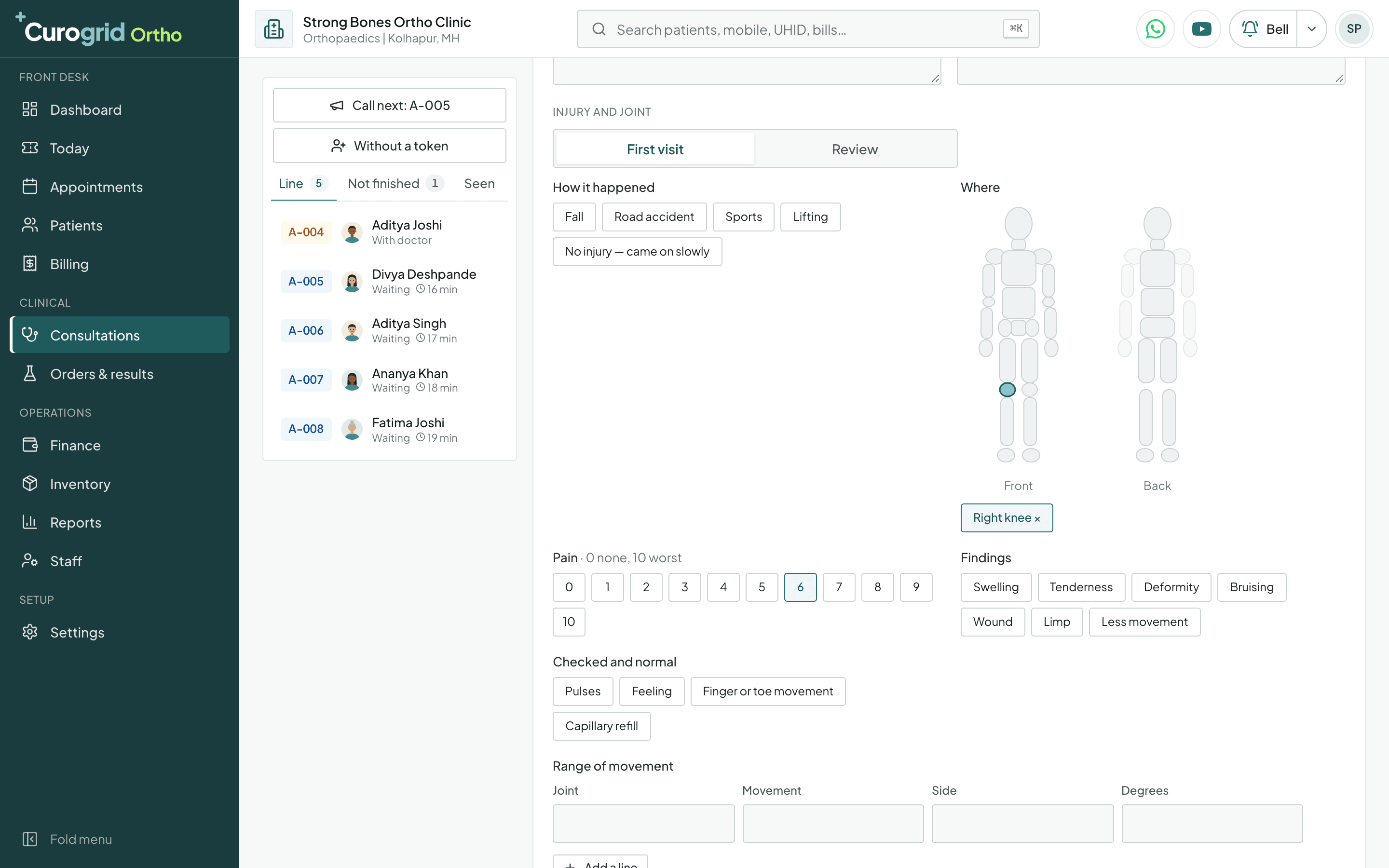
The first visit asks what an orthopaedic surgeon asks, most of it a tap. Where it hurts is marked on a front and back body figure, with right and left as the patient's own.
- The injury marked on a body map, right or left
- Pulses, feeling and movement ticked at every first visit
- The X-ray ordered in one tap
See everything it records
The first visit: Injury and joint
- How it happened
- Fall, road accident, sports, lifting, or no injury, came on slowly.
- Where
- A front and back body figure: tap the right knee, the left wrist or any of 36 areas.
- Pain
- 0, none, to 10, the worst.
- Findings
- Swelling, tenderness, deformity, bruising, wound, limp, less movement.
- Checked and normal
- Pulses, feeling, finger or toe movement, capillary refill.
- Range of movement
- A table of joint, movement, side and degrees.
- X-ray
- Ready words such as “No fracture”, “Undisplaced fracture” and “Degenerative changes”.
- Plan
- Plaster cast, slab, splint or brace, sling, injection, physiotherapy, surgery advised.
The plaster
A plaster's checks, from the day it goes on to the day it comes off
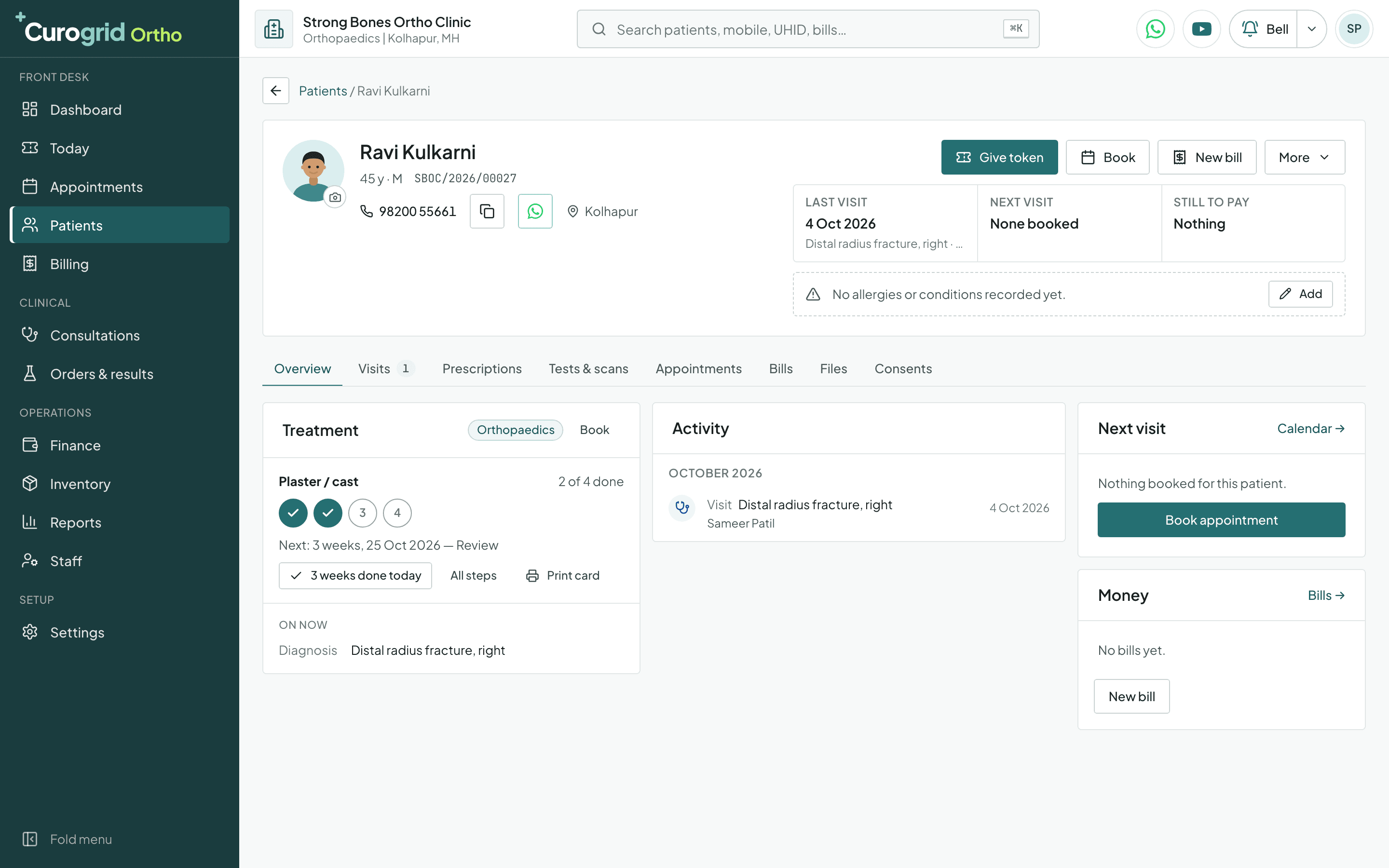
Start the plaster plan on the day the cast goes on and Curogrid dates every check. The patient's file shows how many are done and the next one; one tap marks today's check done.
- Every plaster check dated from the day it went on
- No patient forgets to come back for the X-ray
- A plaster card the patient brings to every check
See everything it records
Each review
- Pain
- The same 0 to 10 scale.
- Plaster
- Intact, loose, damaged, removed today, or no plaster.
- Since last time
- Swelling less, moving better, still painful, stiff, walking without support.
- X-ray
- Fracture uniting, healed, no change.
- Notes
- Ready words such as “Weight bearing allowed” and “Continue the sling”.
The four checks of the plan
- Next day
- Check swelling, fingers or toes
- 1 week
- X-ray check
- 3 weeks
- Review
- 6 weeks
- Plaster off, X-ray
The plaster card
Print the plan as a card on your letterhead: every check with its due date, the day it was done, and a column to sign. The patient brings it to every check.
The dashboard lists every patient whose next check is due this week, the late ones first. Switch on “Care plan reminder” in Notifications and the patient gets a WhatsApp message the day before.
The whole clinic
Front desk, money and team, in one place
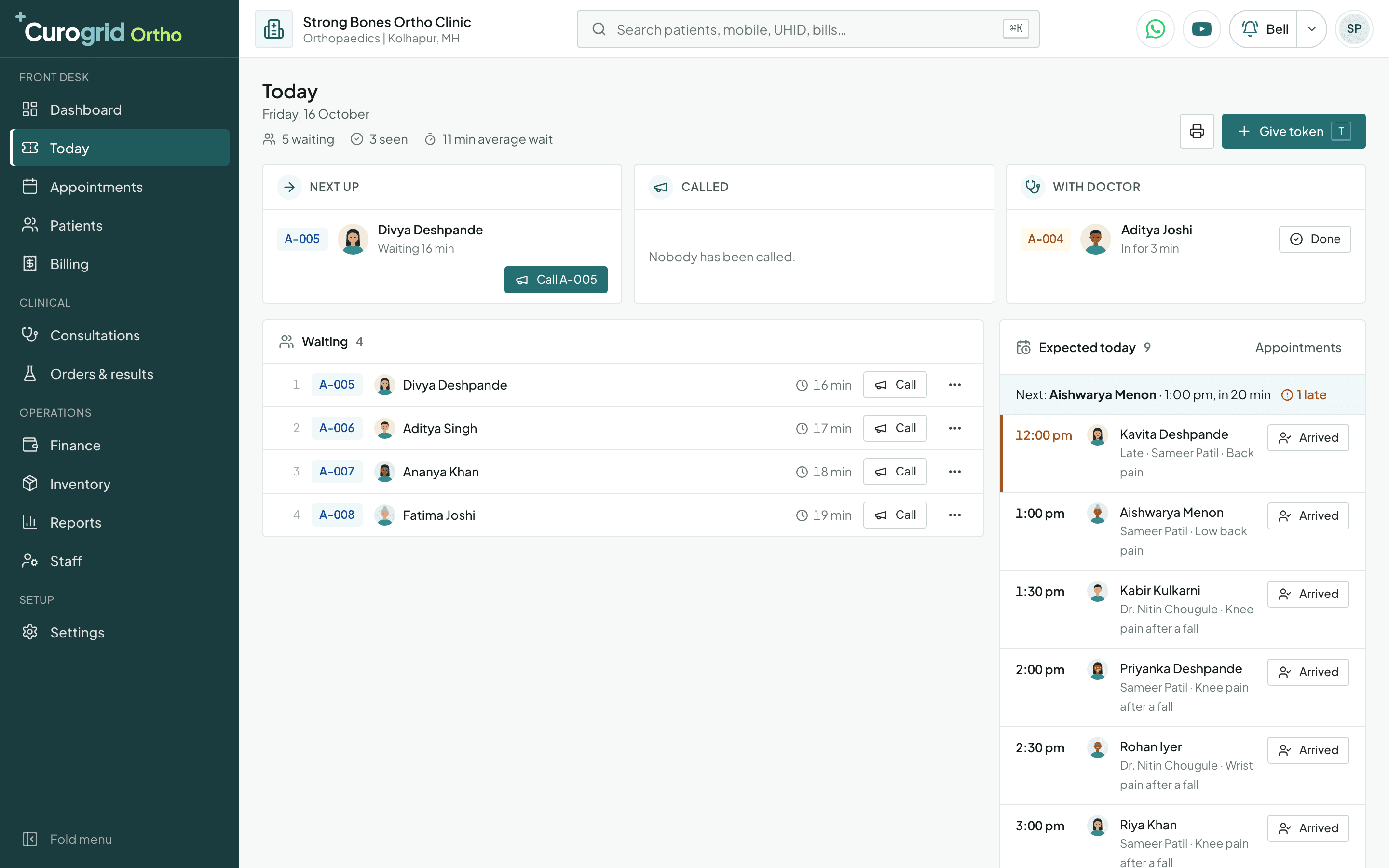
Tokens, appointments, bills, staff and the day's takings, on the computer and the phone.
Today's line 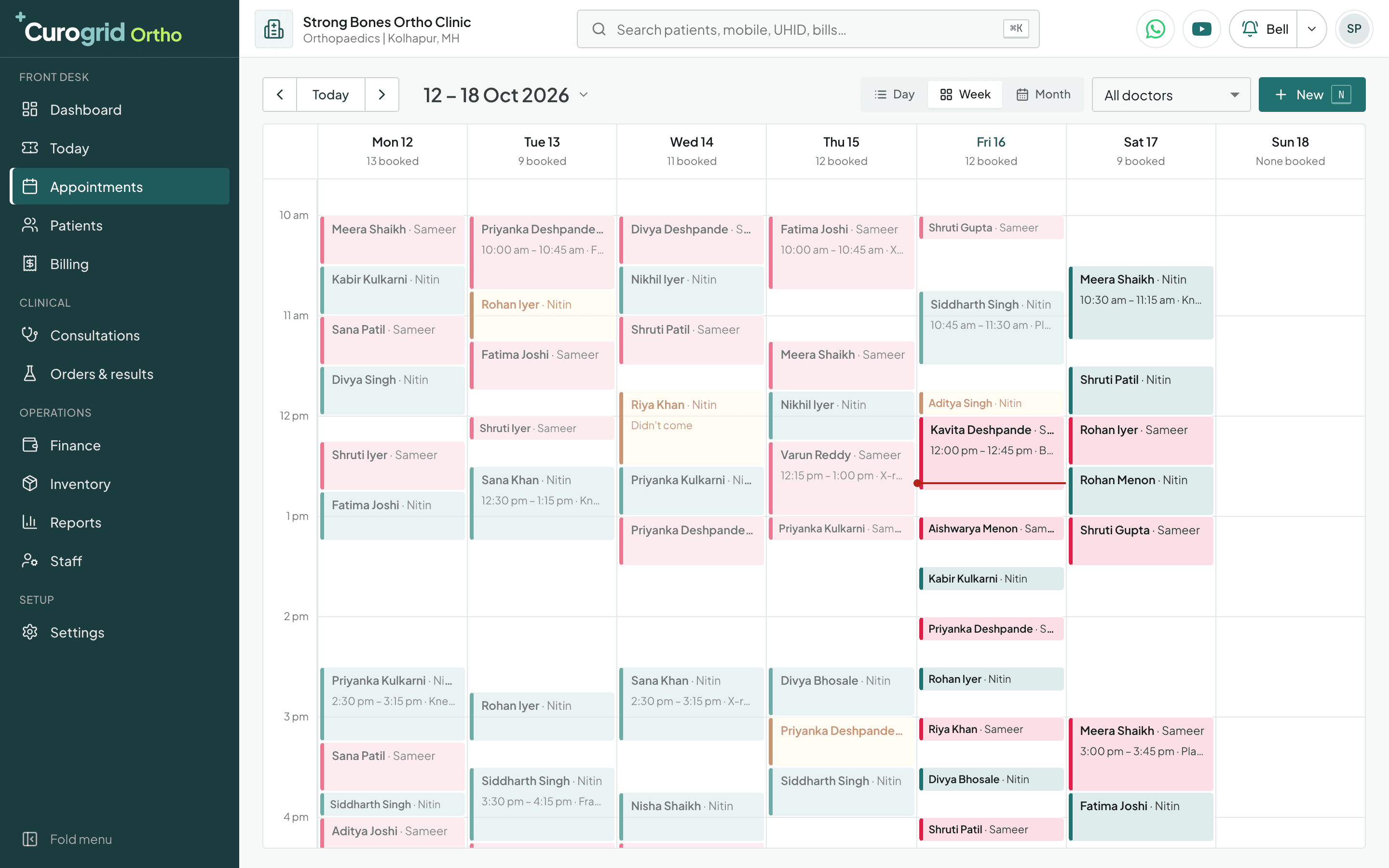
The appointment book 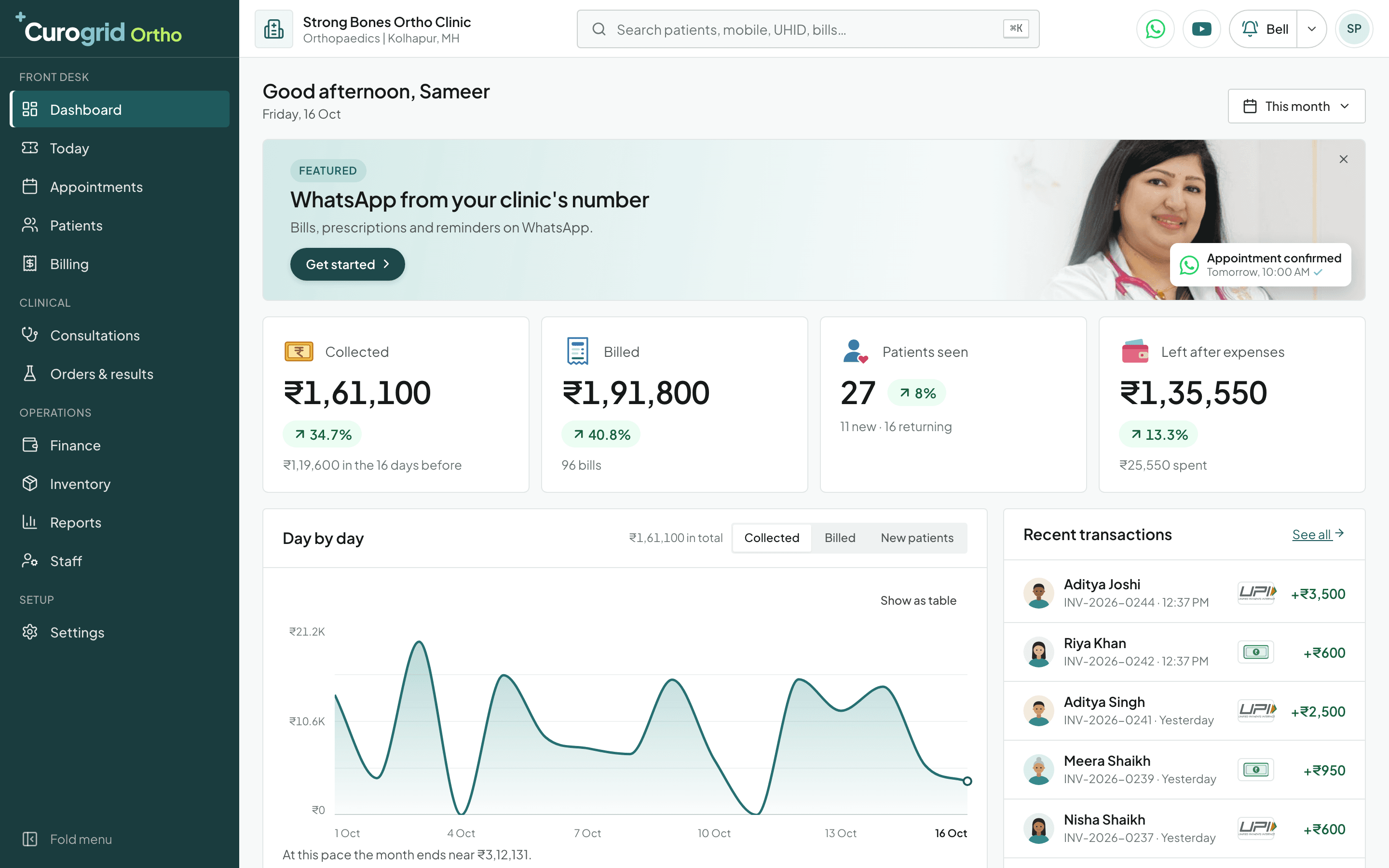
The owner's dashboard 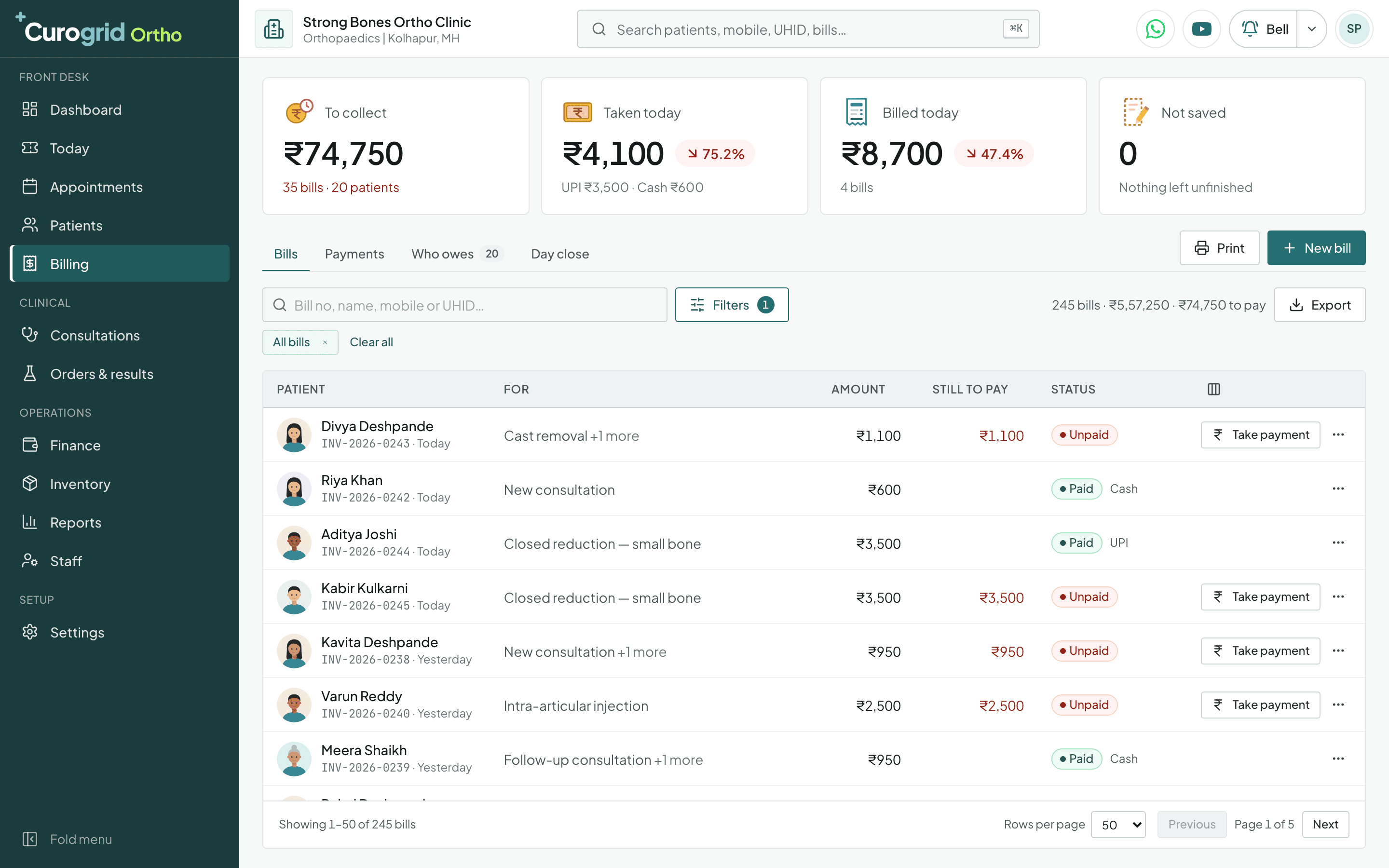
Billing by UPI, card and cash
A fracture patient's way through the clinic, step by step
1. At the desk
A token, ahead if it is an emergency. The desk gives a token, and an emergency or a patient over 60 can go ahead of the line.
2. The first visit
The injury on the body map. How it happened, where, the pain, the findings and the nerves and pulses checked. The X-ray is one tap, and the diagnosis, such as a distal radius fracture, is searched by name.
3. In the plaster room
Consent, the cast, the bill. The patient signs “Procedure or operation” on the screen. The cast is billed from the price list, a starter ₹2,500 below the knee, and the plaster plan starts today.
4. Writing the prescription
Pain relief, calcium and a sling. The orthopaedic medicines are offered first, and a sling, a knee cap or a lumbar belt is written on the prescription and given from stock at the counter. A red warning shows if the patient is allergic to what you write.
5. Booking ahead
The follow-ups booked together. Turn on “Book follow-ups (plaster check, review)” and Curogrid books three follow-ups a week apart, each labelled “Follow-up 2 of 3”.
6. At each check
The review. Pain, the plaster, progress and the X-ray. Tick the plan's step as done today.
7. After the plaster
Physiotherapy in the same clinic. Book the physiotherapy sessions, or the 10 session package, in the Physiotherapy department.
From ₹420 a month, for the whole clinic
Not per doctor. Everything on this page is included. Start with 5 days of Pro, free.
Questions from orthopaedic surgeons
Yes. The injury visit has a front and back body figure. Tap the injured area, such as the right knee, and it is kept with its side, right and left being the patient's own. There are 36 areas, from the neck and shoulders to the heels.
Yes. Start the plaster plan on the day the cast goes on and Curogrid lays out four checks: the next day (swelling, fingers or toes), 1 week (X-ray), 3 weeks (review) and 6 weeks (plaster off, X-ray). The patient's file shows how many are done and the next one, and you can print the card.
How it happened, where on the body map, pain from 0 to 10, findings (swelling, tenderness, deformity, bruising, wound, limp, less movement), pulses, feeling, finger or toe movement and capillary refill checked, range of movement in degrees, the X-ray, and the plan: cast, slab, splint, sling, injection, physiotherapy or surgery.
Yes. Physiotherapy is one of the three departments, with a physiotherapy session and a 10 session package on the price list and the session ready to order. Each physiotherapist has their own login.
Yes. Turn on “Book follow-ups (plaster check, review)” in the booking drawer. Curogrid books three follow-ups a week apart unless you change it, each labelled “Follow-up 2 of 3”.
Yes. A crepe bandage, arm sling, knee cap, lumbar belt and cervical collar are in the medicine names, so they are written on the prescription and given from stock at the counter, which puts them on the bill.
Eight: X-ray knee AP and lateral, shoulder, wrist, ankle, hip and pelvis, cervical spine, MRI knee and a DEXA scan. Each is one tap on the visit, and any other can be typed.
Yes, for Android and iPhone. The doctor sees the line, writes the injury visit with the body map, and opens a patient's file with the plaster plan on the phone. Curogrid also runs in a web browser and as a Windows app.
Curogrid Plus is ₹420 a month and Pro is ₹999 a month, or ₹4,032 and ₹9,590 for a year. GST of 18% is added. The price is for the whole clinic, not for each doctor, and the Orthopaedics setup is included in both plans. Every clinic starts with 5 days of Pro, free.
Yes. Curogrid sends the patient a reminder before the appointment by WhatsApp and email, and can send the prescription, the bill and the receipt the same way. On Plus the WhatsApp messages go from the Curogrid number. On Pro they go from your clinic's own number.
Not yet. A patient's 14-digit ABHA number can be recorded on their file, where it is marked as not checked with ABDM. Curogrid does not yet verify an ABHA number, create one or share records through ABDM.
No. Curogrid needs an internet connection. The phone app tells you when it is offline and saves nothing until the connection is back, and on a computer a visit you are typing is kept on that computer until it can be saved. The screens are in English only.
Good to know
Registrations and rules for an orthopaedic clinic in India, what Curogrid does not do, and the lists it offers. The rules are a plain summary, not legal advice, checked on .
Only a doctor on a State Medical Register or the Indian Medical Register may practise medicine, and the registration number belongs on every prescription, certificate and receipt you sign. The NMC's 2023 conduct regulations were put on hold in August 2023, so the 2002 code of ethics still applies. In Curogrid: Each doctor's qualifications, registration number and council are kept on their staff profile and print under their name on every prescription.
In the states and union territories that have adopted the Act, a clinic cannot run without registering with the district registering authority, and national minimum standards are set for each kind of clinic. Other states have their own registration law. Your district health office will say which applies. In Curogrid: Curogrid does not register your clinic. Your clinic's name, address and contact numbers print on every bill and paper it makes.
Every medical X-ray machine, a portable unit or a C-arm included, needs a licence from the Atomic Energy Regulatory Board. Register the clinic on eLORA, declare each machine, and apply for its licence before you use it. In Curogrid: Curogrid does not hold AERB licences. X-rays are ordered in one tap and their results are kept on the patient's file.
Orthopaedic knee implants have a ceiling price set by the National Pharmaceutical Pricing Authority since 2017, last extended to 15 November 2026 or further orders. The implant's price on the bill may not be above the ceiling. In Curogrid: Curogrid does not check implant prices. An implant is a line on the bill at the price you enter.
An injury from a road accident, an assault, a burn or a poisoning is a medico-legal case. Treat first and never turn the patient away, then inform the local police and keep a careful record of what you saw and did. In Curogrid: Curogrid does not tell the police or keep an MLC register. Each visit records the time, the findings and what was done, and photos and reports can be added to the patient's file.
Physiotherapy is a recognised profession, and its registration regulations were published in September 2026: a physiotherapist may practise only after registering. In Curogrid: Physiotherapy is its own department, and each physiotherapist has their own sign-in and role.
Explain what you will do, why, and its risks before you start, and keep the patient's agreement. For a child, a parent or guardian agrees. In Curogrid: The setup adds four consent forms: “Examination and treatment plan”, “Procedure or operation”, “Local anaesthetic” and “Sedation or general anaesthesia”. The patient, a parent or guardian, or a relative signs with a finger on the screen, and the form is kept in the patient's file.
Needles from joint injections, used plaster with blood or body fluid on it, and dressings are bio-medical waste. Separate waste where it is made, put sharps in a puncture-proof white translucent container, hand it to your area's common bio-medical waste facility, and train the staff who handle it. In Curogrid: Curogrid does not manage waste. Each cast and injection is billed, so what was done and when is on record.
A patient's record is personal data, and the clinic is responsible for it. Tell patients what you keep and why, keep it safe, use it for their care, and let a patient see or correct what you hold. The Rules were notified in November 2025 and most of their duties for clinics apply from May 2027. In Curogrid: Every member of the team has their own sign-in and role, so the records show who did what, and nobody shares a password.
Health care by a clinical establishment or an authorised medical practitioner is exempt from GST: the diagnosis, treatment or care of an illness, injury or pregnancy. Anything sold or done outside that, such as a cosmetic product, may be taxed. Ask your chartered accountant what applies to your clinic. In Curogrid: A GST rate is set on a service only if you give it one, so taxable and exempt services can sit on the same bill. The clinic's GSTIN is needed only if you are registered.
X-rays are ordered in one tap and the result is typed against the order. Curogrid has no image viewer and does not connect to the X-ray machine; a photo or PDF of the film goes in the patient's file.
A closed reduction or a plaster is a service you bill. Implants, a theatre list, the operation note, beds and the discharge summary are not built.
The four checks run from the day the cast goes on, to six weeks. A different schedule is booked with “Book follow-ups” and the plan can be stopped with a reason.
The 10 session package is a price on the bill. The count of sessions comes from the booking, and is not tied to what was paid.
A road accident or an assault is a medico-legal case. Curogrid keeps the visit's record but does not keep an MLC register or inform the police.
Aceclofenac 100 mg tablet, Aceclofenac + Paracetamol tablet, Etoricoxib 90 mg tablet, Diclofenac 50 mg tablet, Naproxen 500 mg tablet, Thiocolchicoside 4 mg capsule, Tizanidine 2 mg tablet, Pregabalin 75 mg capsule, Gabapentin 300 mg capsule, Methylcobalamin 1500 mcg tablet, Calcium + Vitamin D3 tablet, Vitamin D3 60,000 IU sachet, Diclofenac gel, Pantoprazole 40 mg tablet, Trypsin + Chymotrypsin tablet, Allopurinol 100 mg tablet, Febuxostat 40 mg tablet, Alendronate 70 mg tablet, Cefuroxime 500 mg tablet, Crepe bandage, Arm sling, Knee cap, Lumbar belt, Cervical collar.
Uric acid, RA factor, Serum calcium, HLA-B27, Anti-CCP.
X-ray knee AP/lateral, X-ray shoulder, X-ray wrist, X-ray ankle, X-ray hip and pelvis, X-ray cervical spine, MRI knee, DEXA scan (bone density).
Plaster cast, Slab, Cast removal, Joint injection, Joint aspiration, Strapping, Physiotherapy session.
Fracture of lower end of radius, Fracture of clavicle, Fracture of neck of femur, Fracture of lateral malleolus, Fracture of metatarsal bone, Fracture of other finger, Dislocation of shoulder joint, Sprain and strain of ankle, Sprain and strain of wrist, Sprain and strain involving (anterior)(posterior) cruciate ligament of knee (ACL or PCL injury), Derangement of meniscus due to old tear or injury (meniscus tear), Gonarthrosis, Coxarthrosis (hip arthritis), Arthrosis (osteoarthritis), Rheumatoid arthritis, Gout, Osteoporosis, Low back pain, Lumbago with sciatica, Other specified intervertebral disc displacement (slipped disc), Cervicalgia, Spondylosis, Spondylolisthesis, Adhesive capsulitis of shoulder, Rotator cuff syndrome, Lateral epicondylitis, Trigger finger, Radial styloid tenosynovitis (de Quervain), Plantar fascial fibromatosis, Presence of orthopaedic joint implants (joint replacement).
Try Curogrid Ortho in your clinic
5 days of Pro, free. Pick “Orthopaedics” in setup and the injury visit, the body map, the plaster plan and your services are ready before your first patient.