
For gynaecologists, obstetricians and women's clinics
Curogrid Gynae: software for gynaecology and obstetrics clinics
Every pregnancy dated from one LMP, every scan on time, and the baby shown week by week.
From ₹420 a month for the whole clinic. 5 days free.
The pregnancy
The weeks, the due date and the baby, from one date
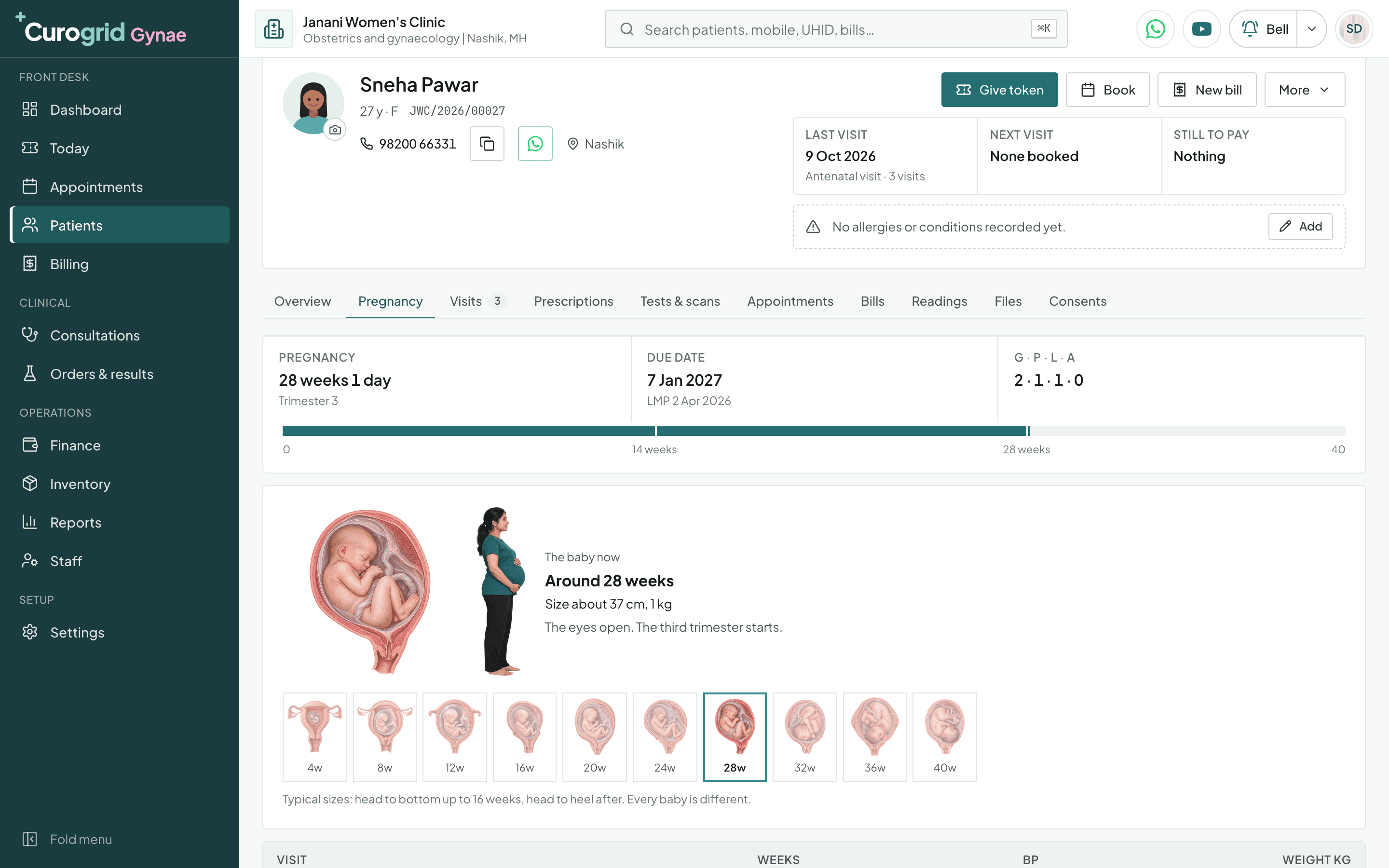
The last period is asked once, at the desk. From then on every pregnant patient's file opens a Pregnancy tab that works out where she is today, and shows the baby's stage in a picture you can turn to her while you explain.
- Weeks and due date worked out, every visit
- Show the mother her baby's stage on the screen
- Every visit's BP and weight against the week
See everything it records
What the Pregnancy tab shows
- Pregnancy
- Weeks and days today, such as “28 weeks 1 day”, and the trimester.
- Due date
- Worked out from the LMP, with the LMP beside it.
- G P L A
- Pregnancies, deliveries, living children and miscarriages, as asked at registration.
- The 40 week bar
- Today's place in the pregnancy, with the 14 and 28 week marks.
- The baby now
- This week's stage with its typical size and one plain line, and the mother at this trimester.
- Every visit
- Each visit's blood pressure and weight, with the week it was taken in.
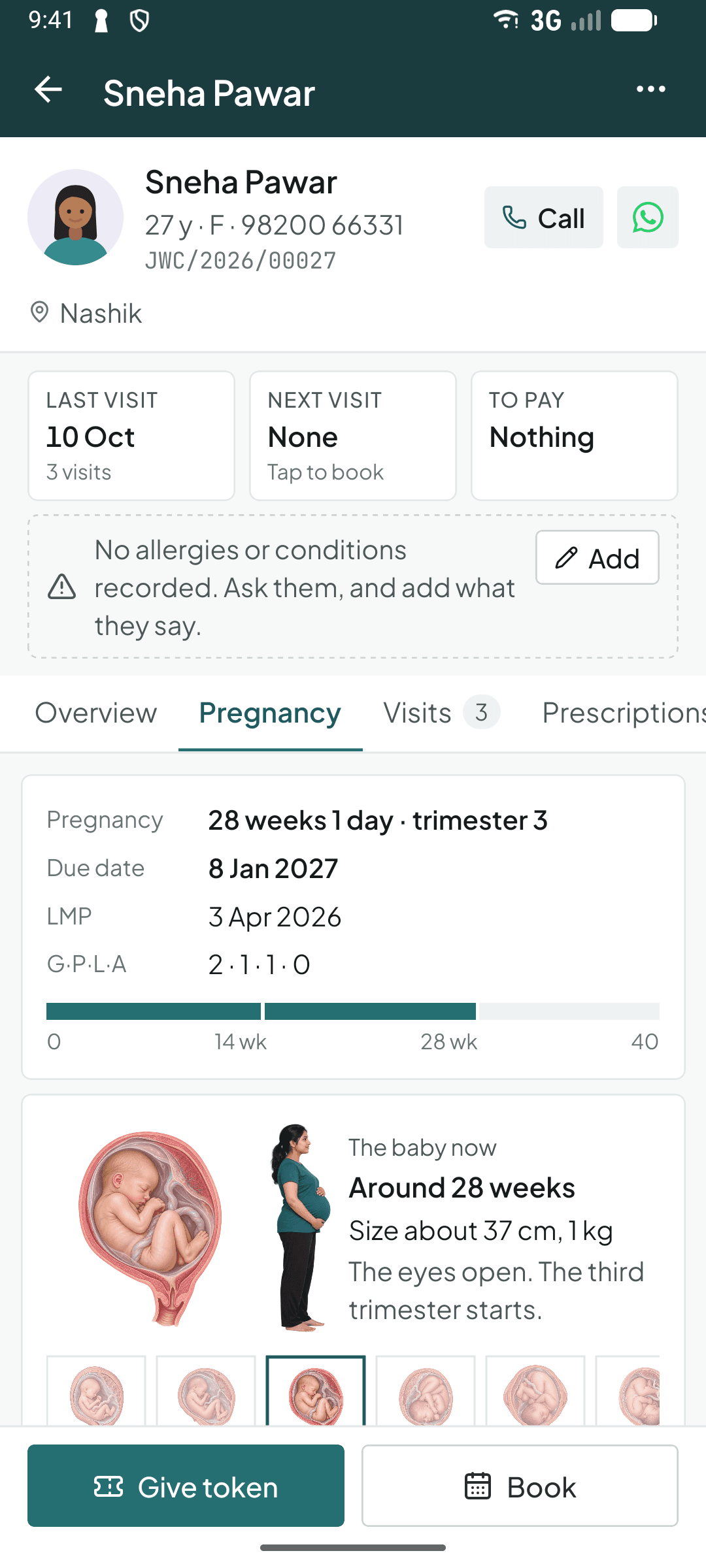
Sizes are averages, head to bottom up to 16 weeks and head to heel after; the tab says every baby is different. The pictures never show the baby's sex. The phone app shows the same tab.
Antenatal care
The visits and scans of a pregnancy, laid out to 40 weeks
Start the pregnancy plan and Curogrid dates every step from the LMP. The patient's file shows what is done and what is next, and one tap marks today's step done.
- No missed NT, anomaly or OGTT window
- The whole pregnancy dated from one LMP
- Patients due this week, listed for your desk
See everything it records
The 11 steps of the pregnancy plan
- 8 weeks
- First visit, dating scan, blood tests
- 12 weeks
- NT scan (11 to 14 weeks), Td 1
- 16 weeks
- Visit, Td 2
- 20 weeks
- Anomaly scan (18 to 22 weeks)
- 24 weeks
- Visit, sugar test (OGTT, 24 to 28 weeks)
- 28 weeks
- Visit, Hb
- 32 weeks
- Growth scan
- 34 and 36 weeks
- Visits; at 36, plan the delivery
- 38 weeks
- Visit
- 40 weeks
- The due date
The pregnancy card
Print the plan as a card on your letterhead: every step with its due date, the day it was done, and a column to sign. She brings it to every visit.
The dashboard lists every patient whose next step is due this week, the late ones first. Switch on “Care plan reminder” in Notifications and she gets a WhatsApp message the day before.
On the doctor's screen
A history on the first visit, an antenatal check after
Two short forms made for a gynaecologist, most of it a tap. The complaint, diagnosis and prescription are on the visit as usual.
- A gynae history in taps, not paragraphs
- Each antenatal check in under a minute
- Fundal height and the baby's heart rate, visit by visit
See everything it records
The first visit: History
- Here for
- Pregnancy, a gynae problem, infertility, contraception or after delivery.
- Last period
- The first day, or “Not sure”.
- Pregnancies (G P L A)
- Ready words such as “G2 P1 L1 A0”.
- Periods
- Regular, irregular, heavy, painful, scanty, stopped.
- Contraception
- None, condom, pill, Copper-T, injection, sterilisation.
- Risks
- High BP, diabetes or GDM, anaemia, Rh negative, previous caesarean, twins, thyroid.
- P/A, P/S, P/V
- Ready words such as “P/S healthy cervix” and “P/V uterus normal size”.
Each pregnancy visit: Antenatal check
- Weeks of pregnancy
- In weeks.
- Fundal height
- In centimetres.
- Baby's heart rate
- Per minute.
- Baby lies
- Head down, breech, transverse, or not known yet.
- Swelling
- None, feet or generalised.
- Urine
- Albumin and sugar, nil or present.
- Given
- Iron and folic acid, calcium, Td injection.
- Notes
- Ready words such as “Baby moving well” and “Danger signs explained”.
The whole clinic
Front desk, money and team, in one place
Tokens, appointments, bills, staff and the day's takings, on the computer and the phone.
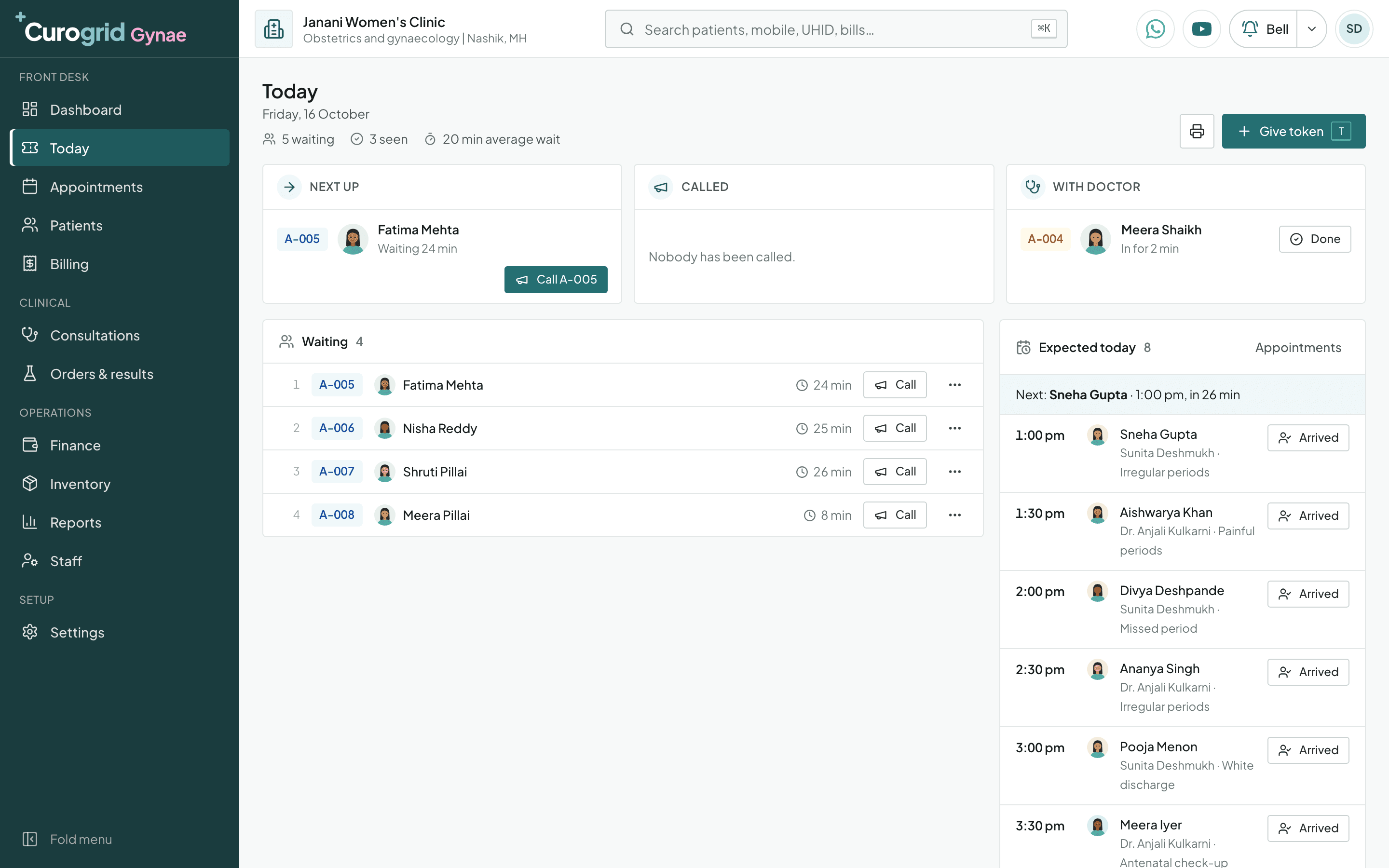
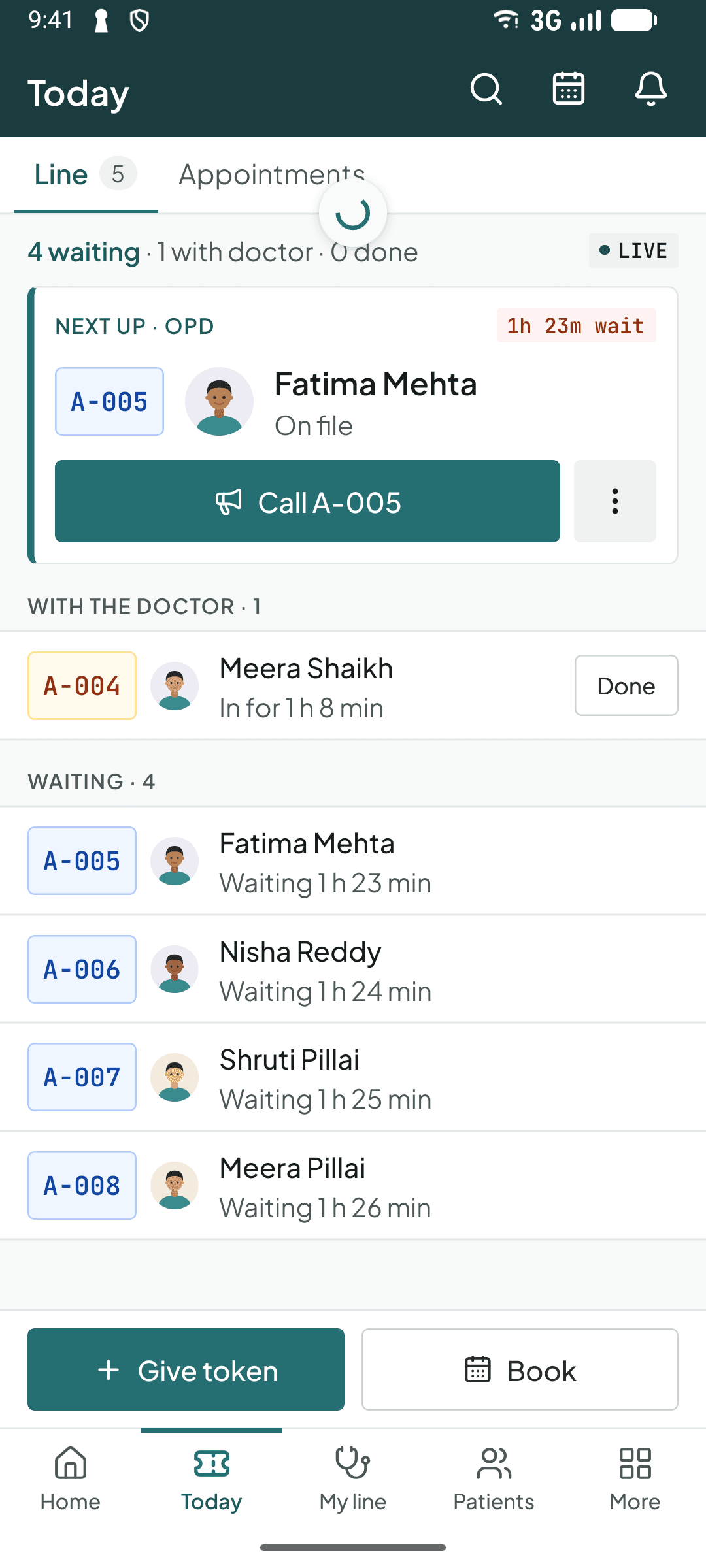
Today's line 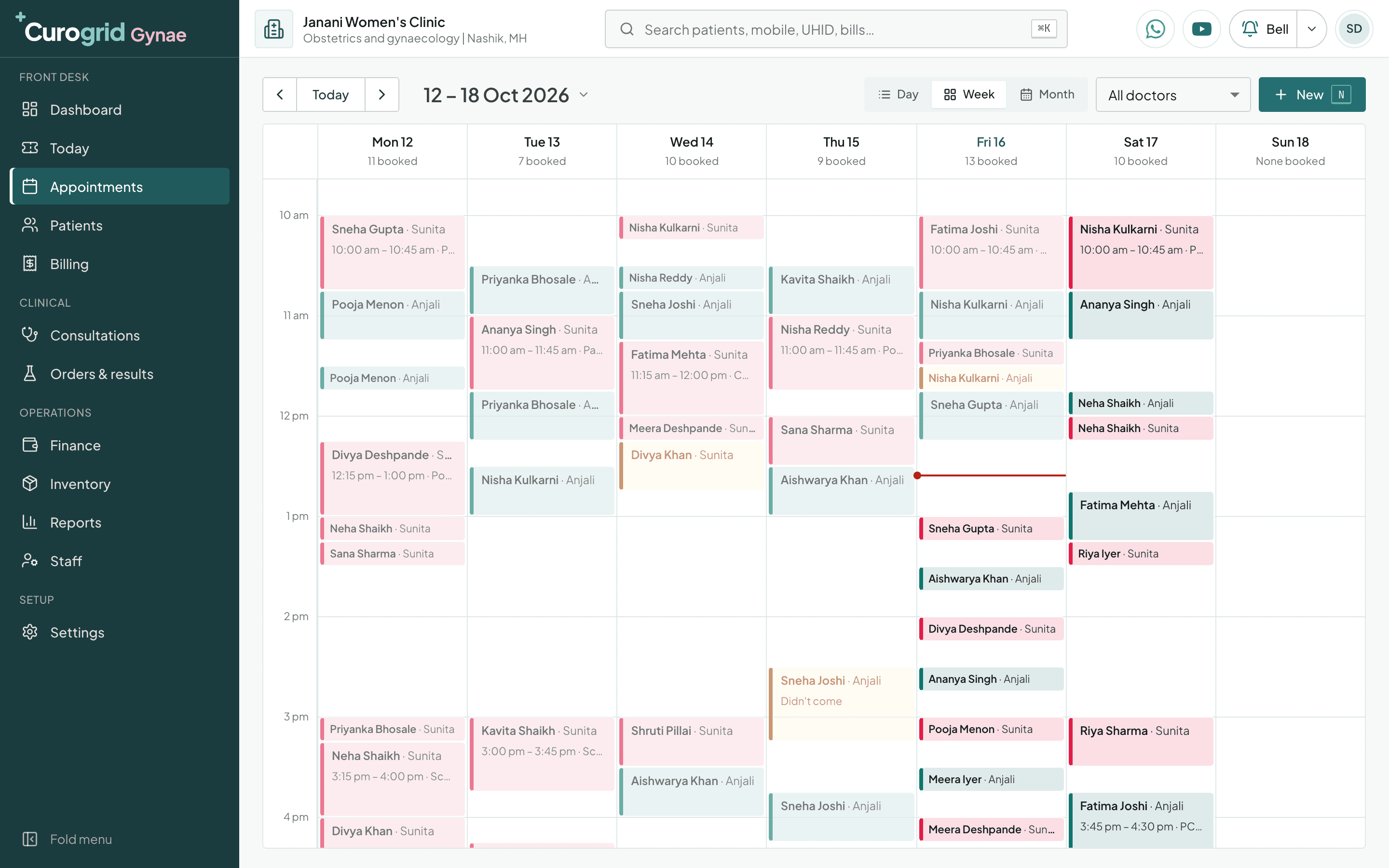
The appointment book 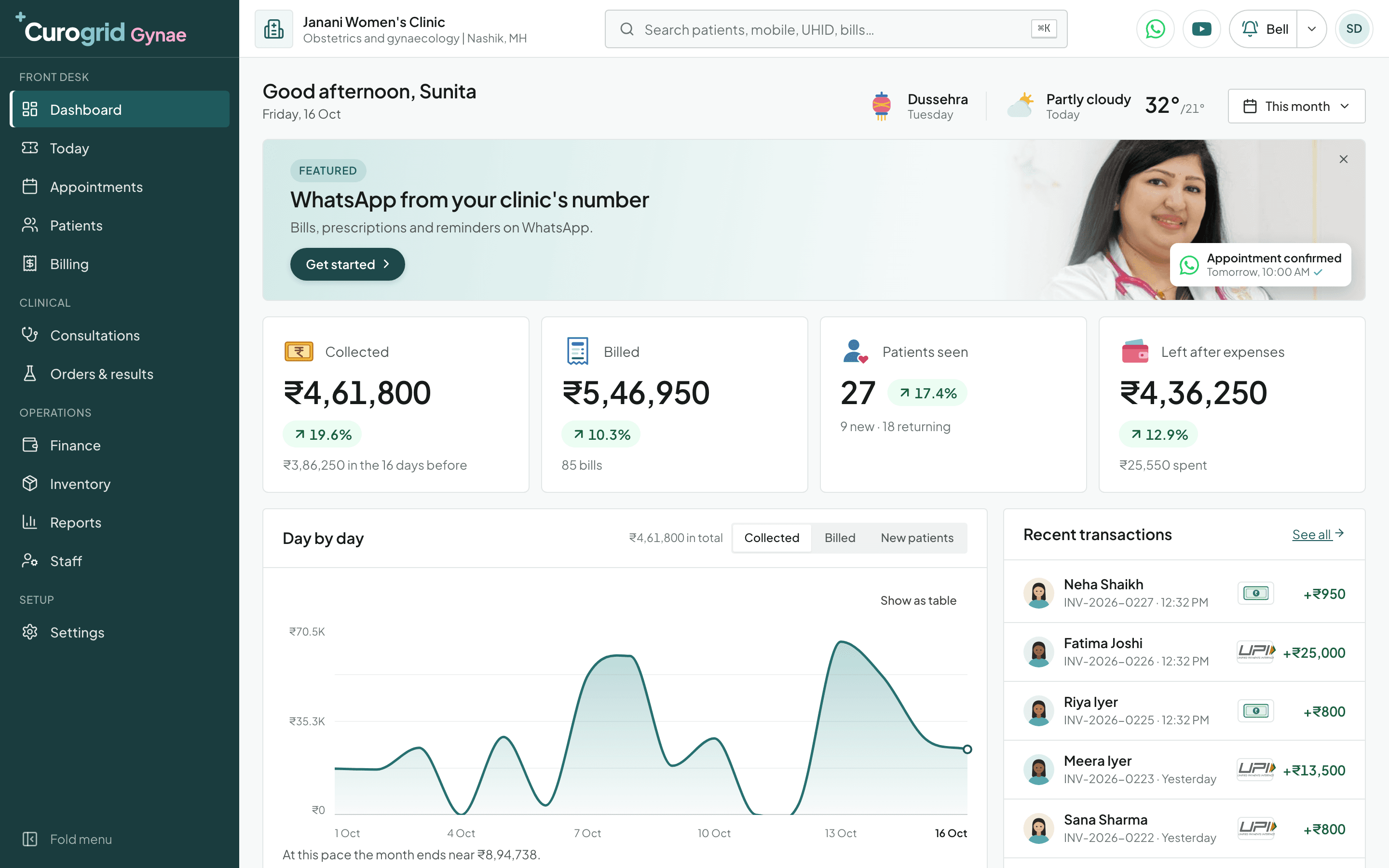
The owner's dashboard 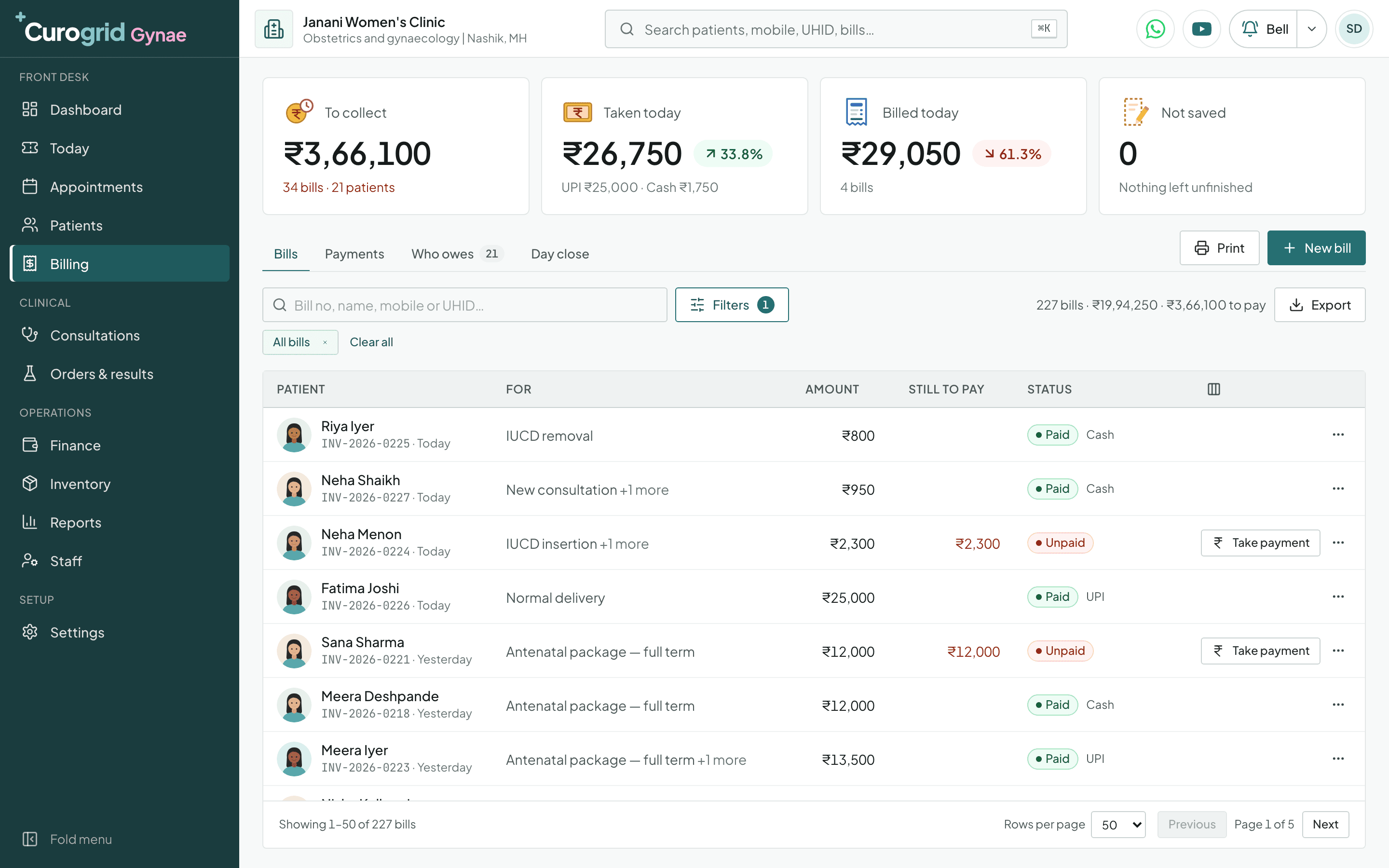
Billing by UPI, card and cash
A pregnancy through the clinic, step by step
1. At the desk
Registered once, with the LMP. Her name, age and mobile number, then the last period, the G P L A and her husband's or partner's name. The LMP dates everything that follows.
2. In the waiting area
A pregnant patient goes ahead. The desk gives a token and marks it “Pregnant”. Priority tokens are placed ahead of normal ones, and the tag shows in the doctor's line.
3. Before the doctor
Weight and blood pressure. The sister records them in the vitals. The Pregnancy tab lists them against the week, visit after visit.
4. The first visit
The history and the plan. Fill the history, start the pregnancy plan from the LMP, and order the dating scan and antenatal profile in one tap each. If she is allergic to a medicine you write, a red warning says so.
5. Booking ahead
The next visits booked together. Turn on “Book antenatal visits” and Curogrid books four visits four weeks apart, at the same time of day, each labelled “Visit 2 of 4”. A date that clashes or falls on leave is skipped and listed.
6. Each antenatal visit
The antenatal check. Weeks, fundal height, the baby's heart rate and lie, swelling, urine and what was given. Tick the plan's step as done today.
7. When a report comes back
Scans and tests in the file. The result is typed against the order and the report is added as a PDF or a photo. The next visit shows what is still not back.
8. For a procedure
Consent, then the bill. Before an IUCD insertion she reads “Procedure or operation” on the screen and signs with a finger. The service is billed from the price list, a starter ₹1,500 until you change it.
9. Through the pregnancy
Due this week. The dashboard lists the patients whose next step is due, the late ones first. With reminders on, she is messaged the day before the anomaly scan or the OGTT.
On the phone
Your clinic in your pocket
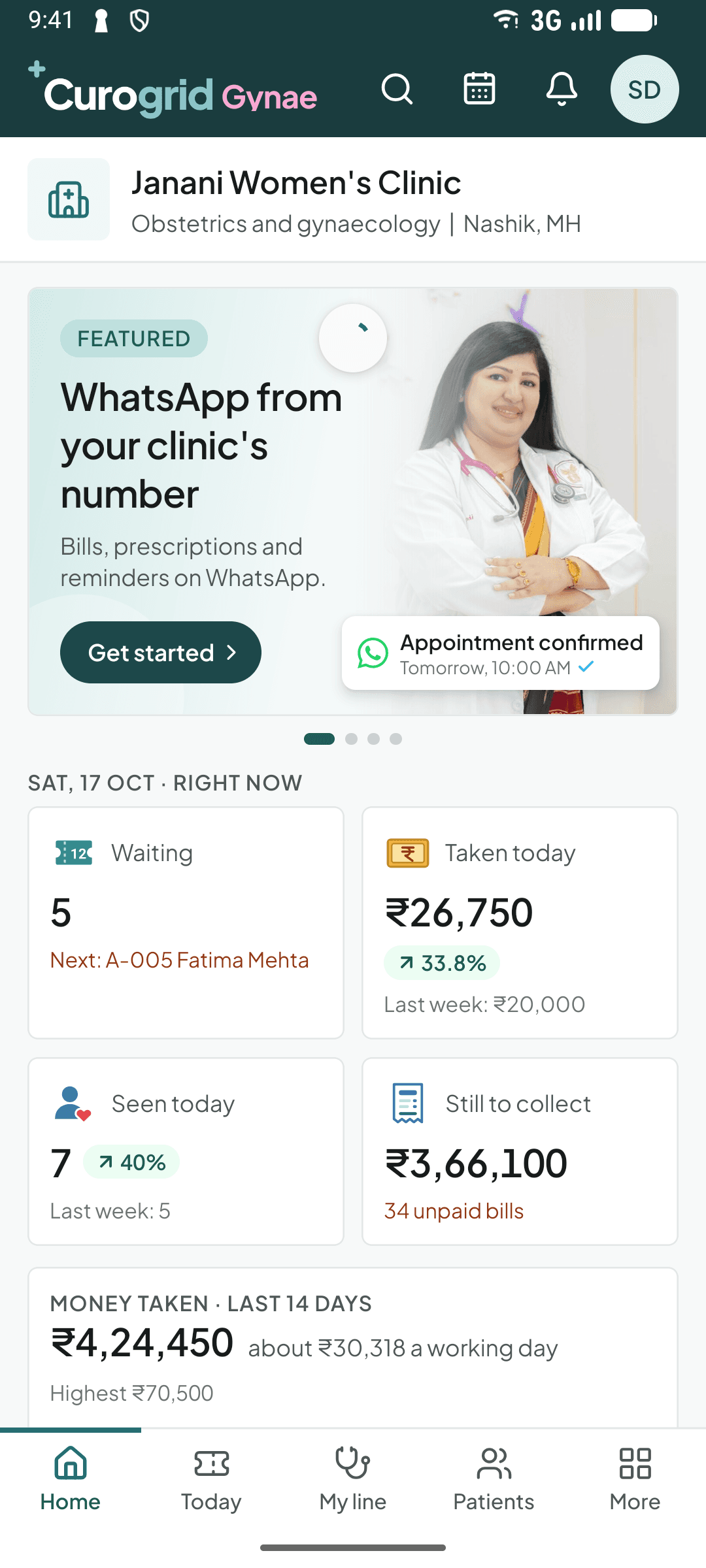
The same Curogrid Gynae on Android and iPhone, for the doctor, the front desk and the owner.
- See the line and call the next patient from anywhere
- Open a patient's file, write the visit, take the payment
- Today's appointments and takings, wherever you are
From ₹420 a month, for the whole clinic
Not per doctor. Everything on this page is included. Start with 5 days of Pro, free.
Questions from gynaecologists
Yes. The desk enters the last period once at registration. The patient's Pregnancy tab then shows the weeks and days today, the due date, the trimester on a 40 week bar and the G P L A, and lists each visit's blood pressure and weight with the week it was taken in.
Yes. Start the pregnancy plan and Curogrid lays out 11 steps from the LMP: 8 weeks (first visit, dating scan, blood tests), 12 weeks (NT scan, Td 1), 16 weeks (Td 2), 20 weeks (anomaly scan), 24 weeks (OGTT), 28 weeks (Hb), 32 weeks (growth scan), 34, 36 (plan the delivery), 38, and the due date at 40. Tick each step when it is done, and print the pregnancy card.
The weeks of pregnancy, fundal height in centimetres, the baby's heart rate, how the baby lies (head down, breech, transverse), swelling, urine albumin and sugar, what was given (iron and folic acid, calcium, Td), and notes such as “Danger signs explained”. Weight and blood pressure are in the visit's vitals.
Yes. In the booking drawer, turn on “Book antenatal visits”. Curogrid books the visits together, four visits four weeks apart unless you change it, and labels each one, for example “Visit 2 of 4”.
Only a reminder. A clinic that chooses Obstetrics and gynaecology gets a PCPNDT registration task on its setup checklist, so the registration is not missed. Curogrid does not generate or submit Form F and is not a PCPNDT register. The baby's sex is never recorded, and the stage pictures never show it.
Yes. Every appointment gets a reminder before it on WhatsApp and by email. Switch on “Care plan reminder” in Notifications and the patient is also messaged the day before the next step of her pregnancy plan, such as the anomaly scan.
Not yet. Curogrid today is for the clinic and OPD: appointments, visits, scans, prescriptions and bills. Admitting a patient, beds and the discharge summary are not built. You can bill a delivery as a service.
Yes. “Antenatal package, full term”, “Normal delivery” and “Caesarean section” are starter services, at starter prices of ₹12,000, ₹25,000 and ₹55,000. They are only a starting point. Set your own fee for each.
Only the staff you allow. Each person has their own login and a role, and you decide what each role can open. A receptionist who may not read clinical notes does not see the visits. The record is not visible to other clinics.
Yes, for Android and iPhone. The doctor sees the line, writes the visit and opens a patient's Pregnancy tab, with the weeks, the due date and the baby's stage, on the phone.
Curogrid Plus is ₹420 a month and Pro is ₹999 a month, or ₹4,032 and ₹9,590 for a year. GST of 18% is added. The price is for the whole clinic, not for each doctor, and the Obstetrics and gynaecology setup is included in both plans. Every clinic starts with 5 days of Pro, free.
Yes. Curogrid sends the patient a reminder before the appointment by WhatsApp and email, and can send the prescription, the bill and the receipt the same way. On Plus the WhatsApp messages go from the Curogrid number. On Pro they go from your clinic's own number.
Not yet. A patient's 14-digit ABHA number can be recorded on their file, where it is marked as not checked with ABDM. Curogrid does not yet verify an ABHA number, create one or share records through ABDM.
No. Curogrid needs an internet connection. The phone app tells you when it is offline and saves nothing until the connection is back, and on a computer a visit you are typing is kept on that computer until it can be saved. The screens are in English only.
Good to know
Registrations and rules for a gynaecology clinic in India, what Curogrid does not do, and the lists it offers. The rules are a plain summary, not legal advice, checked on .
Only a doctor on a State Medical Register or the Indian Medical Register may practise medicine, and the registration number belongs on every prescription, certificate and receipt you sign. The NMC's 2023 conduct regulations were put on hold in August 2023, so the 2002 code of ethics still applies. In Curogrid: Each doctor's qualifications, registration number and council are kept on their staff profile and print under their name on every prescription.
In the states and union territories that have adopted the Act, a clinic cannot run without registering with the district registering authority, and national minimum standards are set for each kind of clinic. Other states have their own registration law. Your district health office will say which applies. In Curogrid: Curogrid does not register your clinic. Your clinic's name, address and contact numbers print on every bill and paper it makes.
Every clinic with an ultrasound machine must be registered and show its certificate. Each pregnant woman scanned needs a Form F, signed by the doctor who did the scan, and the records, images included, are kept for at least two years. The baby's sex is never told, by word, sign or any other way. In Curogrid: A PCPNDT registration task sits on your setup checklist. Curogrid never records the baby's sex and its pictures never show it. It does not make or keep Form F.
Termination is done only at an approved place by a doctor trained for it. Up to 20 weeks one doctor's opinion is enough; from 20 to 24 weeks two are needed, for the categories of women the Rules set. The woman's name and details are kept confidential. In Curogrid: Curogrid has no MTP register. A record is opened only by the staff whose role allows it, and nobody shares a login.
A clinic that does IUI is a Level 1 ART clinic and must register on the National Registry; IVF and other advanced work is Level 2. Registration lasts five years. In Curogrid: Follicular study, AMH and a hormone profile are ready to order. Curogrid has no ART register or cycle record.
The pregnancy of a girl under 18 must be reported to the police or the Special Juvenile Police Unit. Not reporting is an offence. When she seeks a termination, the Supreme Court has said the doctor need not give her name in that report. In Curogrid: Curogrid does not report to the police. Her age is on her file, and the visit records what was seen and done.
Explain what you will do, why, and its risks before you start, and keep the patient's agreement. For a child, a parent or guardian agrees. In Curogrid: The setup adds four consent forms: “Examination and treatment plan”, “Procedure or operation”, “Sedation or general anaesthesia” and “Admission”. The patient, a parent or guardian, or a relative signs with a finger on the screen, and the form is kept in the patient's file.
Used needles, swabs and the waste from a procedure such as an IUCD insertion are bio-medical waste. Separate waste where it is made, put sharps in a puncture-proof white translucent container, hand it to your area's common bio-medical waste facility, and train the staff who handle it. In Curogrid: Curogrid does not manage waste. Each procedure is ordered and billed, so what was done and when is on record.
A patient's record is personal data, and the clinic is responsible for it. Tell patients what you keep and why, keep it safe, use it for their care, and let a patient see or correct what you hold. The Rules were notified in November 2025 and most of their duties for clinics apply from May 2027. In Curogrid: Every member of the team has their own sign-in and role, so the records show who did what, and nobody shares a password.
Health care by a clinical establishment or an authorised medical practitioner is exempt from GST: the diagnosis, treatment or care of an illness, injury or pregnancy. Anything sold or done outside that, such as a cosmetic product, may be taxed. Ask your chartered accountant what applies to your clinic. In Curogrid: A GST rate is set on a service only if you give it one, so taxable and exempt services can sit on the same bill. The clinic's GSTIN is needed only if you are registered.
Curogrid puts a PCPNDT registration task on the setup checklist. It does not generate, keep or submit Form F, and it is not a PCPNDT register. Keep your Form F and scan records as the Act requires.
A scan is ordered and billed in Curogrid. The report is typed as the result or added to the patient's file as a PDF or a photo.
Normal delivery and Caesarean section are services you can bill. Admission, beds, a labour record, a partograph and the discharge summary are not built.
Follicular study, AMH and a hormone profile are ready to order, and letrozole and clomiphene are in the medicine names. There is no IVF cycle chart or embryology record.
The weeks and the due date are worked out from the last period asked at registration. A due date corrected by the dating scan is written in the notes.
Folic acid 5 mg tablet, Iron + Folic acid tablet, Calcium + Vitamin D3 tablet, Doxylamine + Pyridoxine tablet, Progesterone 200 mg capsule, Dydrogesterone 10 mg tablet, Tranexamic acid 500 mg tablet, Mefenamic acid 500 mg tablet, Norethisterone 5 mg tablet, Medroxyprogesterone 10 mg tablet, Combined oral contraceptive pill, Levonorgestrel 1.5 mg tablet, Clotrimazole 100 mg vaginal pessary, Metronidazole 400 mg tablet, Fluconazole 150 mg tablet, Nitrofurantoin 100 mg capsule, Letrozole 2.5 mg tablet, Clomiphene 50 mg tablet, Metformin 500 mg tablet, Labetalol 100 mg tablet, Nifedipine 10 mg tablet, Methyldopa 250 mg tablet, Aspirin 75 mg tablet, Cabergoline 0.5 mg tablet, Anti-D injection, Protein powder.
Antenatal profile (Hb, blood group, HIV, HBsAg, VDRL), Urine pregnancy test, Beta hCG, OGTT (75 g), Urine culture, Pap smear, Double marker, Quadruple marker, Hormone profile (LH, FSH, prolactin), AMH.
USG obstetric (dating), NT scan, Anomaly scan, Growth scan with Doppler, Follicular study.
IUCD insertion, IUCD removal, Pap smear, NST (non-stress test).
Pregnancy confirmed, Supervision of normal first pregnancy, Supervision of high-risk pregnancy, Diabetes mellitus arising in pregnancy, Gestational (pregnancy-induced) hypertension without significant proteinuria, Pre-eclampsia, Anaemia complicating pregnancy, childbirth and the puerperium, Mild hyperemesis gravidarum, Threatened abortion, Routine postpartum follow-up, Polycystic ovarian syndrome (PCOS), Leiomyoma of uterus (fibroid), Endometriosis, Dysmenorrhoea, Excessive and frequent menstruation with irregular cycle, Candidiasis of vulva and vagina, Female pelvic inflammatory disease (PID), Menopausal and female climacteric states, Female infertility, General counselling and advice on contraception.
Try Curogrid Gynae in your clinic
5 days of Pro, free. Pick “Obstetrics and gynaecology” in setup and the Pregnancy tab, the antenatal plan, the scans and tests and your services are ready before your first patient.