
For general physicians and family doctors
Curogrid for general physicians and family doctors
Run a busy walk-in OPD without the chaos: tokens, quick prescriptions, allergy checks and bills in one place.
From ₹420 a month for the whole clinic. 5 days free.
The prescription
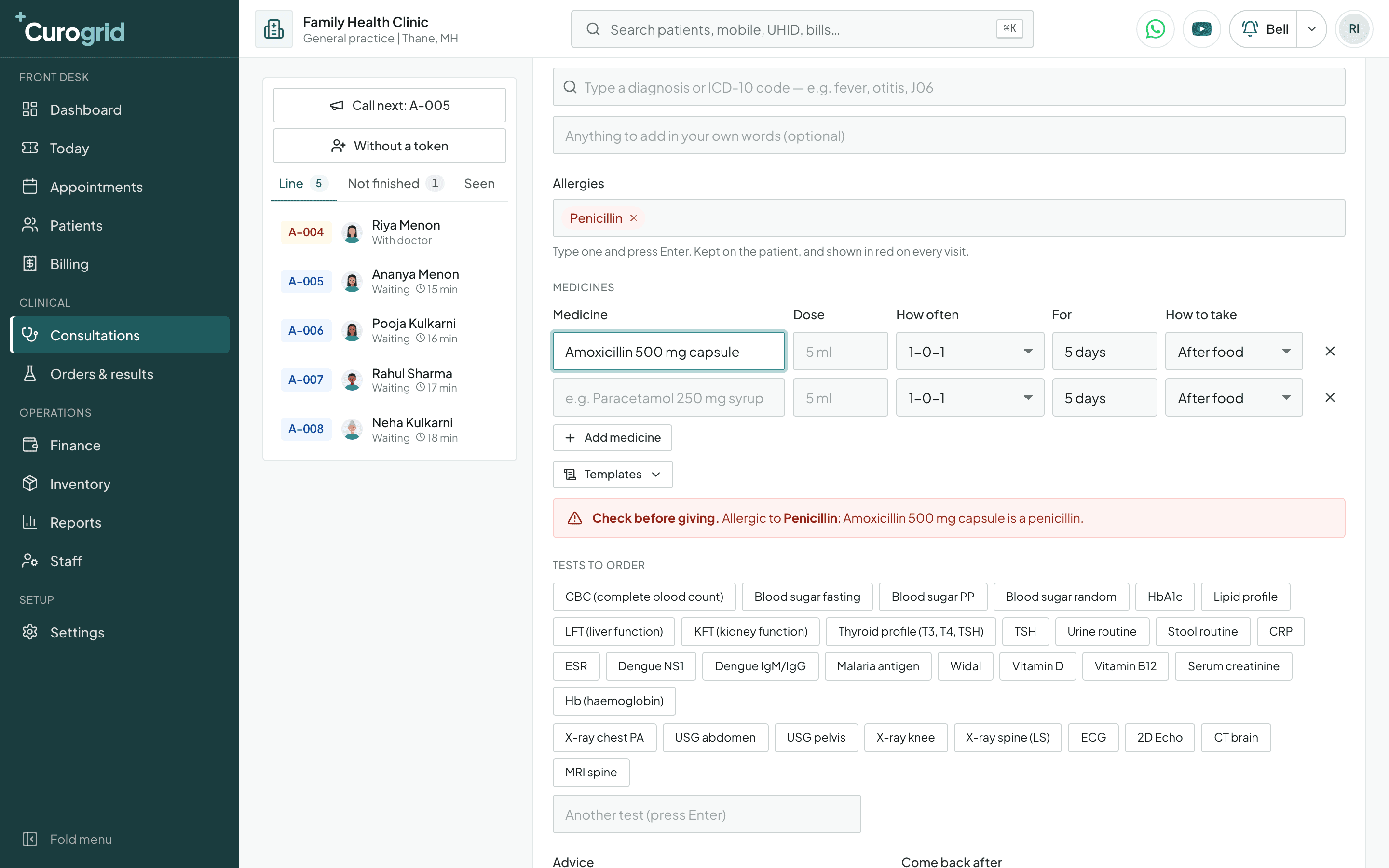
A prescription that checks the patient's allergies for you
A family doctor sees sixty patients a day and cannot remember every allergy. Curogrid does. Allergies are kept on the patient, shown in red on every visit, and a medicine that matches one is flagged before the prescription is printed.
- Never miss a patient's allergy again
- A whole prescription in one tap, from your templates
- Printed or sent on WhatsApp before the patient stands up
See everything it records
On the visit screen
- Diagnosis
- Searched by name or ICD-10 code, such as fever, otitis or J06, with your own words beside it.
- Allergies
- Typed once, kept on the patient, shown in red on every visit.
- Medicines
- The name as you type, the dose, how often (1-0-1), for how long, and how to take (after food).
- Templates
- Put a saved prescription on the visit in a tap, or keep today's under a name.
- Tests to order
- One tap each: CBC, sugar, HbA1c, lipid profile, LFT, KFT, thyroid, dengue, malaria, Widal, vitamin D and B12, and more.
- Scans
- X-ray chest, USG abdomen, ECG, 2D echo, CT brain, MRI spine and more.
- Advice and come back
- Written once, printed on the prescription, sent on WhatsApp if you like.
A reminder, not a block
The red line says “Check before giving”. It never stops you prescribing: the decision is the doctor's, and so is the dose.
The check-up
A complete check-up in a few taps
The first visit has a short examination made for a busy OPD. A review is two parts.
- A full check-up in a few taps
- Known conditions in front of you at every visit
- Your notes read the same, patient after patient
See everything it records
The first visit: Check-up
- Since
- Today, 2 to 3 days, a week, weeks or months.
- Known conditions
- High BP, diabetes, thyroid, asthma or COPD, heart disease, or none.
- Looks
- Well, febrile, pale, dehydrated, jaundiced, breathless.
- Normal on examination
- A tick for the chest, heart, abdomen, nervous system, throat and ears.
- Findings
- Ready words such as “Throat congested” and “Crepitations at bases”.
Each review
- Since last visit
- Better, same, worse, fever gone, still coughing.
- Notes
- Ready words such as “BP controlled” and “Sugar controlled”.
The whole clinic
Front desk, money and team, in one place
Tokens, appointments, bills, staff and the day's takings, on the computer and the phone.
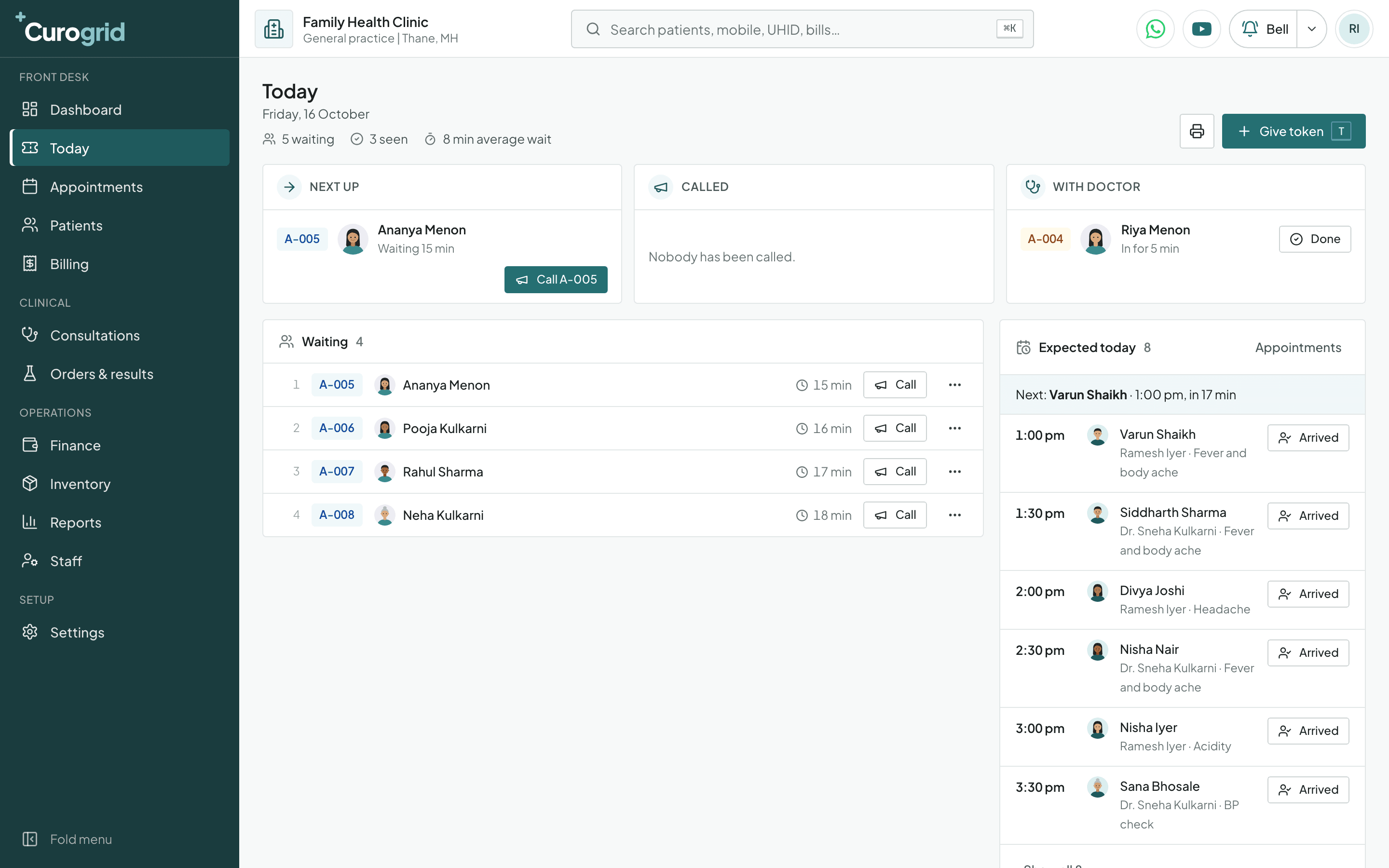
Today's line 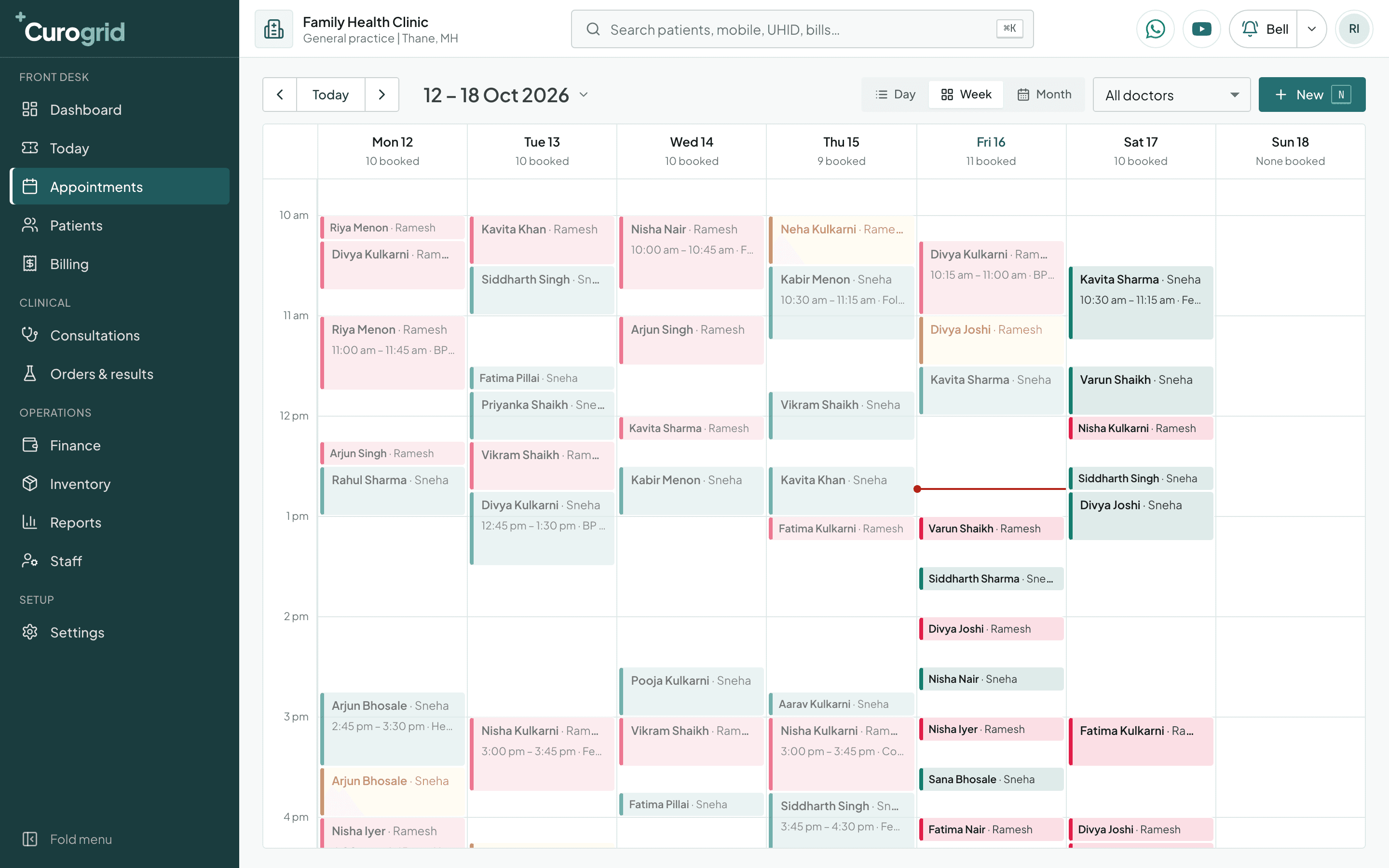
The appointment book 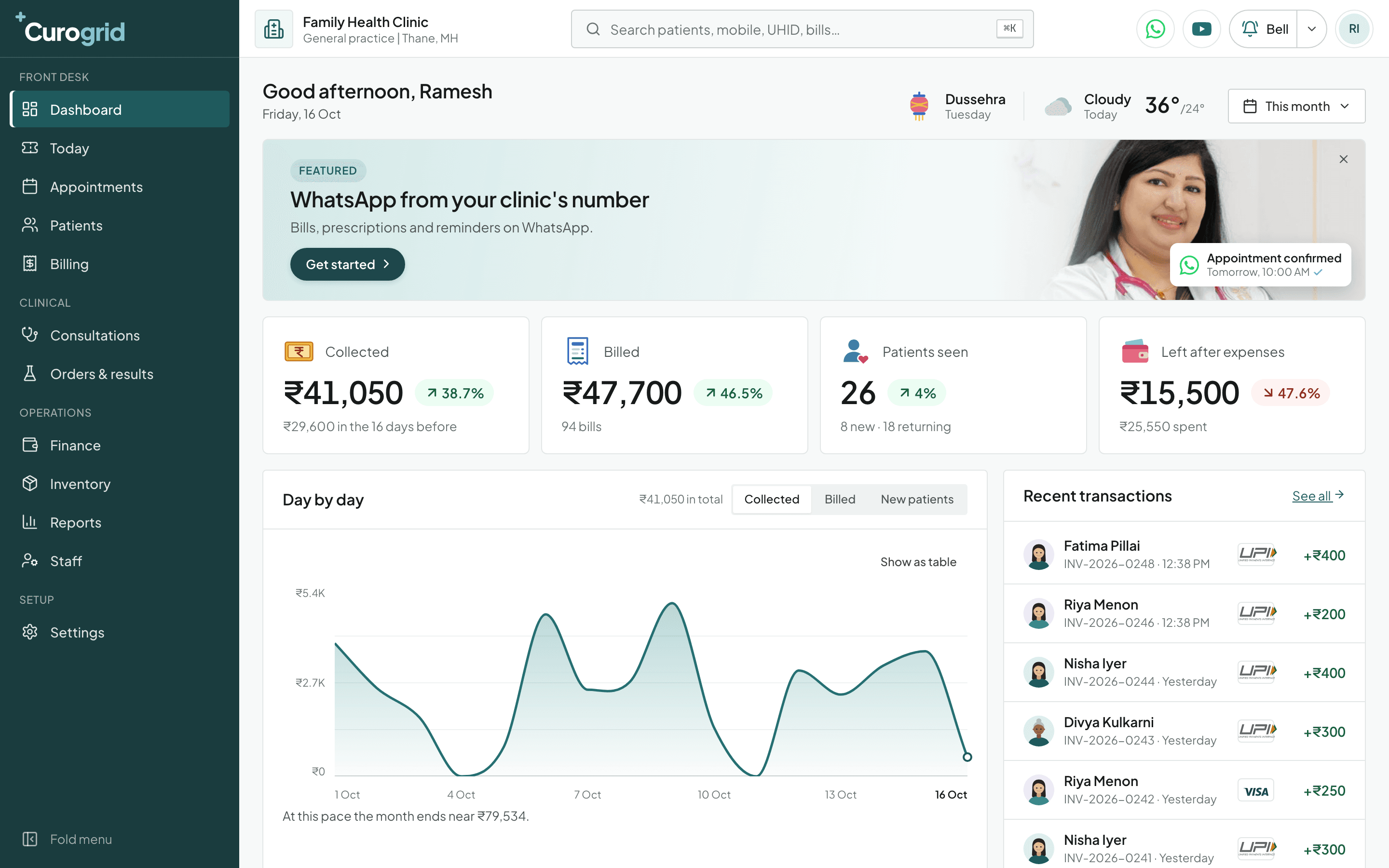
The owner's dashboard 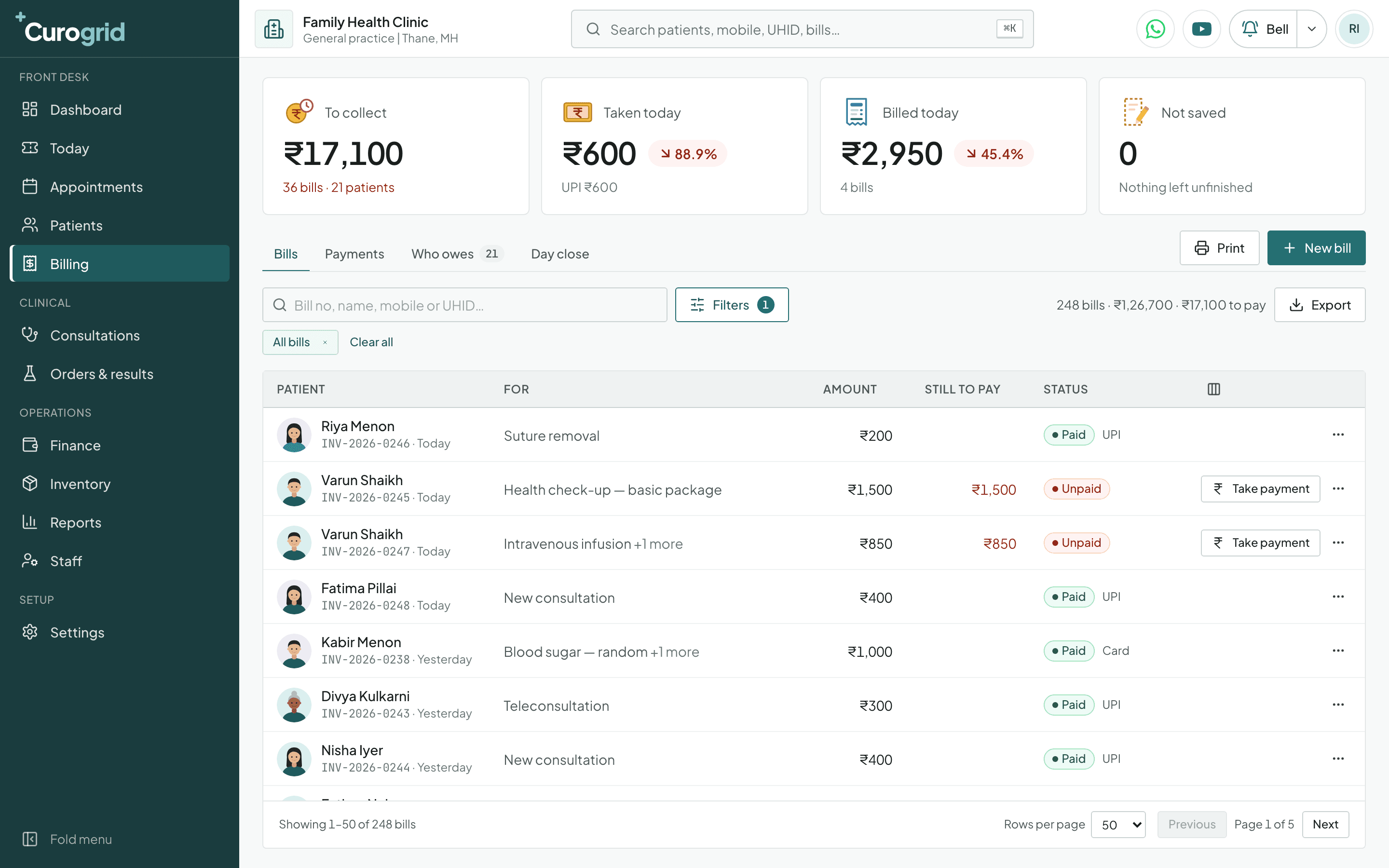
Billing by UPI, card and cash
A day in a family doctor's clinic, step by step
1. At the desk
A token for every walk-in. The receptionist registers a new patient in seconds, or finds an old one by name, mobile or ID, and gives a token. An emergency, a patient over 60, a pregnant woman, a patient with a disability or a baby under 2 goes ahead.
2. Before the doctor
Vitals by the sister. Blood pressure, pulse, temperature, SpO2 and weight go on the visit before the patient goes in.
3. In the doctor's room
Call next, then the check-up. Call the next token from the computer or the phone. The file opens on the last five blood pressure readings; the check-up is a few taps.
4. Writing the prescription
Names as you type, allergies checked. The everyday names are offered as you type, or a saved template goes on in a tap. A red warning shows if the patient is allergic to what you write.
5. Before the patient leaves
Printed or on WhatsApp. The prescription is printed on your letterhead with your registration number, or sent to the patient on WhatsApp. Tests and scans are ordered when the visit is finished.
6. At the counter
Paid by UPI, cash or card. The consultation and any injection or dressing are on one bill. Medicines given from the clinic's shelf come off the stock count and go on the same bill.
7. At night
The day's takings. The dashboard shows what was collected by UPI, cash and card, how many patients were seen, and what is still owed.
From ₹420 a month, for the whole clinic
Not per doctor. Everything on this page is included. Start with 5 days of Pro, free.
Questions from general physicians
Yes. Allergies are typed once and kept on the patient, shown in red on every visit. If a medicine you write matches one, such as amoxicillin for a patient allergic to penicillin, a red warning appears on the prescription. It is a reminder to check, not a block: the decision is yours.
Yes. “Keep these” saves today's medicines under a name, and “Templates” puts a saved one on the visit in a tap. You can still change any line before you finish.
Yes. The Plus plan at ₹420 a month is made for a solo or small clinic. It includes 6 staff logins, so the doctor, the compounder and the receptionist each sign in as themselves.
Yes. The Today screen is built around walk-ins. The desk gives a token, and the line shows who is next and how long each person has waited. Appointments and walk-ins sit in the same line.
Medicine names are offered as you type, tests and scans are one tap, and the last visit's medicines can be repeated with one button. You can also keep a set of medicines you write together under a name and put it on the next patient's visit.
Yes. Vitals are saved at each visit. The patient's file draws the last five blood pressure readings, and a Readings tab draws blood pressure, weight, pulse and SpO2 over every visit. Test results such as HbA1c are kept under Tests and scans.
It does that work. Each visit records vitals, complaint, examination, diagnosis, medicines, tests and advice. The diagnosis is searched by name or ICD-10 code from a list of 365 common OPD diagnoses, or written in your own words. Appointments, tokens and billing are in the same software.
Yes. Curogrid has a phone app for Android and iPhone. The doctor sees the line, presses Call next, writes the visit and opens a patient's file from the phone. It also runs in a web browser and as a Windows app.
It offers medicine names only. It never suggests a dose. After your clinic has written a medicine a few times, it offers that medicine back with the dose and directions your clinic wrote most often.
No. Teleconsultation is one of the 16 starter services, at a starter price of ₹300, so the visit can be recorded and billed. Curogrid has no built-in video call.
Yes. Upload the Excel or CSV file from your old software. You check every row before anything is saved, and the import can be undone.
Yes. The 16 starter services and their prices are only a starting point. You rename them, delete the ones you do not offer and set your own fees.
Curogrid Plus is ₹420 a month and Pro is ₹999 a month, or ₹4,032 and ₹9,590 for a year. GST of 18% is added. The price is for the whole clinic, not for each doctor, and the General practice setup is included in both plans. Every clinic starts with 5 days of Pro, free.
Yes. Curogrid sends the patient a reminder before the appointment by WhatsApp and email, and can send the prescription, the bill and the receipt the same way. On Plus the WhatsApp messages go from the Curogrid number. On Pro they go from your clinic's own number.
Not yet. A patient's 14-digit ABHA number can be recorded on their file, where it is marked as not checked with ABDM. Curogrid does not yet verify an ABHA number, create one or share records through ABDM.
No. Curogrid needs an internet connection. The phone app tells you when it is offline and saves nothing until the connection is back, and on a computer a visit you are typing is kept on that computer until it can be saved. The screens are in English only.
Good to know
Registrations and rules for a general practice clinic in India, what Curogrid does not do, and the lists it offers. The rules are a plain summary, not legal advice, checked on .
Only a doctor on a State Medical Register or the Indian Medical Register may practise medicine, and the registration number belongs on every prescription, certificate and receipt you sign. The NMC's 2023 conduct regulations were put on hold in August 2023, so the 2002 code of ethics still applies. In Curogrid: Each doctor's qualifications, registration number and council are kept on their staff profile and print under their name on every prescription.
In the states and union territories that have adopted the Act, a clinic cannot run without registering with the district registering authority, and national minimum standards are set for each kind of clinic. Other states have their own registration law. Your district health office will say which applies. In Curogrid: Curogrid does not register your clinic. Your clinic's name, address and contact numbers print on every bill and paper it makes.
Only a registered doctor may consult remotely, under the same standards as in person. Your name, qualification and registration number go on the prescription, and some medicines, such as those under the narcotics law, may not be prescribed remotely at all. In Curogrid: “Teleconsultation” is a starter service, so the remote visit is recorded and billed, and the prescription prints with your registration number. The call itself happens outside Curogrid.
An injury from a road accident, an assault, a burn or a poisoning is a medico-legal case. Treat first and never turn the patient away, then inform the local police and keep a careful record of what you saw and did. In Curogrid: Curogrid does not tell the police or keep an MLC register. Each visit records the time, the findings and what was done, and photos and reports can be added to the patient's file.
A clinic that gives medicines to its own patients follows the drug rules. For Schedule H1 drugs, such as certain newer antibiotics and habit-forming medicines, each supply is written in a separate register with the prescriber, the patient, the medicine and the quantity, and the register is kept for three years. In Curogrid: When the medicine counter gives a medicine, it comes off the shelf count and goes on the patient's bill, so you can see who got what and when. Curogrid does not print a Schedule H1 register.
Explain what you will do, why, and its risks before you start, and keep the patient's agreement. For a child, a parent or guardian agrees. In Curogrid: The setup adds three consent forms: “Examination and treatment plan”, “Procedure or operation” and “Local anaesthetic”. The patient, a parent or guardian, or a relative signs with a finger on the screen, and the form is kept in the patient's file.
Needles from injections, IV sets, dressings and suture material are bio-medical waste. Separate waste where it is made, put sharps in a puncture-proof white translucent container, hand it to your area's common bio-medical waste facility, and train the staff who handle it. In Curogrid: Curogrid does not manage waste. Each injection, infusion and dressing is a service on the bill, so what was done and when is on record.
A patient's record is personal data, and the clinic is responsible for it. Tell patients what you keep and why, keep it safe, use it for their care, and let a patient see or correct what you hold. The Rules were notified in November 2025 and most of their duties for clinics apply from May 2027. In Curogrid: Every member of the team has their own sign-in and role, so the records show who did what, and nobody shares a password.
Health care by a clinical establishment or an authorised medical practitioner is exempt from GST: the diagnosis, treatment or care of an illness, injury or pregnancy. Anything sold or done outside that, such as a cosmetic product, may be taxed. Ask your chartered accountant what applies to your clinic. In Curogrid: A GST rate is set on a service only if you give it one, so taxable and exempt services can sit on the same bill. The clinic's GSTIN is needed only if you are registered.
Curogrid offers medicine names and a diagnosis list to search. The dose, the diagnosis and the decision are the doctor's.
Teleconsultation is a starter service you can bill at your own fee. The call itself happens on your phone, outside Curogrid.
A result is typed against the order, and the report is added to the patient's file as a photo or a PDF.
Medical fitness certificate is a service on the price list, so it can be billed. The certificate itself is written on your own letterhead.
Beds, admissions and the discharge summary are not built. Curogrid is for the clinic and the OPD.
Paracetamol 500 mg tablet, Paracetamol 650 mg tablet, Paracetamol 250 mg/5 ml syrup, Ibuprofen 400 mg tablet, Amoxicillin 500 mg capsule, Amoxicillin + Clavulanate 625 mg tablet, Azithromycin 500 mg tablet, Azithromycin 200 mg/5 ml syrup, Cefixime 200 mg tablet, Cetirizine 10 mg tablet, Levocetirizine 5 mg tablet, Pantoprazole 40 mg tablet, Omeprazole 20 mg capsule, Ondansetron 4 mg tablet, Domperidone 10 mg tablet, ORS sachet, Zinc 20 mg tablet, Metformin 500 mg tablet, Amlodipine 5 mg tablet, Telmisartan 40 mg tablet, Atorvastatin 10 mg tablet, Salbutamol inhaler, Montelukast 10 mg tablet, Diclofenac gel, Vitamin D3 60,000 IU sachet, Iron + Folic acid tablet, Calcium + Vitamin D3 tablet, B-complex tablet, Chlorpheniramine syrup, Ambroxol syrup, Dextromethorphan syrup, Clotrimazole cream, Mupirocin ointment, Albendazole 400 mg tablet, Metronidazole 400 mg tablet, Ciprofloxacin eye drops, Normal saline nasal drops.
CBC (complete blood count), Blood sugar fasting, Blood sugar PP, Blood sugar random, HbA1c, Lipid profile, LFT (liver function), KFT (kidney function), Thyroid profile (T3, T4, TSH), TSH, Urine routine, Stool routine, CRP, ESR, Dengue NS1, Dengue IgM/IgG, Malaria antigen, Widal, Vitamin D, Vitamin B12, Serum creatinine, Hb (haemoglobin).
X-ray chest PA, USG abdomen, USG pelvis, X-ray knee, X-ray spine (LS), ECG, 2D Echo, CT brain, MRI spine.
Dressing, Nebulisation, Injection, Suture removal, Ear wash, ECG.
Essential (primary) hypertension, Type 2 diabetes mellitus without complications, Hypothyroidism, Acute upper respiratory infection, Fever, Dengue fever (classical dengue), Typhoid fever, Asthma, Gastritis, Gastro-oesophageal reflux disease without oesophagitis (GERD, acid reflux), Urinary tract infection, site not specified, Iron deficiency anaemia, Vitamin D deficiency, Hyperlipidaemia (high cholesterol), Low back pain, Migraine.
Try Curogrid in your clinic
5 days of Pro, free. Pick “General practice” in setup and the token line, the check-up, the allergy warning and your services are ready before your first patient.