
For ENT specialists and ear, nose and throat clinics
Curogrid ENT: software for ear, nose and throat clinics
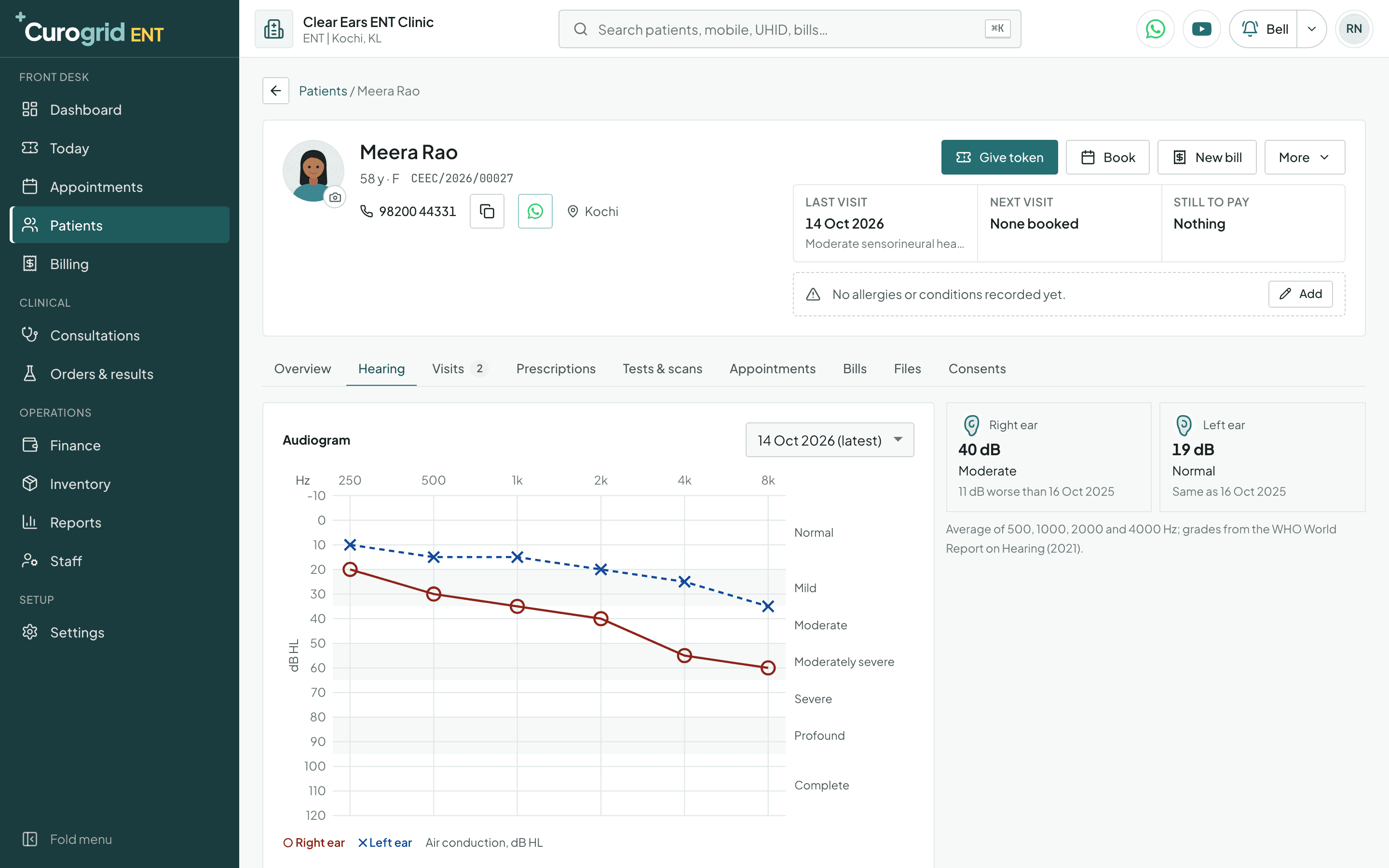
Enter the hearing test and see the audiogram, each ear graded and compared with the last test.
From ₹420 a month for the whole clinic. 5 days free.
Hearing
The audiogram, drawn from your own visit
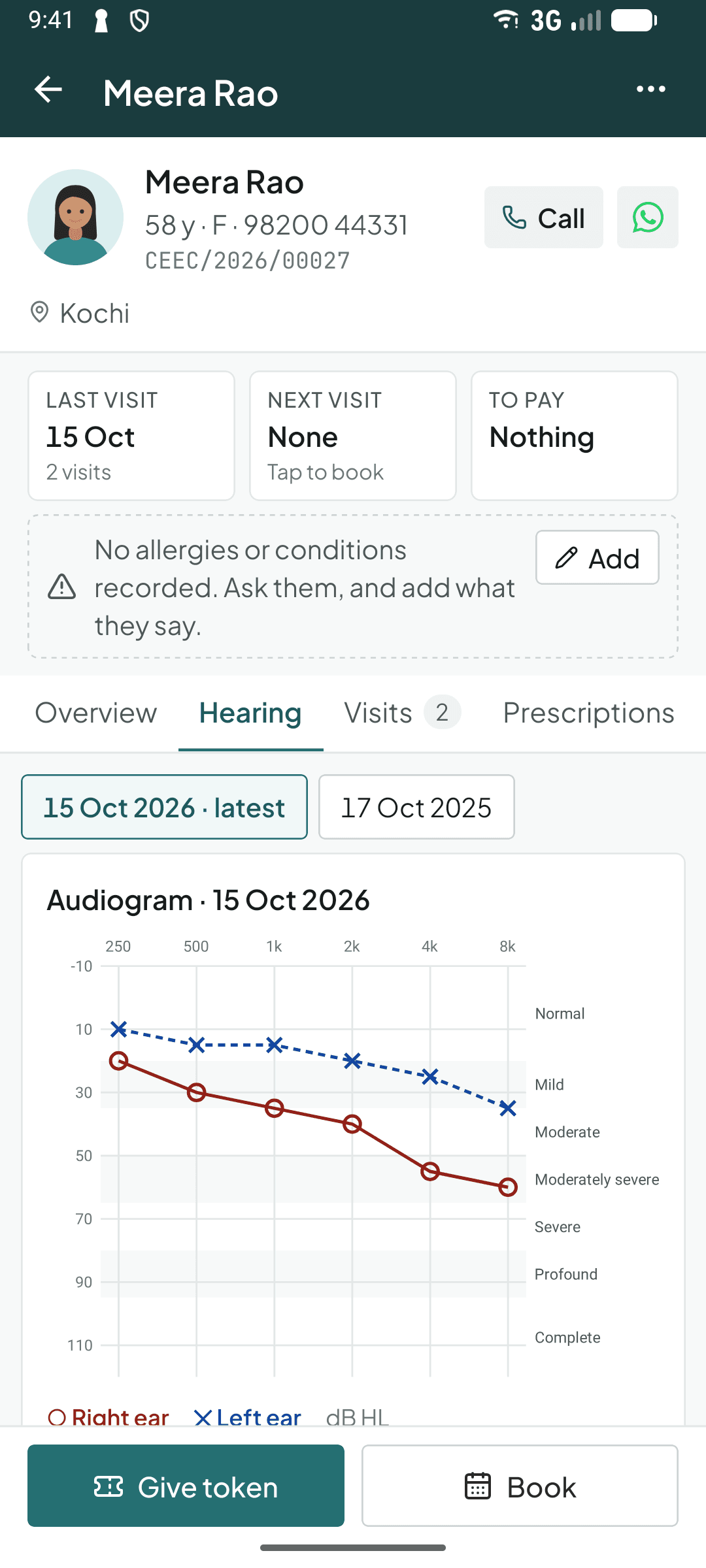
Type the thresholds from the audiometer into the visit, ear by ear, and Curogrid ENT draws the audiogram the way an audiologist draws it. Each ear is graded, and compared with the test before.
- The audiogram drawn the moment you enter the test
- Each ear graded, and compared with the last test
- A printed hearing test for the patient to keep
See everything it records
What the Hearing tab shows
- The audiogram
- Frequency across the top from 250 Hz to 8 kHz, louder further down, the right ear as red circles and the left as blue crosses.
- The grade bands
- Normal, mild, moderate, moderately severe, severe, profound and complete, behind the lines.
- Each ear's average
- Of 500, 1000, 2000 and 4000 Hz, with its WHO grade from the World Report on Hearing (2021).
- The change
- Since the test before it: “11 dB worse than 16 Oct 2025” or “Same as”.
- Every test
- Pick any earlier date from the list and its audiogram is drawn.
The hearing test, printed
Print the hearing test from the visit on your letterhead: each ear's thresholds and the tympanometry type, signed with your name, qualification and registration number.
The phone app shows the same Hearing tab.
On the doctor's screen
An ENT examination with both ears side by side
The first visit is the examination an ENT surgeon writes, with right and left in two columns. A review is three short parts.
- Both ears side by side, as you examine them
- Rinne, Weber and tonsil grade in a tap
- Drops prescribed for the right ear, every time
See everything it records
The first visit: Ear, nose and throat
- Problem
- Ear pain, discharge, hearing loss, ringing, giddiness, blocked nose, sneezing, nose bleed, sore throat, snoring, voice change.
- Ears
- Right and left side by side: the ear canal, the ear drum and Rinne.
- Weber
- Central, to the right or to the left.
- Nose
- Normal, DNS to right or left, turbinates enlarged, polyp, discharge.
- Tonsils
- Not seen, or grade 1 to 4.
- Neck
- “No nodes felt” or “Nodes felt”.
- Hearing test (dB)
- Air conduction for each ear at 250, 500, 1000, 2000, 4000 and 8000 Hz.
- Tympanometry
- The type for each ear.
Each review
- Since last time
- Better, same, worse, discharge stopped, hearing better, still blocked.
- Ears
- The ear drum, right and left.
- Notes
- Ready words such as “Keep ears dry” and “Steam inhalation advised”.
The whole clinic
Front desk, money and team, in one place
Tokens, appointments, bills, staff and the day's takings, on the computer and the phone.
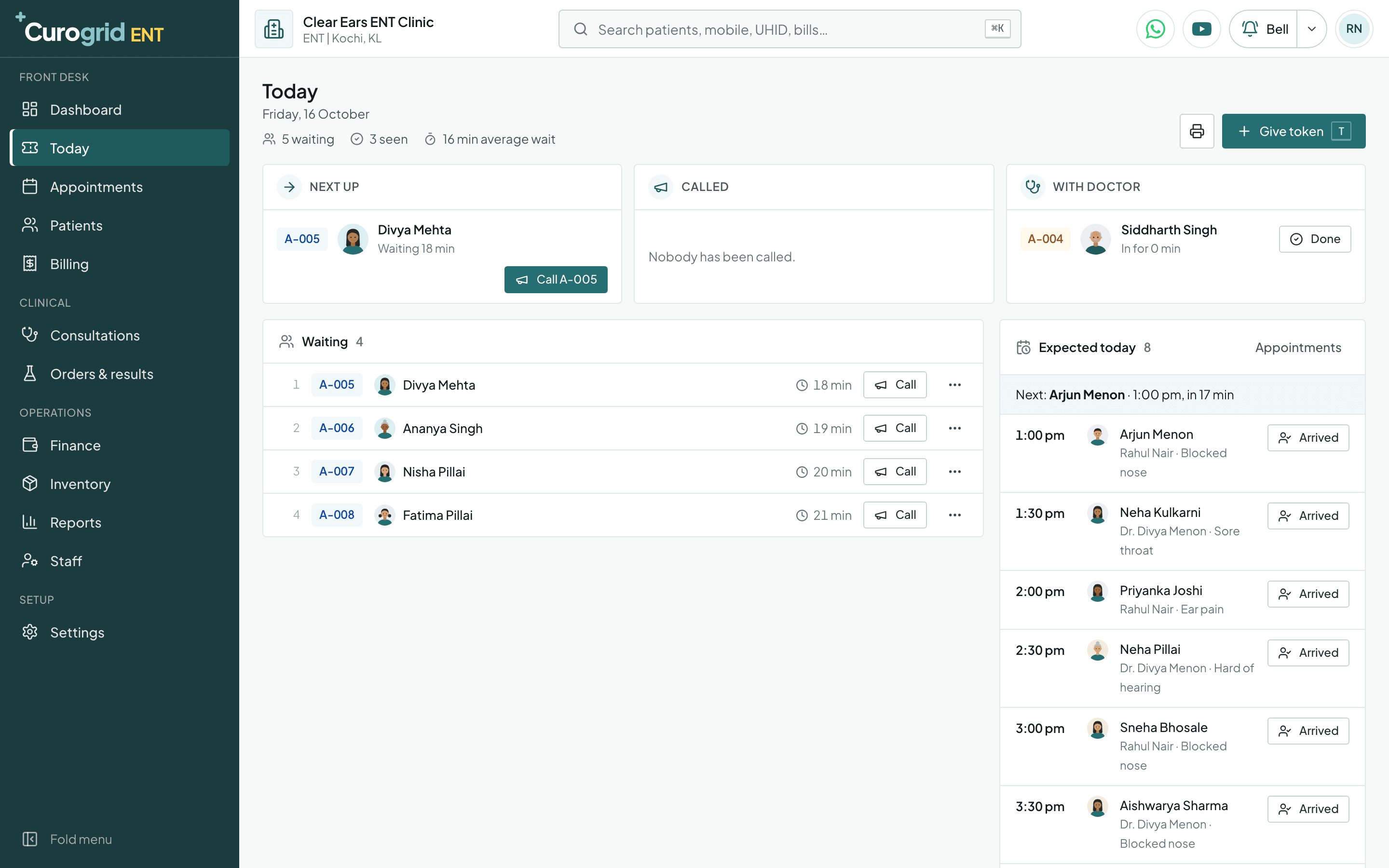
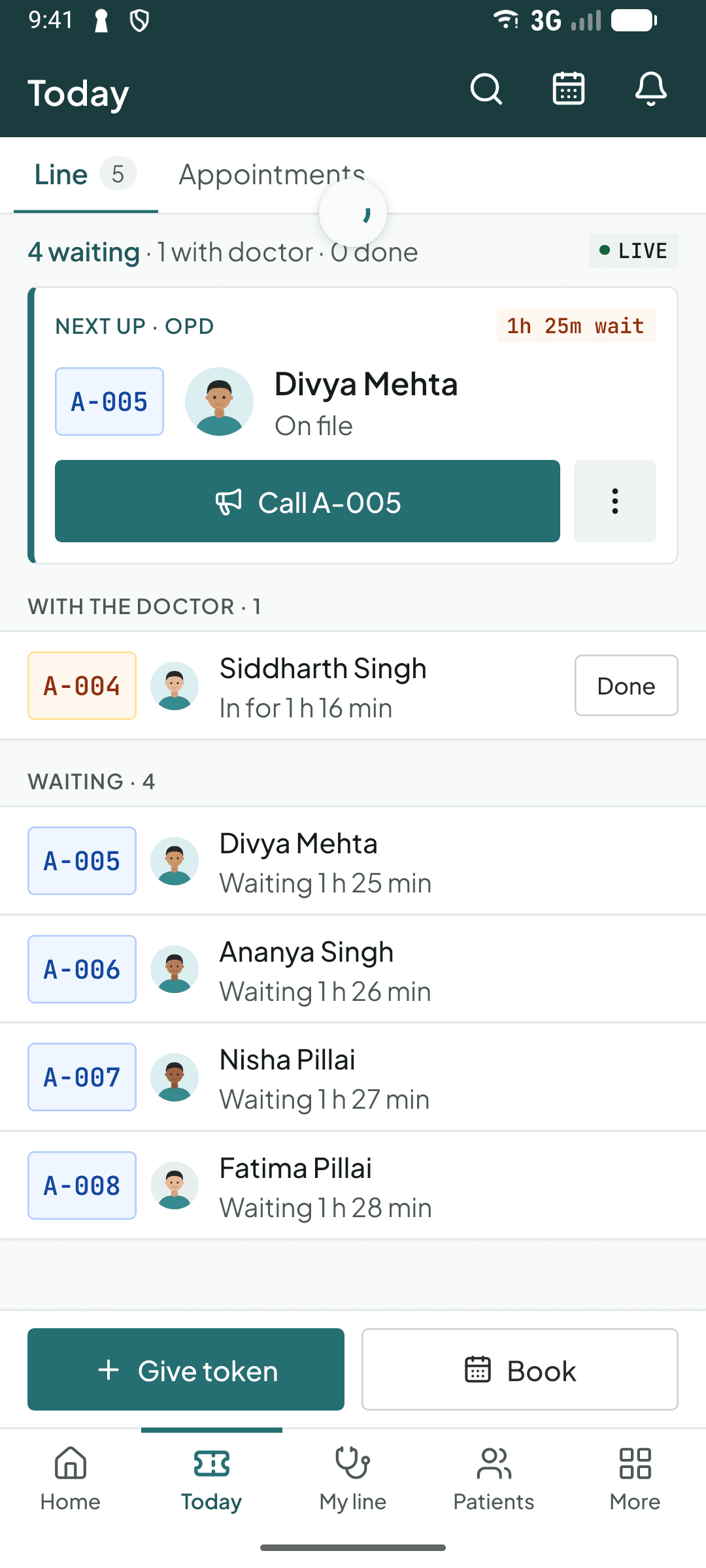
Today's line 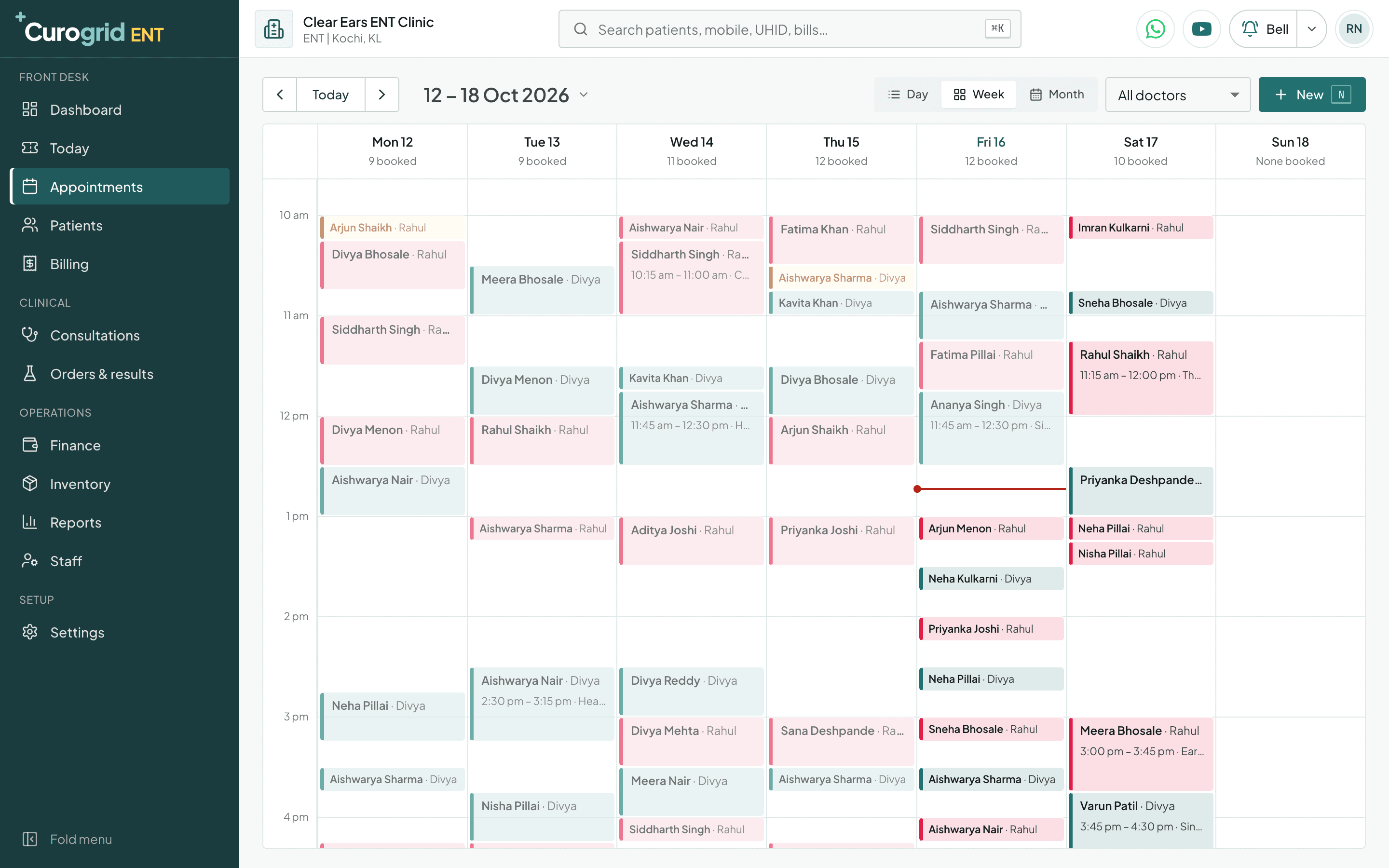
The appointment book 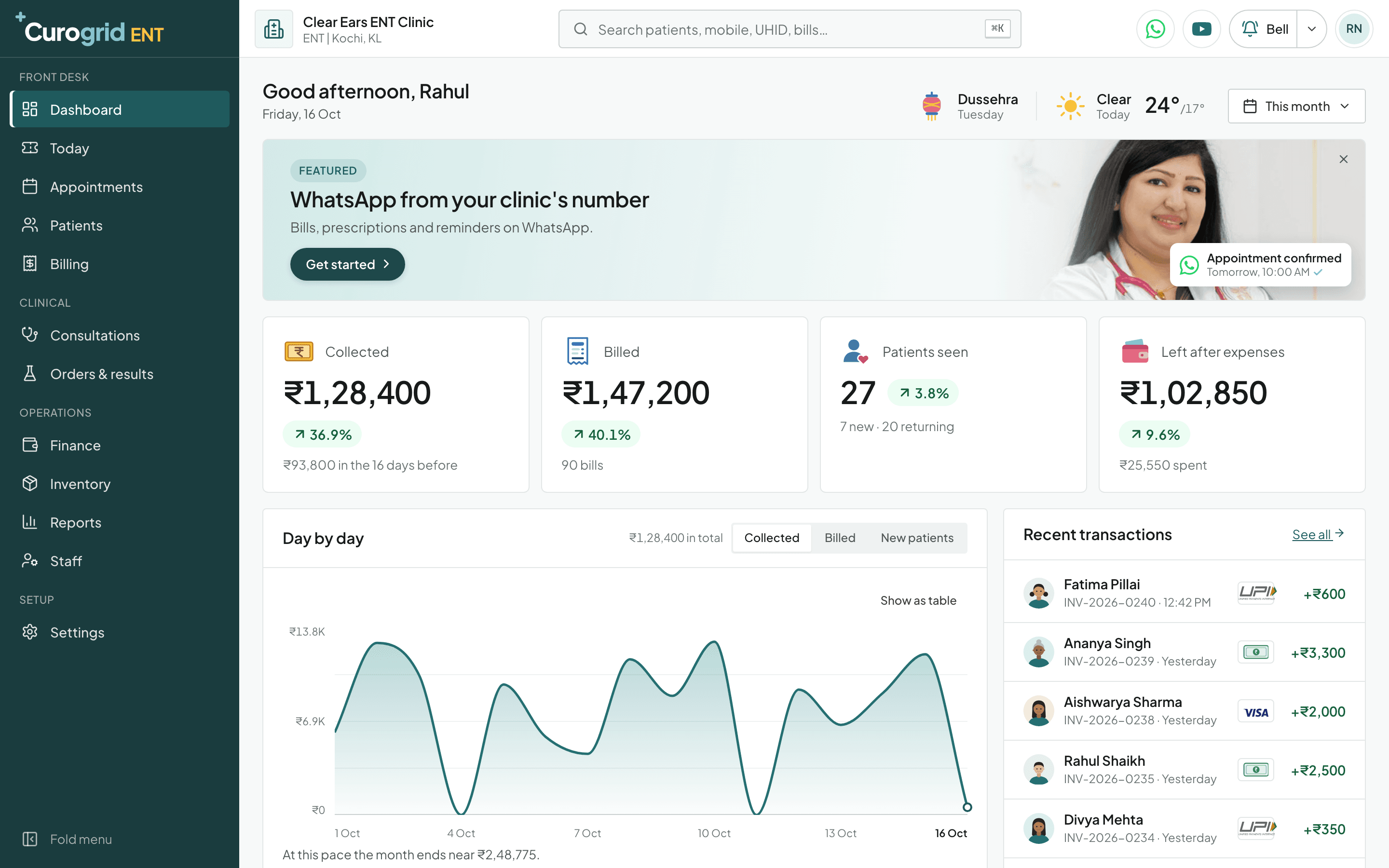
The owner's dashboard 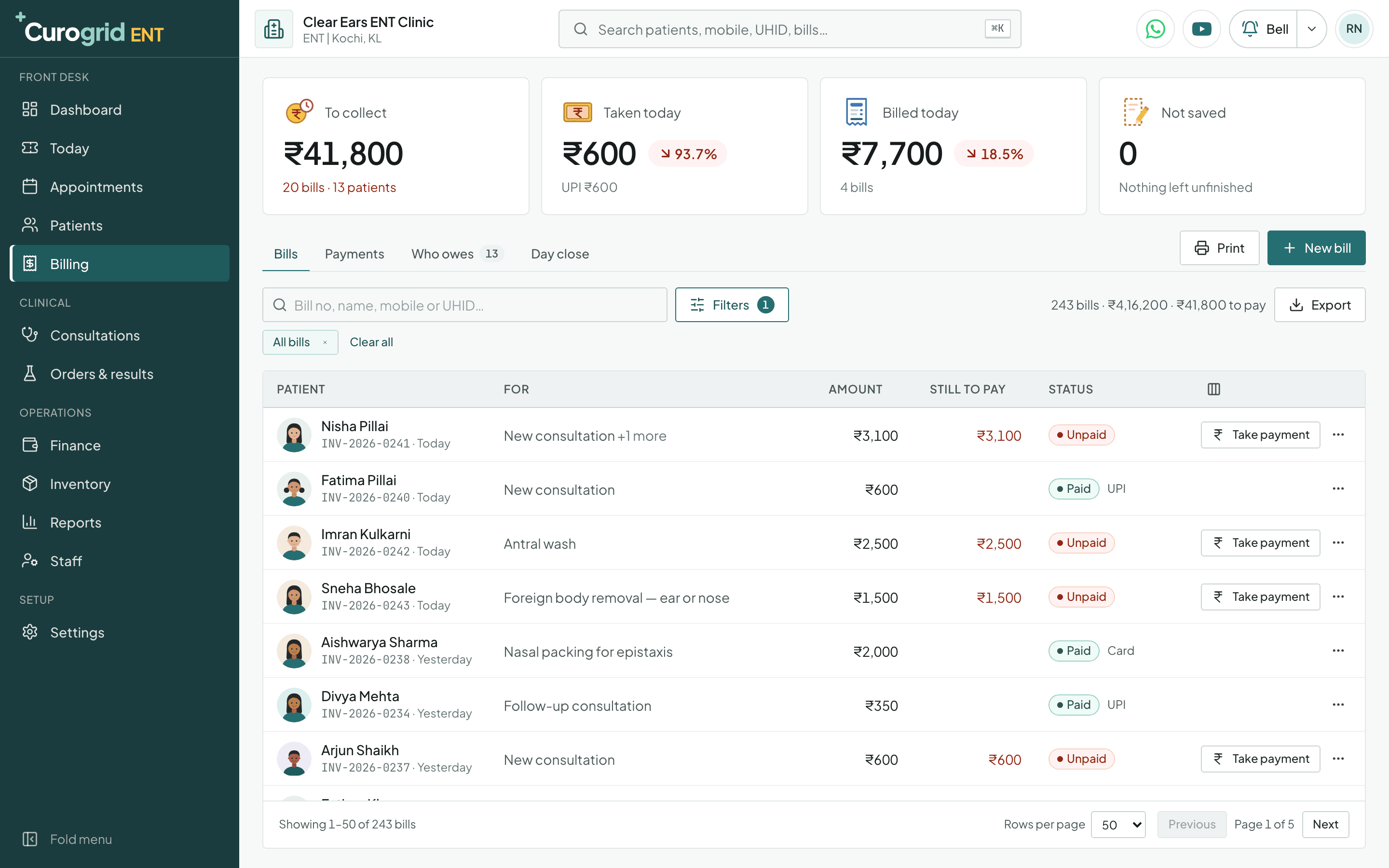
Billing by UPI, card and cash
An ENT patient's way through the clinic, step by step
1. Before the visit
The booking and the reminder. The desk books the visit, and the patient gets a reminder before it on WhatsApp and by email. Walk-ins get a token.
2. In the doctor's room
The ENT examination. Both ears side by side, Rinne and Weber, the nose, the tonsil grade and the neck. The diagnosis, such as CSOM, DNS or allergic rhinitis, is searched by name.
3. In Audiology
The hearing test. The audiologist runs pure tone audiometry and tympanometry and types the thresholds into the visit. The audiogram is drawn and each ear graded.
4. Back with the doctor
The result, and the change. The Hearing tab shows each ear's grade and how it moved since the last test. Explain it to the patient on the screen.
5. Writing the prescription
Drops with a side. Ear drops “In the right ear”, a spray “In each nostril”, a gargle. If the patient is allergic to a medicine you write, a red warning says so.
6. At the procedure chair
Consent, then the procedure. Before an ear wash or a nasal packing the patient reads “Procedure or operation” on the screen and signs with a finger. The procedure is one tap in a new order and is billed from the price list.
7. At the counter
The bill and the hearing test. The patient pays by UPI, cash or card and takes the printed hearing test.
On the phone
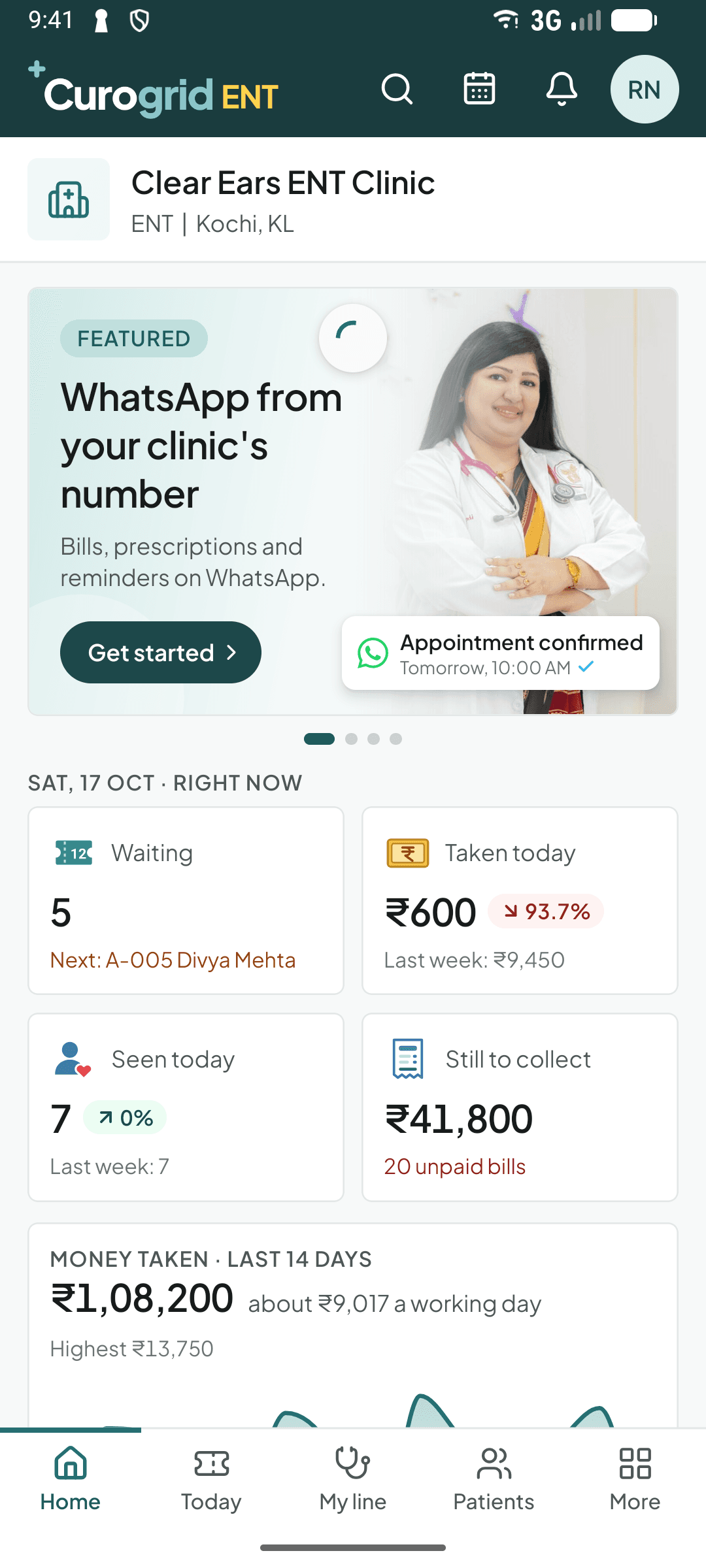
Your clinic in your pocket
The same Curogrid ENT on Android and iPhone, for the doctor, the front desk and the owner.
- See the line and call the next patient from anywhere
- Open a patient's file, write the visit, take the payment
- Today's appointments and takings, wherever you are
From ₹420 a month, for the whole clinic
Not per doctor. Everything on this page is included. Start with 5 days of Pro, free.
Questions from ENT specialists
Yes. Enter the air conduction thresholds for each ear on the visit, from 250 Hz to 8000 Hz. The patient's Hearing tab draws them as an audiogram, right ear as red circles and left ear as blue crosses, over the WHO grade bands from normal to complete. Any earlier test can be picked from the list.
Yes. Each ear gets its average of 500, 1000, 2000 and 4000 Hz and its grade from the WHO World Report on Hearing (2021), with the change since the test before it, such as “11 dB worse than 16 Oct 2025”.
Yes. The hearing test prints from the visit on your letterhead: the thresholds for each ear and the tympanometry type, with your name and registration number.
Each ear side by side (ear canal, ear drum, Rinne), Weber, the nose (DNS to either side, enlarged turbinates, polyp, discharge), tonsils graded 1 to 4, the neck nodes, and the hearing test and tympanometry for each ear. A review records progress and the ear drums.
Yes. ENT adds eight procedures that are one tap in a new order: ear wash, ear suction cleaning, nasal endoscopy, laryngoscopy, pure tone audiometry, tympanometry, foreign body removal and nasal packing.
No. Curogrid does not connect to the endoscope, capture pictures or video from it, or generate an endoscopy report. Nasal endoscopy and laryngoscopy are ordered and billed in Curogrid, and the findings are written in the visit.
Yes. Audiology is set up as its own department, and each person has their own login. The Plus plan includes 6 staff logins and Pro includes 12.
Five scans: X-ray PNS, X-ray neck lateral, CT PNS, CT temporal bone and USG neck. Four tests: throat swab culture, ear swab culture, absolute eosinophil count and serum IgE. Each is one tap on the visit, and any other test can be typed.
No. Curogrid is for the clinic and the OPD. Admitting a patient, beds and the discharge summary are not built. A procedure done in the clinic is ordered, consented and billed.
Yes, for Android and iPhone. The doctor sees the line, writes the visit and opens a patient's Hearing tab on the phone, with the same ear and nose directions on the prescription. It also runs in a web browser and as a Windows app.
Curogrid Plus is ₹420 a month and Pro is ₹999 a month, or ₹4,032 and ₹9,590 for a year. GST of 18% is added. The price is for the whole clinic, not for each doctor, and the ENT setup is included in both plans. Every clinic starts with 5 days of Pro, free.
Yes. Curogrid sends the patient a reminder before the appointment by WhatsApp and email, and can send the prescription, the bill and the receipt the same way. On Plus the WhatsApp messages go from the Curogrid number. On Pro they go from your clinic's own number.
Not yet. A patient's 14-digit ABHA number can be recorded on their file, where it is marked as not checked with ABDM. Curogrid does not yet verify an ABHA number, create one or share records through ABDM.
No. Curogrid needs an internet connection. The phone app tells you when it is offline and saves nothing until the connection is back, and on a computer a visit you are typing is kept on that computer until it can be saved. The screens are in English only.
Good to know
Registrations and rules for an ENT clinic in India, what Curogrid does not do, and the lists it offers. The rules are a plain summary, not legal advice, checked on .
Only a doctor on a State Medical Register or the Indian Medical Register may practise medicine, and the registration number belongs on every prescription, certificate and receipt you sign. The NMC's 2023 conduct regulations were put on hold in August 2023, so the 2002 code of ethics still applies. In Curogrid: Each doctor's qualifications, registration number and council are kept on their staff profile and print under their name on every prescription.
In the states and union territories that have adopted the Act, a clinic cannot run without registering with the district registering authority, and national minimum standards are set for each kind of clinic. Other states have their own registration law. Your district health office will say which applies. In Curogrid: Curogrid does not register your clinic. Your clinic's name, address and contact numbers print on every bill and paper it makes.
Audiologists and speech therapists must be on the Central Rehabilitation Register to practise and to charge for it. Check each one's CRR number when you hire them. In Curogrid: Each person on your team has their own sign-in and role, and Audiology is a department of its own.
A disability certificate for hearing loss is issued by the medical authority your state notifies, through the UDID portal, not by a private clinic. Your audiogram can go with the patient to the board. In Curogrid: Curogrid does not issue disability certificates. The hearing test prints with each ear's thresholds, for the patient to take.
A clinic that gives medicines to its own patients follows the drug rules. For Schedule H1 drugs, such as certain newer antibiotics and habit-forming medicines, each supply is written in a separate register with the prescriber, the patient, the medicine and the quantity, and the register is kept for three years. In Curogrid: When the medicine counter gives a medicine, it comes off the shelf count and goes on the patient's bill, so you can see who got what and when. Curogrid does not print a Schedule H1 register.
Explain what you will do, why, and its risks before you start, and keep the patient's agreement. For a child, a parent or guardian agrees. In Curogrid: The setup adds three consent forms: “Examination and treatment plan”, “Procedure or operation” and “Local anaesthetic”. The patient, a parent or guardian, or a relative signs with a finger on the screen, and the form is kept in the patient's file.
Used suction tips, swabs, nasal packs and needles are bio-medical waste. Separate waste where it is made, put sharps in a puncture-proof white translucent container, hand it to your area's common bio-medical waste facility, and train the staff who handle it. In Curogrid: Curogrid does not manage waste. Each procedure is ordered and billed, so what was done and when is on record.
A patient's record is personal data, and the clinic is responsible for it. Tell patients what you keep and why, keep it safe, use it for their care, and let a patient see or correct what you hold. The Rules were notified in November 2025 and most of their duties for clinics apply from May 2027. In Curogrid: Every member of the team has their own sign-in and role, so the records show who did what, and nobody shares a password.
Health care by a clinical establishment or an authorised medical practitioner is exempt from GST: the diagnosis, treatment or care of an illness, injury or pregnancy. Anything sold or done outside that, such as a cosmetic product, may be taxed. Ask your chartered accountant what applies to your clinic. In Curogrid: A GST rate is set on a service only if you give it one, so taxable and exempt services can sit on the same bill. The clinic's GSTIN is needed only if you are registered.
The thresholds are typed in from the audiometer, ear by ear. Curogrid does not read them from the machine. The hearing test is drawn from what you enter.
The hearing grid is air conduction, 250 to 8000 Hz. Bone conduction, masking and speech audiometry are written in the notes, or the audiometer's own report is added to the file.
Curogrid does not capture pictures or video from a scope. You add the saved pictures to the patient's Files. Videos are not accepted: files are photographs and PDFs only.
Admission, beds and the discharge summary are not built. Curogrid is for the clinic, the procedure chair and the OPD.
Amoxicillin + Clavulanate 625 mg tablet, Cefuroxime 500 mg tablet, Levocetirizine + Montelukast tablet, Fexofenadine 120 mg tablet, Fluticasone nasal spray, Mometasone nasal spray, Xylometazoline 0.1% nasal drops, Saline nasal spray, Ciprofloxacin ear drops, Ofloxacin ear drops, Clotrimazole ear drops, Wax-softening ear drops, Betahistine 16 mg tablet, Cinnarizine 25 mg tablet, Chlorhexidine mouthwash, Povidone-iodine gargle, Benzydamine mouthwash, Pantoprazole + Domperidone capsule, Prednisolone 10 mg tablet, Steam inhalation capsule.
Throat swab culture, Ear swab culture, Absolute eosinophil count, Serum IgE.
X-ray PNS (sinuses), X-ray neck lateral, CT PNS, CT temporal bone, USG neck.
Ear wash (syringing), Ear suction cleaning, Nasal endoscopy, Laryngoscopy, Pure tone audiometry, Tympanometry, Foreign body removal, Nasal packing.
Other chronic suppurative otitis media (CSOM), Chronic mucoid otitis media (glue ear), Otitis externa, Impacted cerumen, Perforation of tympanic membrane, Sensorineural hearing loss, bilateral (nerve deafness), Tinnitus (ringing in the ear), Benign paroxysmal vertigo, Ménière disease, Allergic rhinitis, Chronic sinusitis, Deviated nasal septum (DNS), Nasal polyp, Epistaxis (nose bleed), Acute tonsillitis, Chronic tonsillitis, Hypertrophy of adenoids, Nodules of vocal cords, Dysphonia (hoarse voice), Foreign body in ear.
Try Curogrid ENT in your clinic
5 days of Pro, free. Pick “ENT” in setup and the hearing test, the audiogram, the ENT examination and your services are ready before your first patient.