
For dermatologists, skin, hair and aesthetic clinics
Curogrid Derma: software for skin and hair clinics
Show patients their progress with before and after photos, and keep every session's settings.
From ₹420 a month for the whole clinic. 5 days free.
Before and after
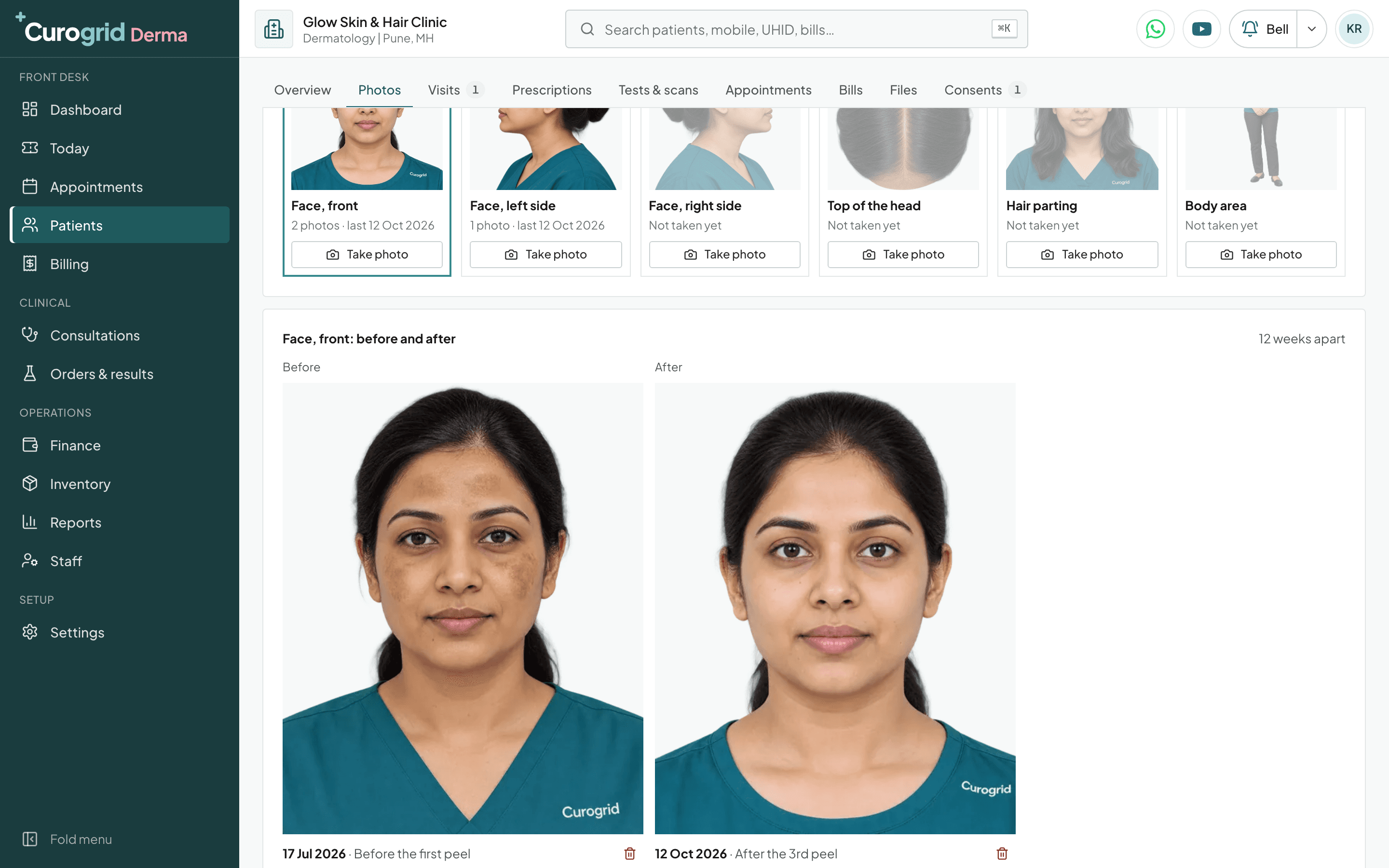
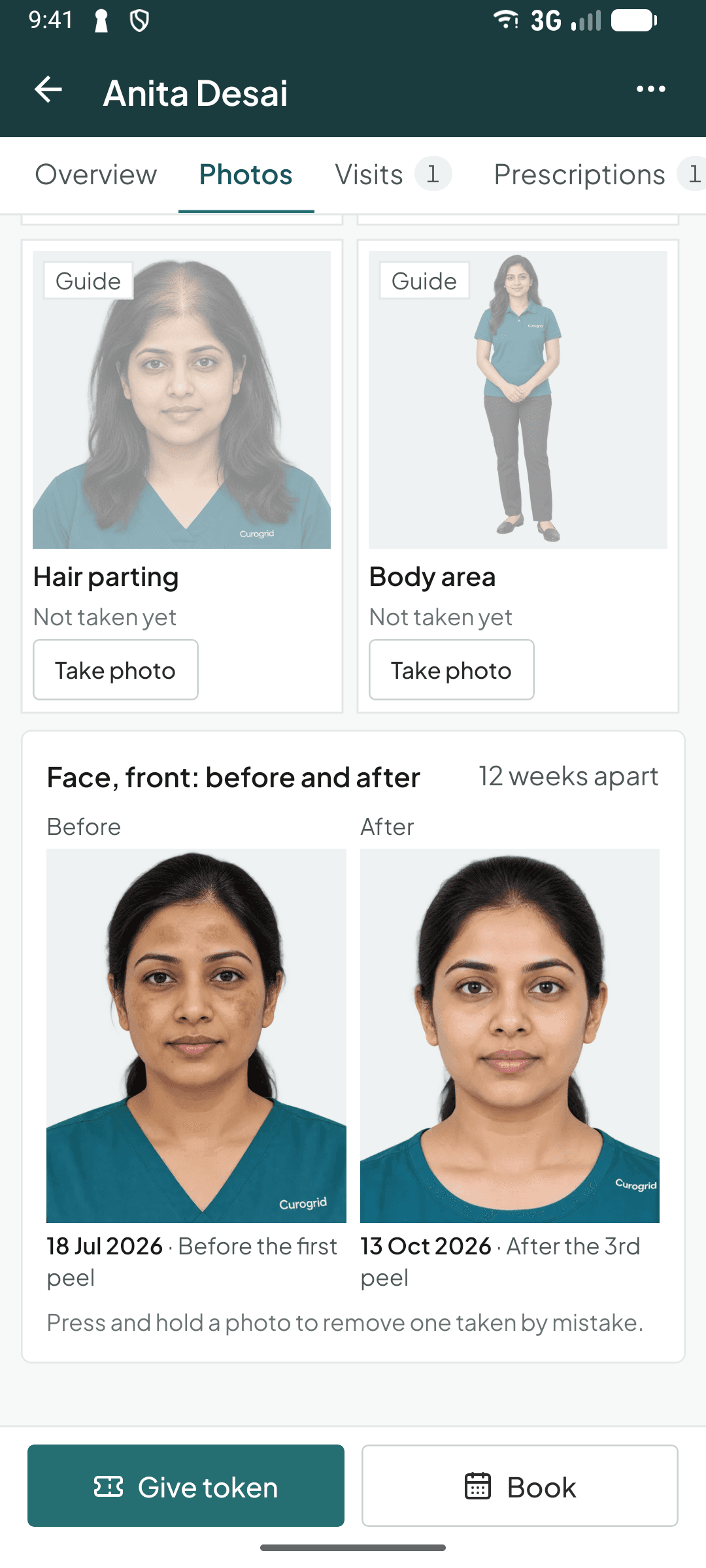
Progress you can see, at the same angle every time
A skin patient forgets how she looked three months ago; the photo does not. Curogrid Derma keeps each patient's photos under six standard angles, shows a guide so each one is taken the same way, and puts any two dates side by side.
- Show patients their own progress, side by side
- Every photo taken the same way, at the same angle
- Nothing is photographed without signed consent
See everything it records
The six angles, each with its guide
- Face, front
- Straight on, eyes level, hair back, even light.
- Face, left side
- The left cheek to the camera, nose pointing away.
- Face, right side
- The right cheek to the camera.
- Top of the head
- From above, the crown in the middle.
- Hair parting
- A centre parting, from above.
- Body area
- The affected area, with a little normal skin around it.
Consent comes first
Nothing can be photographed until the patient has signed the Clinical photographs consent, on the screen, with a finger. The photos are served only to your signed-in staff.
Before a photo is kept it is shown beside its guide, with the date and a short note such as “After the 3rd peel”. On a tablet or the phone app the camera opens; on a computer you pick the file.
Hair
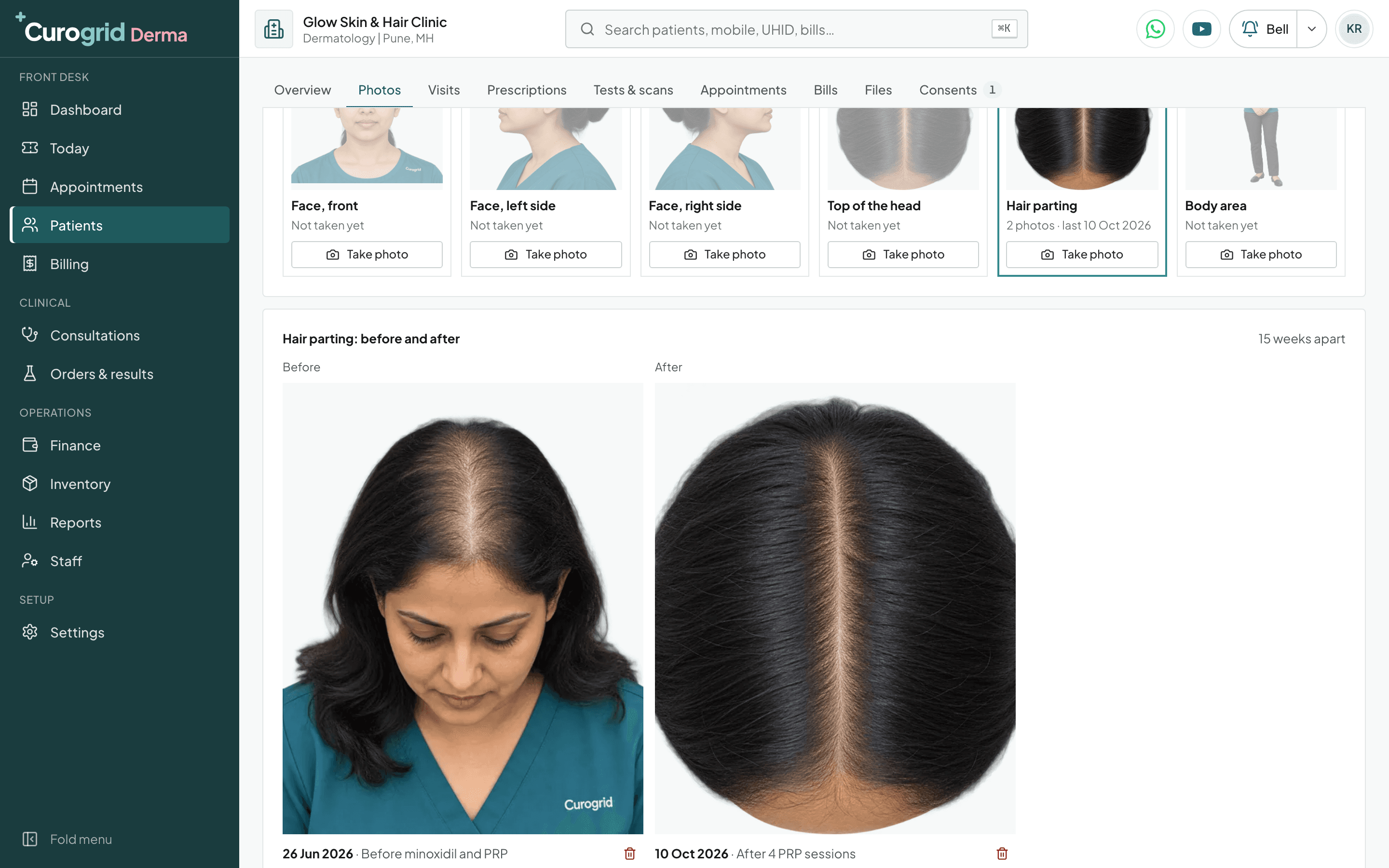
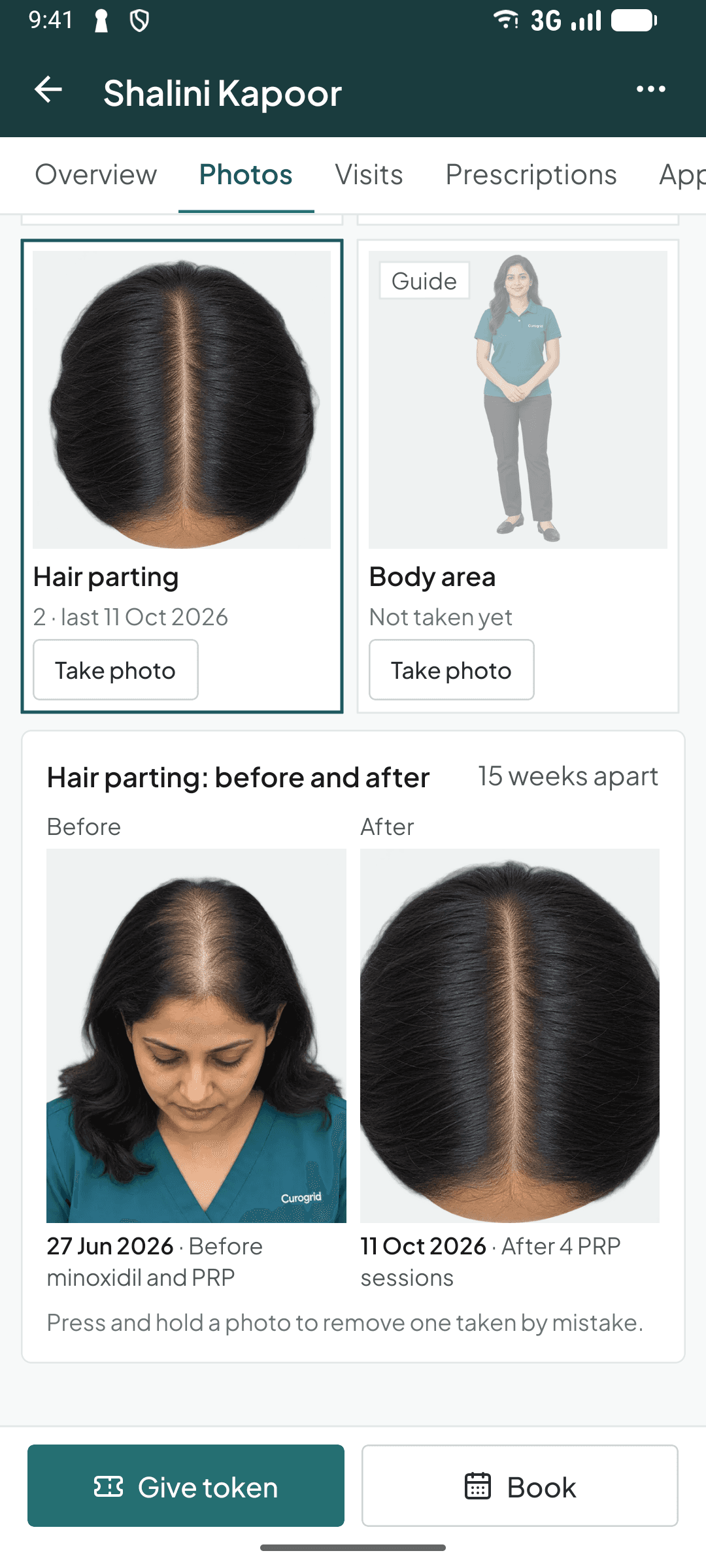
A hair clinic's proof, in two photos
Hair fall is slow to change and slow to show. The top of the head and the hair parting are standard angles of their own, so a patient on minoxidil and PRP can see the parting fill in, dated, side by side.
- Prove PRP and minoxidil are working, in two photos
- Norwood and Ludwig stages recorded in one tap
- Patients who see results stay for the full course
See everything it records
For a hair patient
- Hair loss stage
- Norwood 1 to 7 for men, Ludwig I to III for women.
- Dermoscopy
- Ready words such as “Yellow dots” and “Exclamation-mark hairs”.
- Tried before
- Hair oils or shampoos, steroid creams, home remedies, or nothing yet.
- Ready to order
- Serum ferritin, a hormone profile, a PRP session; minoxidil, finasteride and biotin in the medicines.
On the doctor's screen
A skin visit, and a short form for every session
The first visit is an assessment in a dermatologist's words, most of it a tap. A laser, peel or PRP session, or a review, uses the short form.
- Acne grade, skin type and hair loss stage in taps
- Every peel and laser setting kept for the next session
- Sessions booked as a course, so patients come back
See everything it records
The first visit: Skin and hair
- Concern
- Acne, pigmentation, hair fall, itching or rash, fungal infection, psoriasis, eczema, warts, vitiligo, nails, cosmetic.
- Where
- Face, scalp, neck, chest, back, arms, hands, legs, feet, groin, nails, whole body.
- What it looks like
- Macule, patch, papule, plaque, nodule, pustule, vesicle, scale, crust, erosion, scar, darker or lighter skin.
- Itch
- 0, none, to 10, the worst.
- Skin type
- Fitzpatrick I to VI.
- Acne grade
- I comedones, II papules, III pustules, IV nodules and cysts.
- Tried before
- Steroid creams, antifungals, home remedies, isotretinoin, hair oils or shampoos, nothing yet.
- Findings
- Dermoscopy and other findings, with ready words such as “Collarette of scale”.
Each session: Procedure or review
- Done today
- Chemical peel, laser, PRP, microneedling, electrocautery, cryotherapy, intralesional injection, or review only.
- Settings
- One line per area: the area, the setting, and the passes or minutes.
- Since last time
- Better, same, worse, redness, peeling, darkening, fewer spots, less hair fall.
- Itch
- The same 0 to 10 scale.
- Notes
- Ready words such as “Sunscreen advised” and “Next session in 4 weeks”.
The whole clinic
Front desk, money and team, in one place
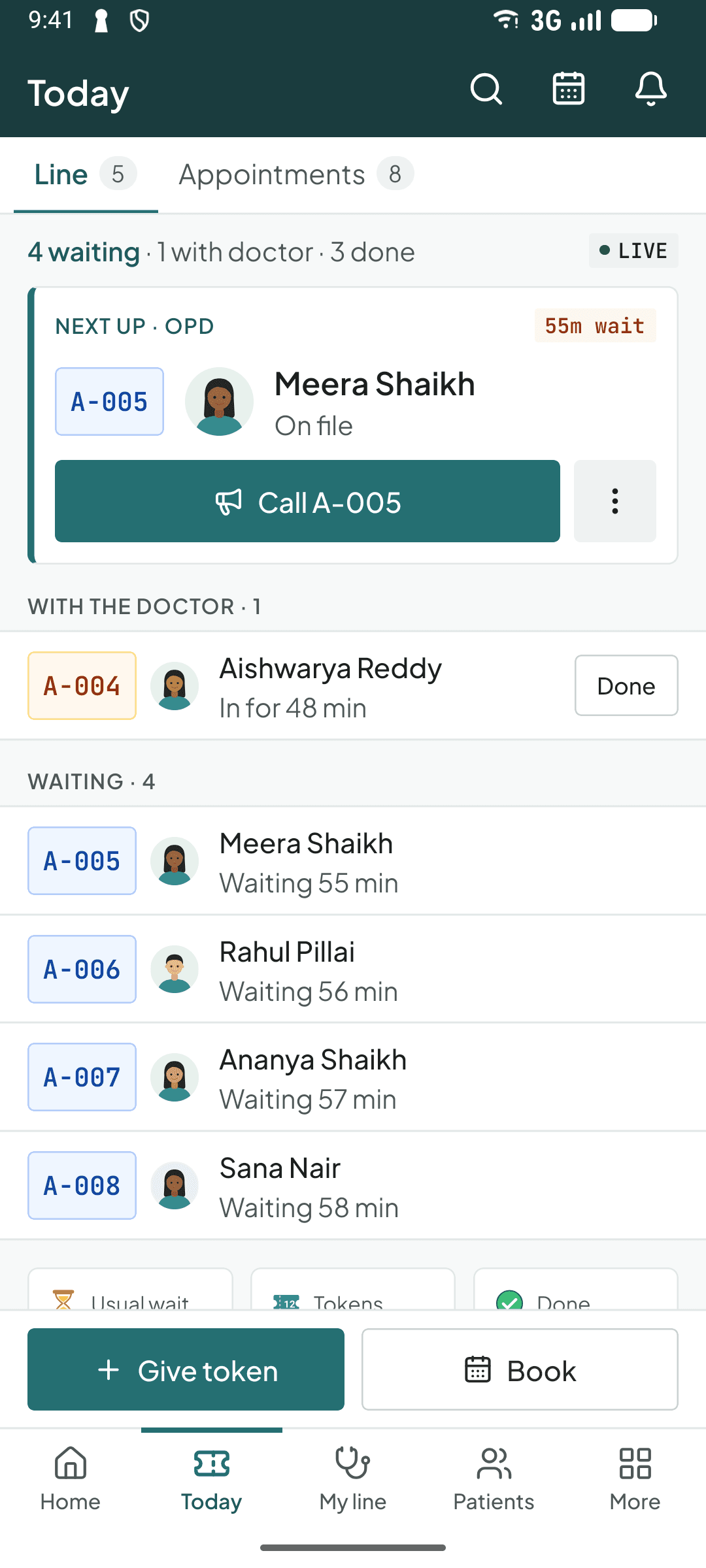
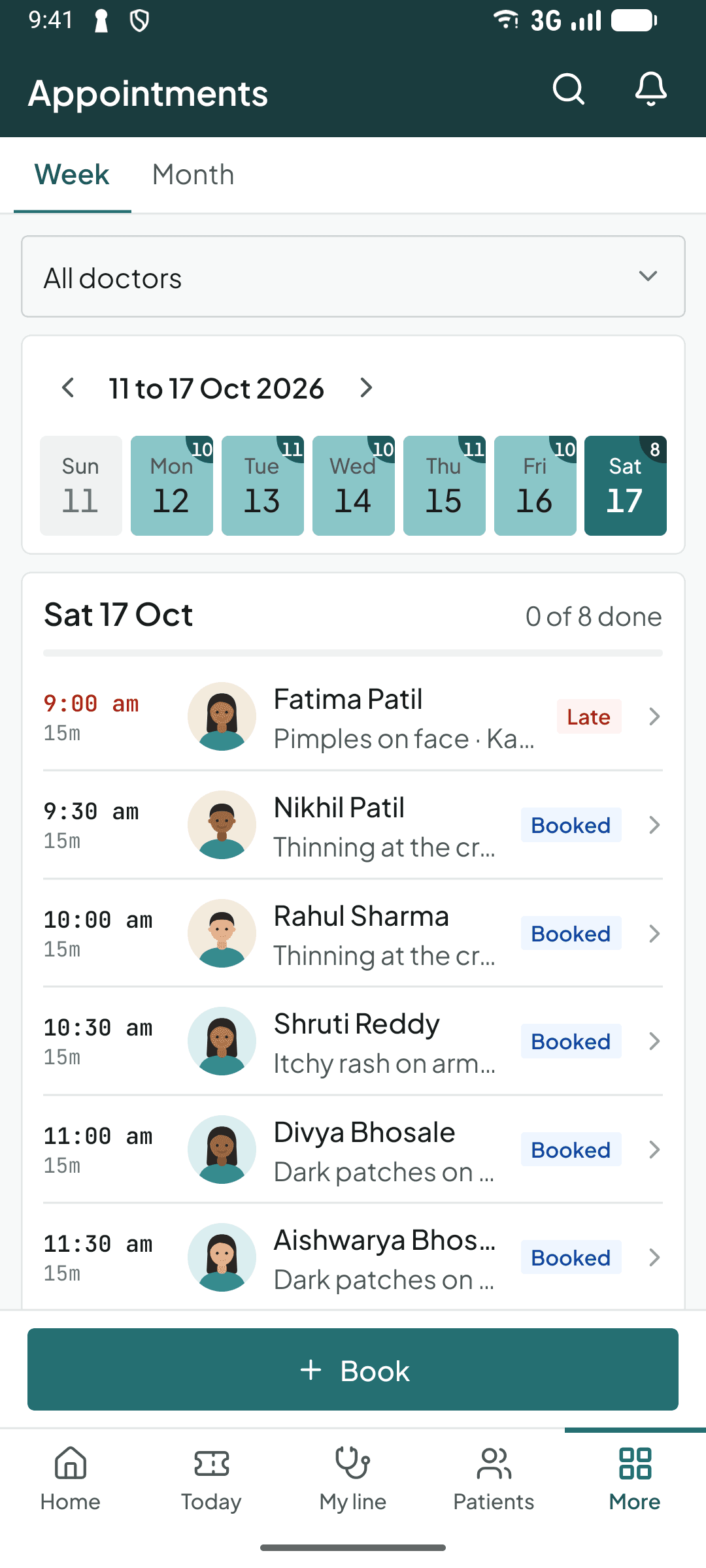
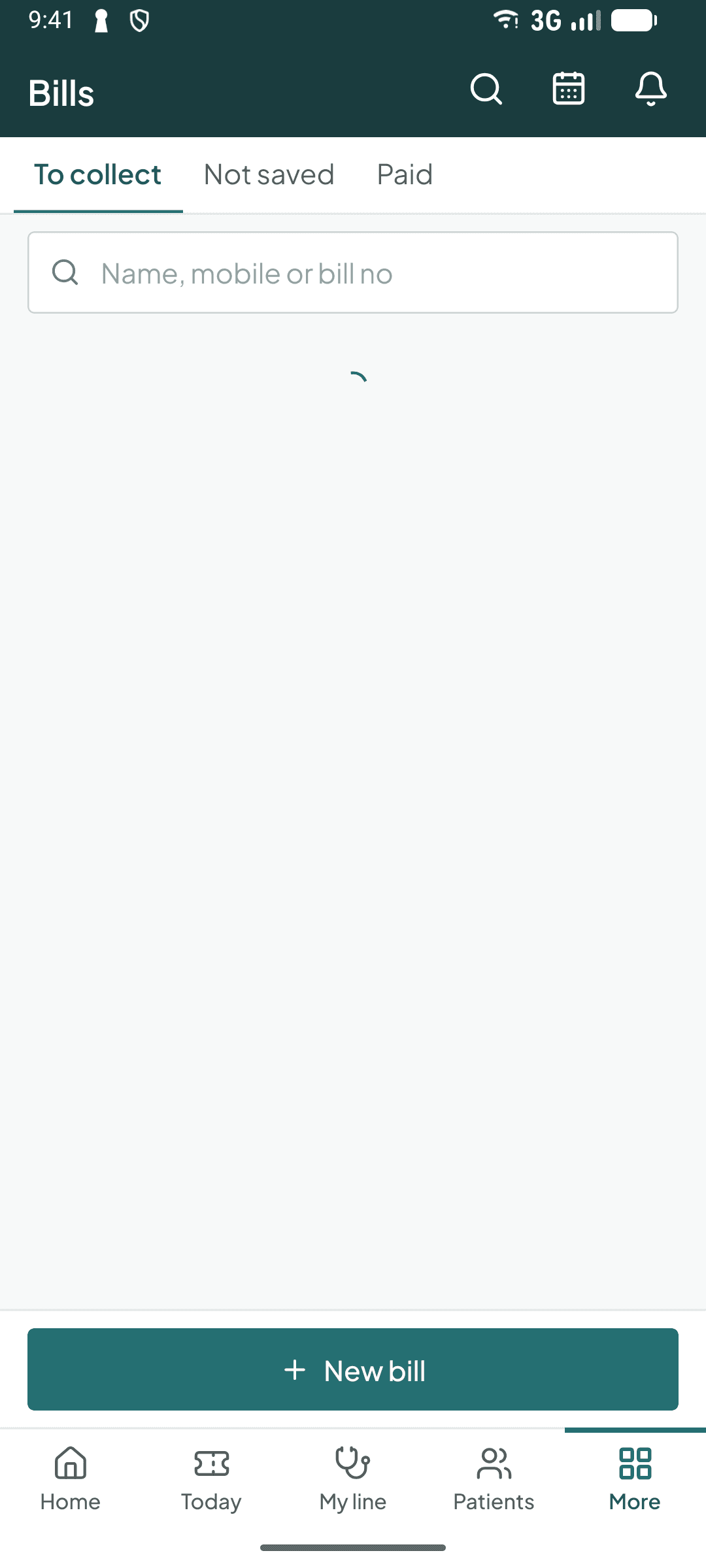
Tokens, appointments, bills, staff and the day's takings, on the computer and the phone.
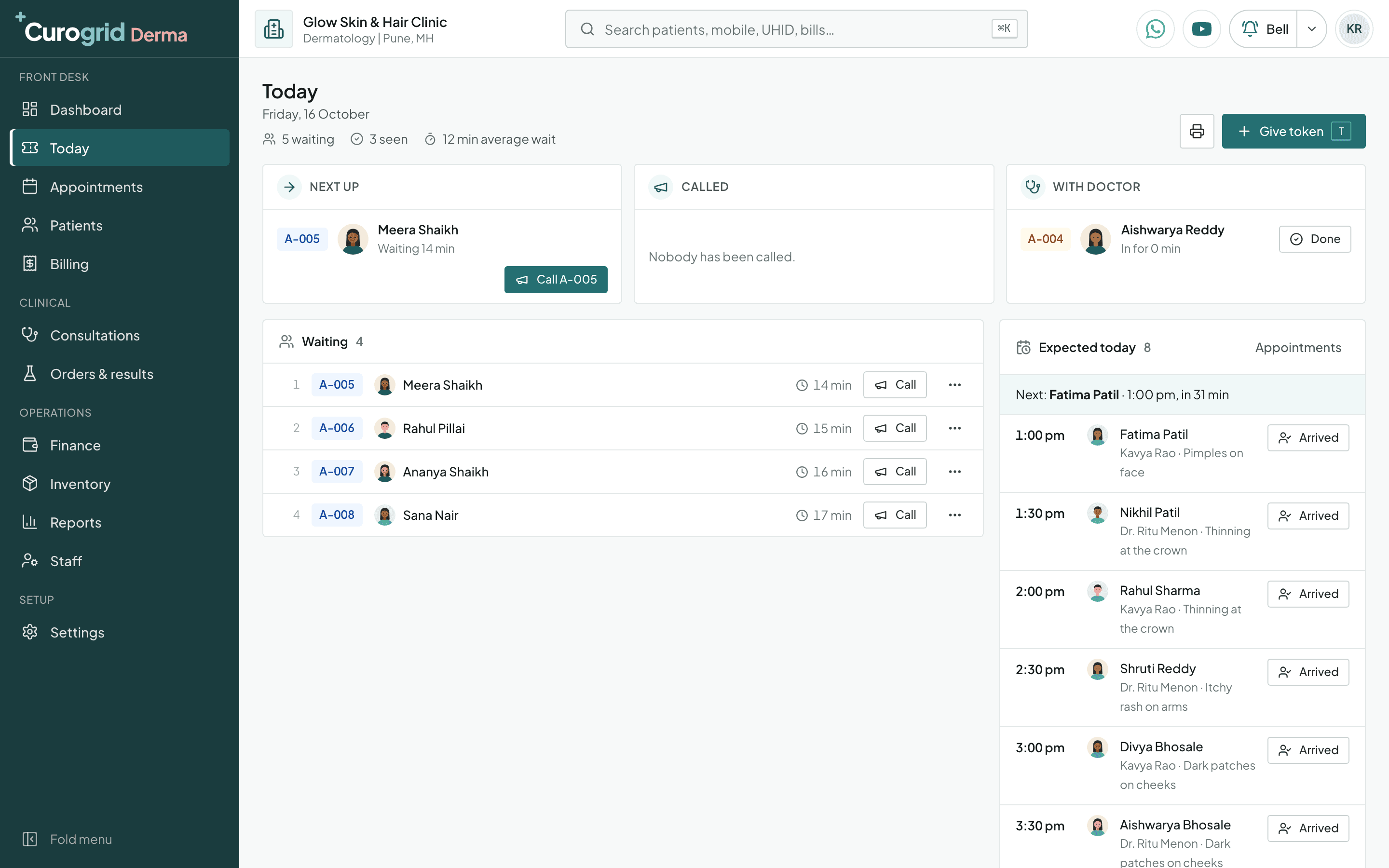
Today's line 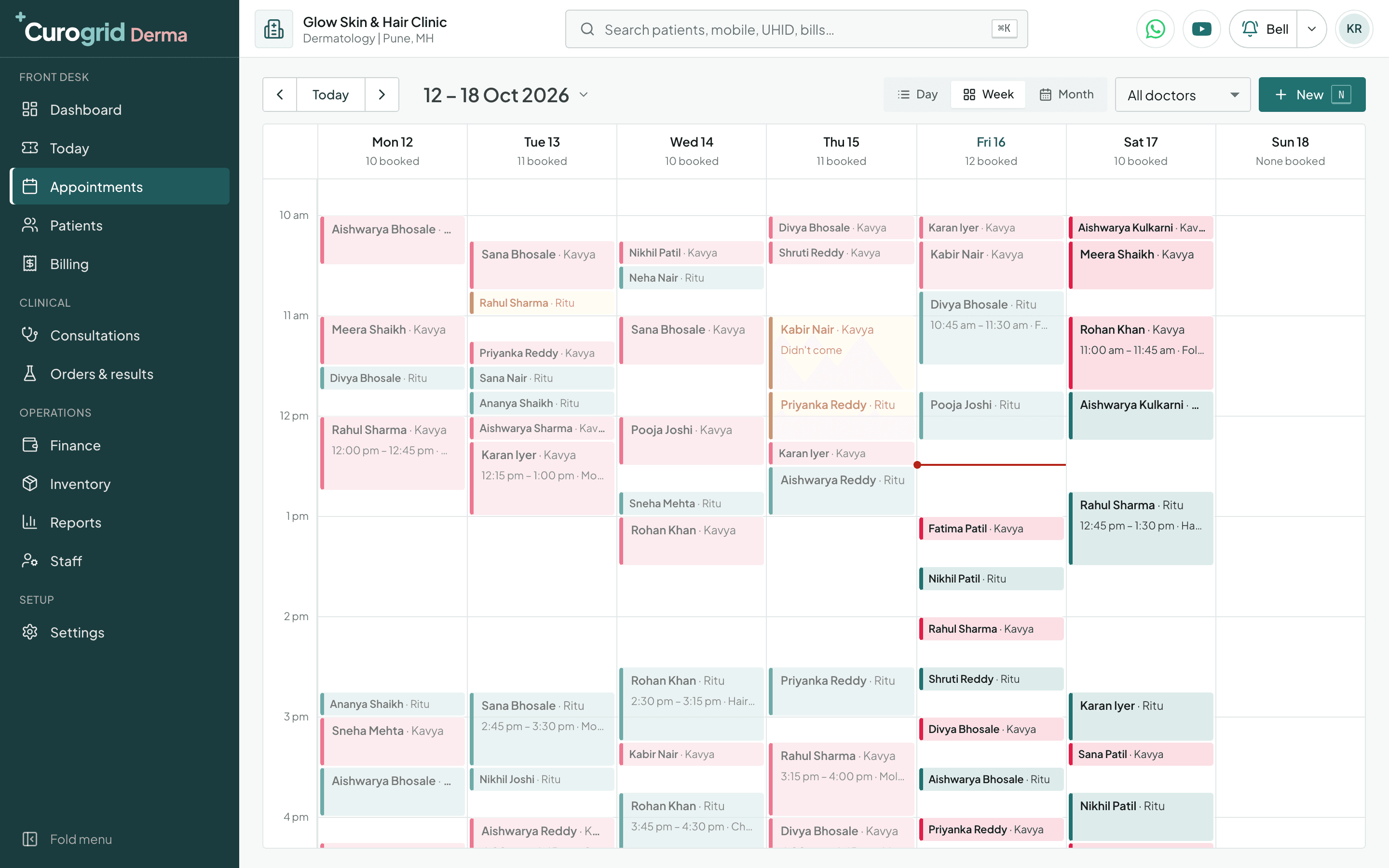
The appointment book 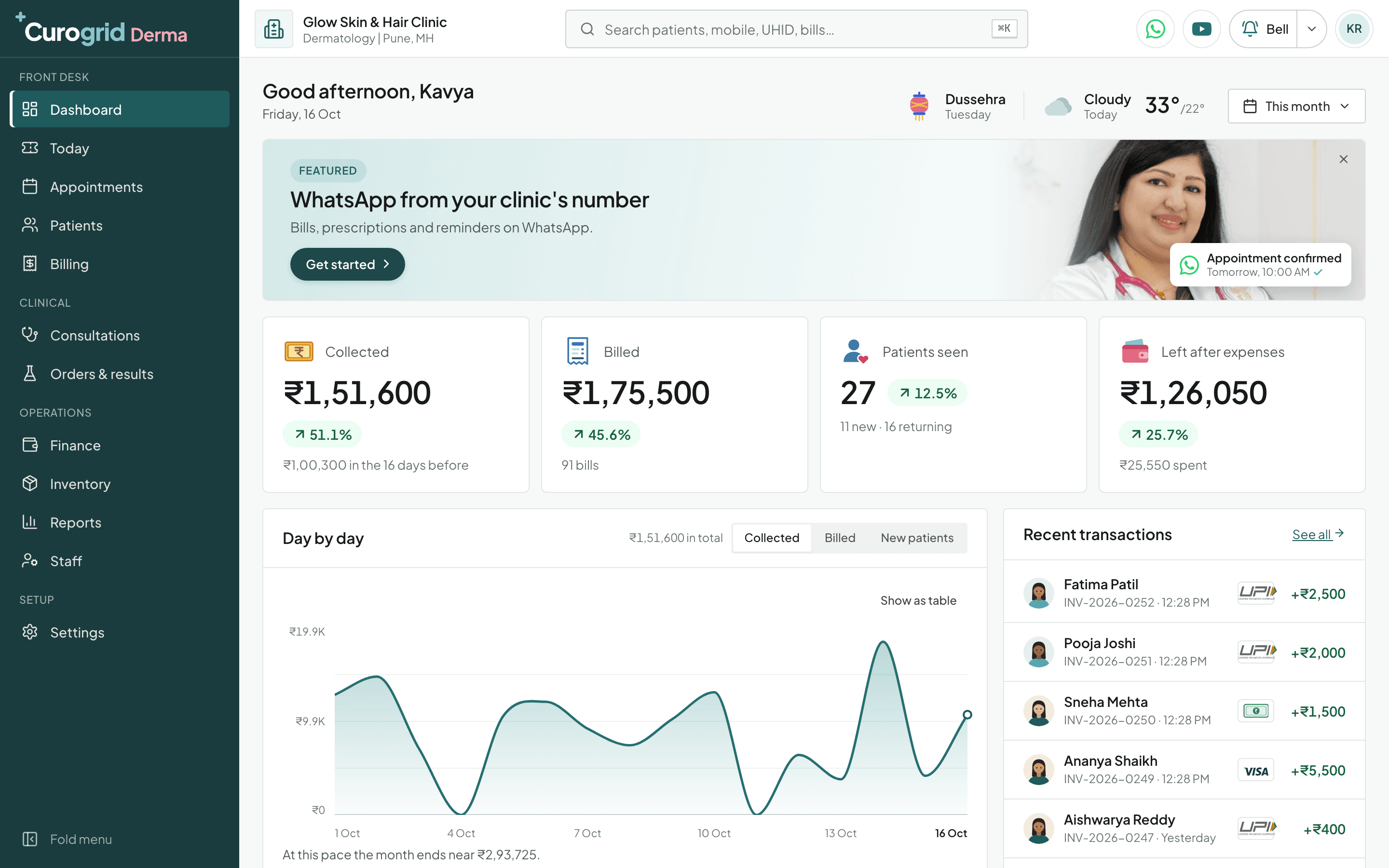
The owner's dashboard 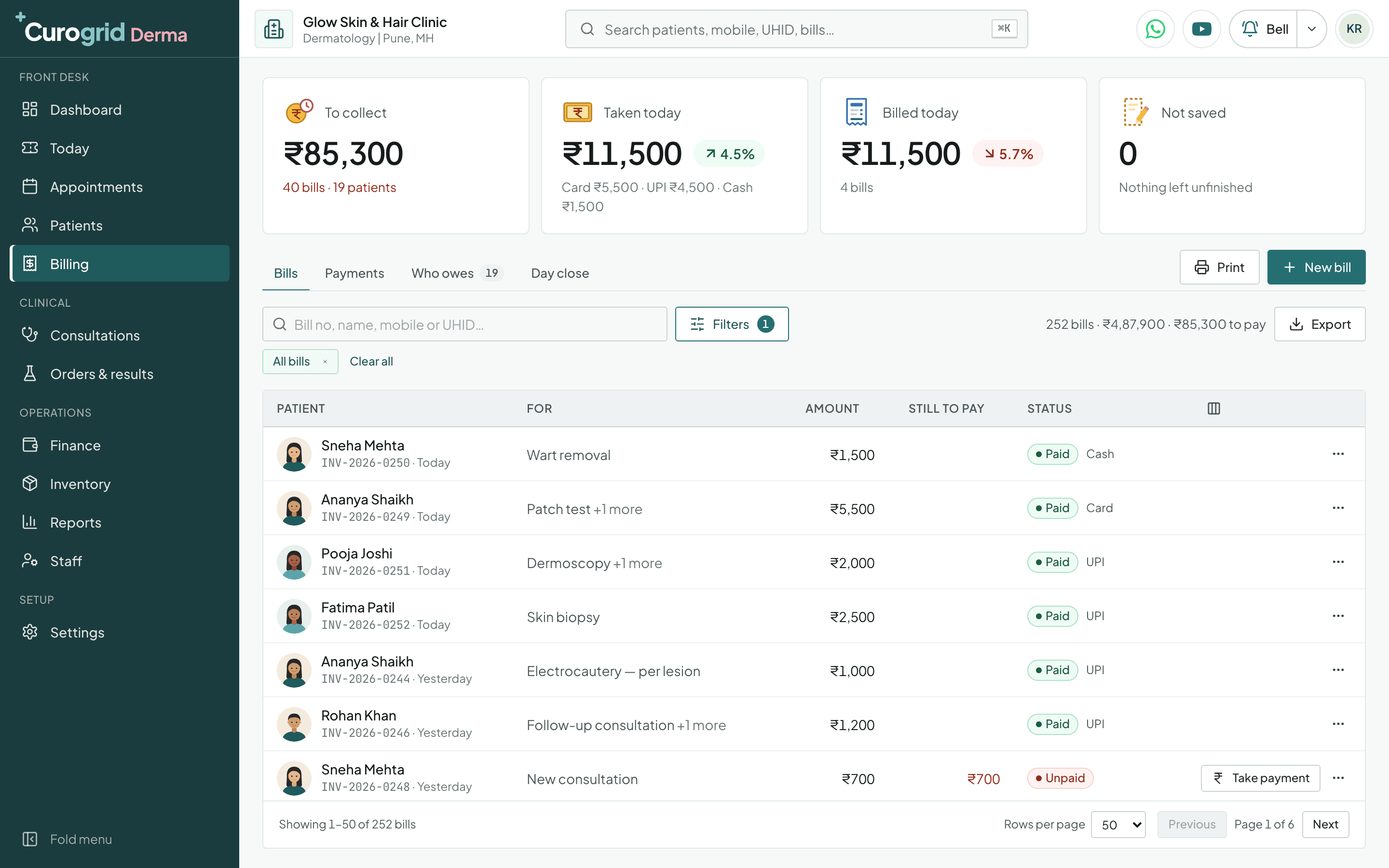
Billing by UPI, card and cash
A skin patient's way through the clinic, step by step
1. At the desk
Registered with the skin type. Name, age and mobile number, then two questions only a skin clinic asks: the Fitzpatrick skin type, from “always burns” to “never burns”, and whether she comes for skin, hair, nails or cosmetic care.
2. Before the first photo
Consent on the screen. She reads “Clinical photographs” and signs with a finger. Until then the Photos tab will not take a photo.
3. The first visit
The assessment and the baseline photos. Record the concern, where it is, what it looks like, the grade or stage and the dermoscopy findings. Take the baseline photos at the standard angles, each beside its guide.
4. Writing the prescription
Topicals in your own words. The skin and hair medicines are offered first. Pick “Thin layer on affected area”, “On the scalp” or “Alternate nights”, and “6 weeks” or “3 months” for how long. A KOH scraping, a biopsy or a patch test is one tap. A red warning shows if she is allergic to what you write.
5. Planning a course
The sessions booked together. Turn on “Book treatment sessions (laser, peels)”. Curogrid books four sessions, four weeks apart, 30 minutes each, at the same time of day. Change the number or the gap before you save.
6. Each session
What was done, and the settings. Record the procedure, the settings for each area, the response since last time, and a photo at the same angle. The booking shows “Session 2 of 4”.
7. At the counter
The session and the products on one bill. The peel is billed from the price list. A sunscreen the doctor wrote is given from the shelf at the medicine counter, which takes it off the stock count and puts it on the same bill.
8. At the review
Before and after, side by side. Open the angle and the first and latest photos are side by side, with the weeks between them. The patient sees her own progress, dated.
On the phone
Your clinic in your pocket
The same Curogrid Derma on Android and iPhone, for the doctor, the front desk and the owner.
- See the line and call the next patient from anywhere
- Open a patient's file, write the visit, take the payment
- Today's appointments and takings, wherever you are
From ₹420 a month, for the whole clinic
Not per doctor. Everything on this page is included. Start with 5 days of Pro, free.
Questions from dermatologists
Yes. The patient's Photos tab has six standard angles: face from the front, the left and the right side, the top of the head, the hair parting and a body area. Pick an angle and the first and latest photos open side by side, with their dates and how far apart they are. You can pick any two dates.
Each angle shows a guide picture, female or male to match the patient, with a line such as “Straight on, eyes level, hair back, even light”. Before a photo is kept it is shown next to its guide, with the date and a short note.
Yes. Nothing can be photographed until the patient has signed the Clinical photographs consent, which is part of the setup along with consent for procedures and local anaesthetic. Forms are read on the screen, signed with a finger and kept in the patient's file.
Yes. A session records what was done today (chemical peel, laser, PRP, microneedling, electrocautery, cryotherapy or an intralesional injection) and a settings table with one line per area: the area, the setting, and the passes or minutes.
Yes. The first visit has acne grade I to IV, the Norwood stages 1 to 7 for men and Ludwig I to III for women, Fitzpatrick skin type I to VI, itch from 0 to 10, and dermoscopy findings such as yellow dots or exclamation-mark hairs.
Yes. Turn on “Book treatment sessions (laser, peels)” while booking. Curogrid books the course together, four sessions four weeks apart and 30 minutes each by default, and labels each one, for example “Session 2 of 4”.
Yes. The hair parting and the top of the head are standard photo angles, a PRP session is ready to order, minoxidil, finasteride and biotin are in the medicine names, and pattern hair loss, alopecia areata and telogen effluvium are in the diagnosis search.
Yes. Procedures are billed as services from the price list. A product the doctor writes on the prescription, such as a sunscreen, is given from stock at the medicine counter, which lowers the shelf count and adds it to the patient's bill.
No. “Laser session” and “PRP session” are ready to order as procedures and to book as a course, but the ten starter services stop at chemical peel, cryotherapy, electrocautery and the like. You add laser and PRP to the price list with your own fees.
Yes. On a tablet or the phone app the camera opens; on a computer you pick the file. The photo goes to the patient's Photos tab under its angle.
Curogrid Plus is ₹420 a month and Pro is ₹999 a month, or ₹4,032 and ₹9,590 for a year. GST of 18% is added. The price is for the whole clinic, not for each doctor, and the Dermatology setup is included in both plans. Every clinic starts with 5 days of Pro, free.
Yes. Curogrid sends the patient a reminder before the appointment by WhatsApp and email, and can send the prescription, the bill and the receipt the same way. On Plus the WhatsApp messages go from the Curogrid number. On Pro they go from your clinic's own number.
Not yet. A patient's 14-digit ABHA number can be recorded on their file, where it is marked as not checked with ABDM. Curogrid does not yet verify an ABHA number, create one or share records through ABDM.
No. Curogrid needs an internet connection. The phone app tells you when it is offline and saves nothing until the connection is back, and on a computer a visit you are typing is kept on that computer until it can be saved. The screens are in English only.
Good to know
Registrations and rules for a skin and hair clinic in India, what Curogrid does not do, and the lists it offers. The rules are a plain summary, not legal advice, checked on .
Only a doctor on a State Medical Register or the Indian Medical Register may practise medicine, and the registration number belongs on every prescription, certificate and receipt you sign. The NMC's 2023 conduct regulations were put on hold in August 2023, so the 2002 code of ethics still applies. In Curogrid: Each doctor's qualifications, registration number and council are kept on their staff profile and print under their name on every prescription.
In the states and union territories that have adopted the Act, a clinic cannot run without registering with the district registering authority, and national minimum standards are set for each kind of clinic. Other states have their own registration law. Your district health office will say which applies. In Curogrid: Curogrid does not register your clinic. Your clinic's name, address and contact numbers print on every bill and paper it makes.
A doctor may not advertise or solicit patients, and a patient's photo is personal data. Take clinical photos with written consent, use them for her care, and never publish one, a before and after post included, without her separate permission and in a way she cannot be recognised. In Curogrid: No photo can be taken before the Clinical photographs consent is signed. Photos are shown only to your signed-in staff, and Curogrid never posts or shares them.
Health care services are exempt from GST, but the definition leaves out hair transplant and cosmetic or plastic surgery, unless it restores or reconstructs after a birth defect, an injury or trauma. A skin clinic often bills both kinds. Ask your chartered accountant which of your services are taxed. In Curogrid: A GST rate is set on a service only if you give it one, so taxable and exempt services can sit on the same bill. The clinic's GSTIN is needed only if you are registered.
A clinic that gives medicines to its own patients follows the drug rules. For Schedule H1 drugs, such as certain newer antibiotics and habit-forming medicines, each supply is written in a separate register with the prescriber, the patient, the medicine and the quantity, and the register is kept for three years. In Curogrid: When the medicine counter gives a medicine, it comes off the shelf count and goes on the patient's bill, so you can see who got what and when. Curogrid does not print a Schedule H1 register.
Explain what you will do, why, and its risks before you start, and keep the patient's agreement. For a child, a parent or guardian agrees. In Curogrid: The setup adds four consent forms: “Examination and treatment plan”, “Procedure or operation”, “Local anaesthetic” and “Clinical photographs”. The patient, a parent or guardian, or a relative signs with a finger on the screen, and the form is kept in the patient's file.
Needles from injections and PRP, biopsy tissue and the swabs from cautery are bio-medical waste. Separate waste where it is made, put sharps in a puncture-proof white translucent container, hand it to your area's common bio-medical waste facility, and train the staff who handle it. In Curogrid: Curogrid does not manage waste. Each procedure is ordered and recorded on the session, so what was done and when is on record.
A patient's record is personal data, and the clinic is responsible for it. Tell patients what you keep and why, keep it safe, use it for their care, and let a patient see or correct what you hold. The Rules were notified in November 2025 and most of their duties for clinics apply from May 2027. In Curogrid: Every member of the team has their own sign-in and role, so the records show who did what, and nobody shares a password.
Where the problem is is picked from a list of areas: face, scalp, neck, chest, back, arms, hands, legs, feet, groin, nails or the whole body. There is no body diagram to mark, and photos cannot be drawn on.
“Laser session” and “PRP session” are ready to order as procedures, but they are not among the ten starter services. Add them to your price list with your own fee before you bill them.
A package can be a service on your price list and billed. The count of sessions comes from the course booking, such as “2 of 4 done”, and is not tied to what was paid.
Photos are served only to signed-in staff. Curogrid does not post them anywhere or make a before and after picture for social media, and it should not: see the rules below on using patients' photos.
The six angles are Curogrid's own. A 45 degree view of the face and the hairline from the front are not in the list yet; use “Body area” for anything else.
Isotretinoin 10 mg capsule, Isotretinoin 20 mg capsule, Doxycycline 100 mg capsule, Adapalene 0.1% gel, Adapalene + Benzoyl peroxide gel, Benzoyl peroxide 2.5% gel, Clindamycin 1% gel, Tretinoin 0.025% cream, Azelaic acid 20% cream, Itraconazole 100 mg capsule, Itraconazole 200 mg capsule, Terbinafine 250 mg tablet, Fluconazole 150 mg tablet, Luliconazole 1% cream, Terbinafine 1% cream, Ketoconazole 2% cream, Ketoconazole 2% shampoo, Sertaconazole 2% cream, Clobetasol 0.05% cream, Mometasone 0.1% cream, Hydrocortisone 1% cream, Tacrolimus 0.1% ointment, Tacrolimus 0.03% ointment, Fusidic acid 2% cream, Permethrin 5% cream, Ivermectin 12 mg tablet, Hydroxyzine 25 mg tablet, Fexofenadine 180 mg tablet, Bilastine 20 mg tablet, Acyclovir 800 mg tablet, Valacyclovir 500 mg tablet, Minoxidil 5% solution, Minoxidil 2% solution, Finasteride 1 mg tablet, Biotin 10 mg tablet, Hydroquinone 2% cream, Salicylic acid 6% ointment, Coal tar + Salicylic acid shampoo, Urea 10% cream, Calamine lotion, Sunscreen SPF 50, Moisturising cream.
KOH scraping (fungus), Skin biopsy (histopathology), Patch test, Serum ferritin, Hormone profile (LH, FSH, testosterone, prolactin), Urine pregnancy test.
Chemical peel, Laser session, PRP session, Electrocautery, Cryotherapy, Intralesional injection, Wart removal, Comedone extraction.
Acne vulgaris, Chloasma (melasma), Postinflammatory hyperpigmentation, Scar conditions and fibrosis of skin (acne scars), Hypertrophic scar (keloid), Rosacea, Androgenic alopecia (pattern hair loss), Alopecia areata, Telogen effluvium (hair fall), Seborrhoeic dermatitis (dandruff), Tinea corporis, Tinea cruris, Pityriasis versicolor, Scabies, Atopic dermatitis, Psoriasis, Vitiligo, Urticaria, Lichen planus, Viral warts.
Try Curogrid Derma in your clinic
5 days of Pro, free. Pick “Dermatology” in setup and the Photos tab, the skin visit, the session settings and your services are ready before your first patient.